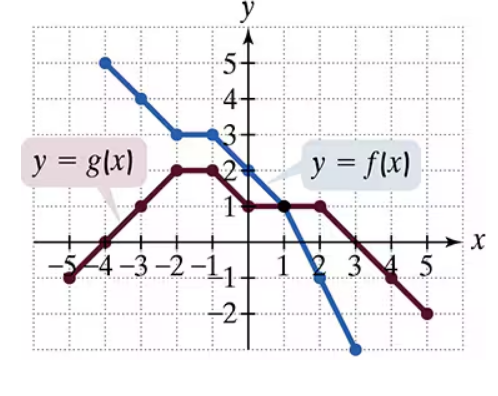
In Exercises 77–92, use the graph to determine a. the function's domain; b. the function's range; c. the x-intercepts, if any; d. the y-intercept, if any; and e. the missing function values, indicated by question marks, below each graph.
Ch. 2 - Functions and Graphs

Capitolo 3, Problema 85
Use the graphs of f and g to solve Exercises 83–90.

Find (fg) (2).
Guida verificata passo dopo passo1
Step 1: Understand the problem. You are tasked with finding (fg)(2), which means you need to evaluate the product of the functions f(x) and g(x) at x = 2.
Step 2: Locate x = 2 on the graph. Look at the horizontal axis and find the point where x = 2.
Step 3: Determine the value of f(2). Find the red graph (representing f(x)) and identify the y-coordinate of the point where x = 2.
Step 4: Determine the value of g(2). Find the blue graph (representing g(x)) and identify the y-coordinate of the point where x = 2.
Step 5: Multiply the values of f(2) and g(2). Once you have the values of f(2) and g(2), multiply them together to find (fg)(2).

Risposta video verificata per un problema simile:
Questa soluzione video è stata consigliata dai nostri tutor come utile per risolvere questo problema.
Durata del video:
1mConcetti chiave
Ecco i concetti essenziali che devi comprendere per rispondere correttamente alla domanda.
Function Evaluation
Function evaluation involves substituting a specific input value into a function to determine its output. For example, if we have a function f(x), evaluating it at x = 2 means finding f(2). This is essential for solving problems that require specific outputs from given functions.
Video consigliato:
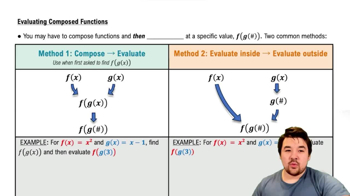
Evaluating Composed Functions
Product of Functions
The product of two functions, denoted as (fg)(x), is defined as the multiplication of their outputs at a given input x. Specifically, (fg)(x) = f(x) * g(x). To find (fg)(2), one must first evaluate f(2) and g(2), then multiply these results together.
Video consigliato:
Special Products - Cube Formulas
Graph Interpretation
Interpreting graphs of functions involves analyzing the visual representation of the functions to extract information such as values at specific points. In this case, the graphs of f(x) and g(x) can be used to find f(2) and g(2) by locating the corresponding y-values at x = 2 on their respective graphs.
Video consigliato:
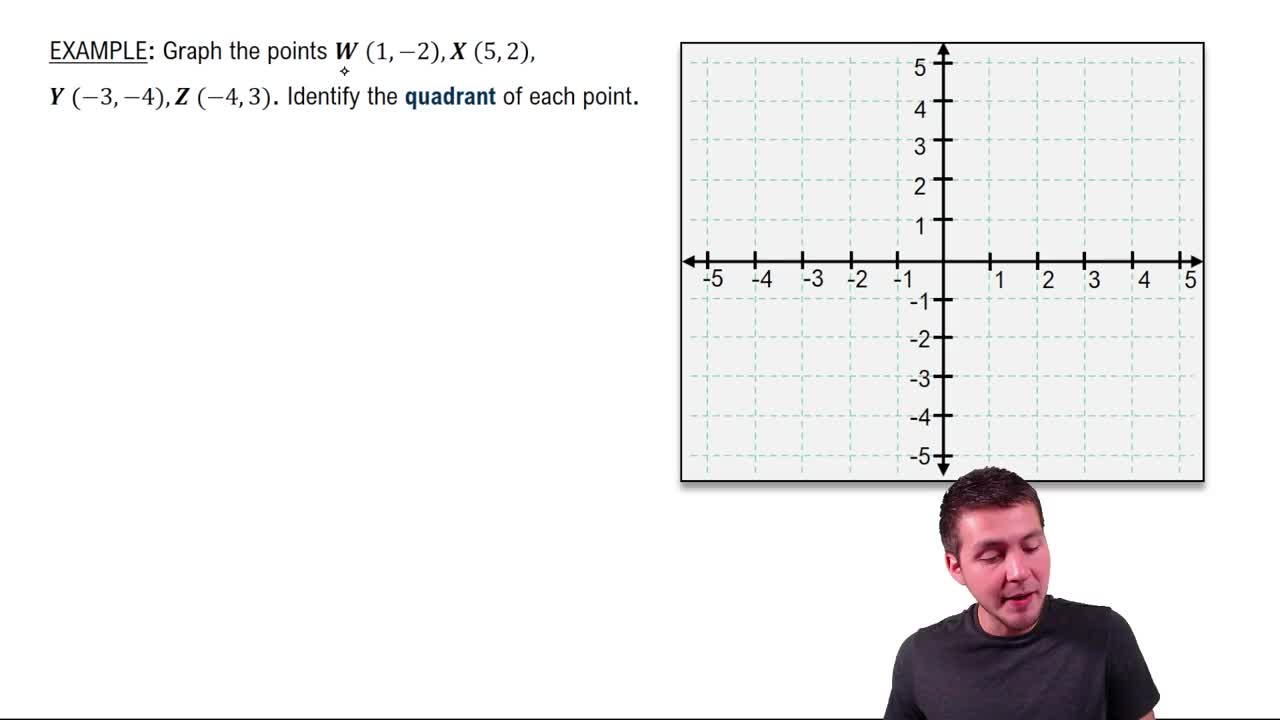
Graphs and Coordinates - Example
Pratica correlata
Domanda del libro di testo
899
views
Domanda del libro di testo
Begin by graphing the absolute value function, f(x) = |x|. Then use transformations of this graph to graph the given function. h(x) = |x + 3| - 2
791
views
Domanda del libro di testo
Use the graphs of f and g to solve Exercises 83–90.
Find(g/f)(3)
1295
views
Domanda del libro di testo
In Exercises 77–92, use the graph to determine a. the function's domain; b. the function's range; c. the x-intercepts, if any; d. the y-intercept, if any; and e. the missing function values, indicated by question marks, below each graph.
107
views
Domanda del libro di testo
Use the graphs of f and g to solve Exercises 83–90.
Find (g-f) (-2).
1195
views
Domanda del libro di testo
In Exercises 82–84, find f + g, f - g, fg, and f/g. Determine the domain for each function. f(x) = √(x + 7), g(x) = √(x - 2)
586
views
