Ch. 2 - Functions and Graphs
Blitzer - College Algebra 8th Edition
Blitzer8th EditionCollege AlgebraISBN: 9780136970514Non è quello che usi tu?Cambia libro di testo
Capitolo 3, Problema 94

Begin by graphing the absolute value function, f(x) = |x|. Then use transformations of this graph to graph the given function. g(x) = -2|x+3|+2

Guida verificata passo dopo passo
1
Start by graphing the parent function f(x) = |x|. This is a V-shaped graph with its vertex at the origin (0, 0) and symmetry about the y-axis. The graph increases linearly for x > 0 and decreases linearly for x < 0.
Identify the transformations applied to f(x) = |x| to obtain g(x) = -2|x+3|+2. The transformations include: (1) a horizontal shift, (2) a vertical stretch and reflection, and (3) a vertical shift.
Apply the horizontal shift: The term |x+3| indicates a shift 3 units to the left. This moves the vertex of the graph from (0, 0) to (-3, 0).
Apply the vertical stretch and reflection: The coefficient -2 in front of |x+3| stretches the graph vertically by a factor of 2 and reflects it across the x-axis. This makes the V-shape open downward and steeper.
Apply the vertical shift: The +2 at the end of the function shifts the entire graph 2 units upward. The new vertex of the graph is at (-3, 2). Combine all these transformations to sketch the final graph of g(x).

Risposta video verificata per un problema simile:

Questa soluzione video è stata consigliata dai nostri tutor come utile per risolvere questo problema.
Durata del video:
6m

Concetti chiave

Ecco i concetti essenziali che devi comprendere per rispondere correttamente alla domanda.

Absolute Value Function

The absolute value function, denoted as f(x) = |x|, outputs the non-negative value of x. This function has a V-shaped graph that opens upwards, with its vertex at the origin (0,0). Understanding this function is crucial as it serves as the foundation for applying transformations to graph other functions.
Video consigliato:
4:56
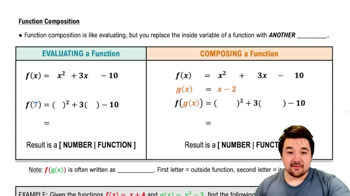
Function Composition

Transformations of Functions

Transformations involve shifting, reflecting, stretching, or compressing the graph of a function. For example, adding a constant inside the absolute value affects horizontal shifts, while adding outside affects vertical shifts. In the function g(x) = -2|x+3|+2, the transformations include a horizontal shift left by 3 units, a vertical stretch by a factor of 2, and a reflection across the x-axis.
Video consigliato:
4:22
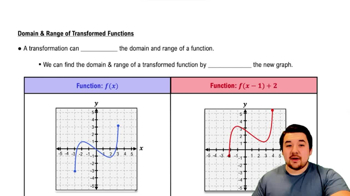
Domain & Range of Transformed Functions

Graphing Techniques

Graphing techniques involve plotting points and understanding how transformations affect the shape and position of a graph. For the function g(x), one must first graph f(x) = |x|, then apply the identified transformations systematically. This process helps visualize the final graph and understand the relationship between the original and transformed functions.
Video consigliato:
02:16
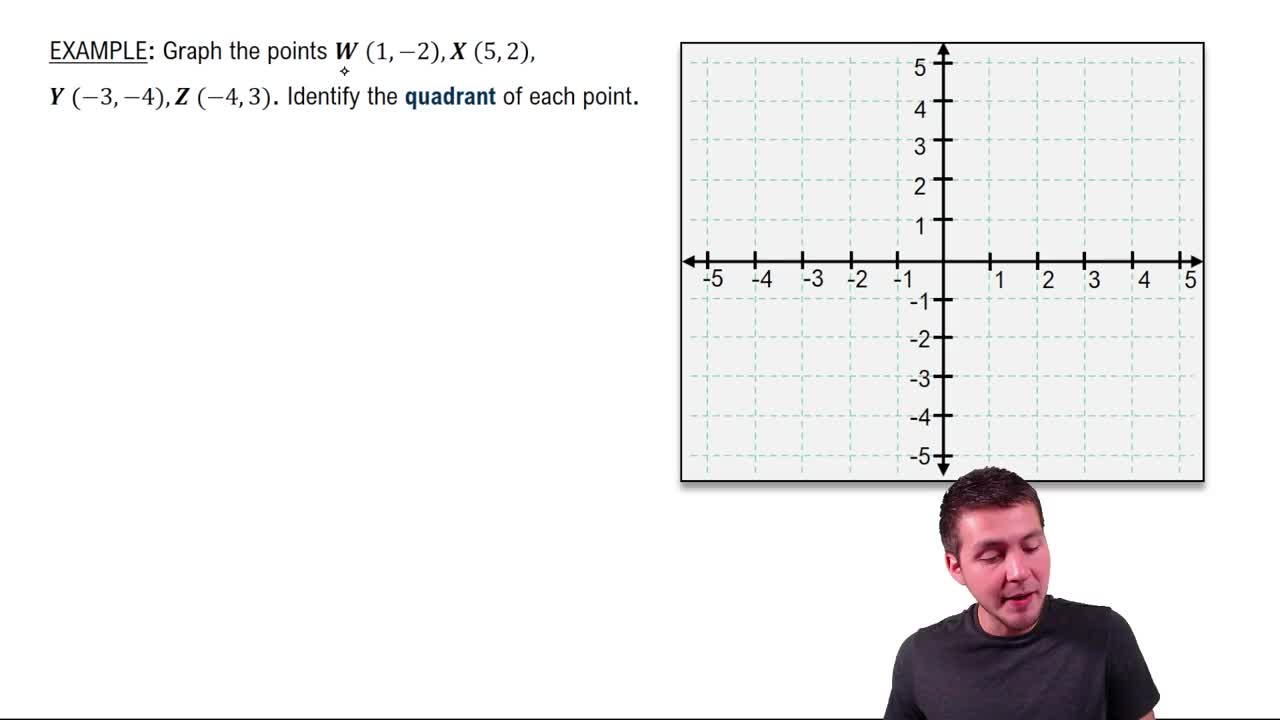
Graphs and Coordinates - Example