Ch. 2 - Functions and Graphs
Blitzer - College Algebra 8th Edition
Blitzer8th EditionCollege AlgebraISBN: 9780136970514Non è quello che usi tu?Cambia libro di testo
Capitolo 3, Problema 93

The functions in Exercises 93–95 are all one-to-one. For each function, (a) find an equation for f-1(x), the inverse function. (b) Verify that your equation is correct by showing that f(f-1(x)) = x and f-1(f(x)) = x. f(x) = 4x - 3

Guida verificata passo dopo passo
1
Start with the given function: \(f(x) = 4x - 3\). To find the inverse function \(f^{-1}(x)\), first replace \(f(x)\) with \(y\): \(y = 4x - 3\).
Next, swap the roles of \(x\) and \(y\) to find the inverse: replace \(y\) with \(x\) and \(x\) with \(y\), giving \(x = 4y - 3\).
Solve this new equation for \(y\) to express the inverse function: add 3 to both sides to get \(x + 3 = 4y\), then divide both sides by 4 to isolate \(y\): \(y = \frac{x + 3}{4}\).
Rewrite \(y\) as \(f^{-1}(x)\), so the inverse function is \(f^{-1}(x) = \frac{x + 3}{4}\).
To verify the inverse, compute \(f(f^{-1}(x))\) by substituting \(f^{-1}(x)\) into \(f\): \(f\left(f^{-1}(x)\right) = 4 \times \frac{x + 3}{4} - 3\). Simplify this expression and check if it equals \(x\). Then compute \(f^{-1}(f(x))\) by substituting \(f(x)\) into \(f^{-1}\): \(f^{-1}(4x - 3) = \frac{(4x - 3) + 3}{4}\). Simplify and check if it equals \(x\).

Risposta video verificata per un problema simile:

Questa soluzione video è stata consigliata dai nostri tutor come utile per risolvere questo problema.
Durata del video:
8m

Concetti chiave

Ecco i concetti essenziali che devi comprendere per rispondere correttamente alla domanda.

One-to-One Functions

A function is one-to-one if each output corresponds to exactly one input, meaning it passes the horizontal line test. This property ensures the function has an inverse because no two different inputs produce the same output.
Video consigliato:
4:07
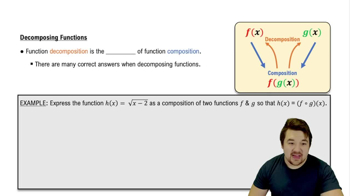
Decomposition of Functions

Inverse Functions

The inverse of a function reverses the roles of inputs and outputs, denoted as f⁻¹(x). To find the inverse, solve the equation y = f(x) for x in terms of y, then interchange x and y. The inverse 'undoes' the original function.
Video consigliato:
4:30
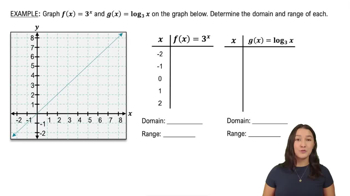
Graphing Logarithmic Functions

Verification of Inverse Functions

To verify that two functions are inverses, show that composing them in either order returns the input: f(f⁻¹(x)) = x and f⁻¹(f(x)) = x. This confirms that each function reverses the effect of the other.
Video consigliato:
4:30
Graphing Logarithmic Functions