Ch. 2 - Functions and Graphs
Blitzer - College Algebra 8th Edition
Blitzer8th EditionCollege AlgebraISBN: 9780136970514Non è quello che usi tu?Cambia libro di testo
Capitolo 3, Problema 46

Solve: 2x2/3 - 5x1/3 -3 = 0.

Guida verificata passo dopo passo
1
Rewrite the equation by substituting a new variable to simplify the exponents. Let \( y = x^{1/3} \), so \( x^{2/3} = y^2 \). The equation becomes \( 2y^2 - 5y - 3 = 0 \).
Recognize that the equation \( 2y^2 - 5y - 3 = 0 \) is a quadratic equation. Use the quadratic formula \( y = \frac{-b \pm \sqrt{b^2 - 4ac}}{2a} \), where \( a = 2 \), \( b = -5 \), and \( c = -3 \).
Substitute the values of \( a \), \( b \), and \( c \) into the quadratic formula to find \( y \). This gives \( y = \frac{-(-5) \pm \sqrt{(-5)^2 - 4(2)(-3)}}{2(2)} \). Simplify the expression under the square root and the rest of the formula.
Once you solve for \( y \), remember that \( y = x^{1/3} \). Rewrite the solutions for \( y \) as \( x^{1/3} = y \), and then cube both sides to solve for \( x \). This gives \( x = y^3 \).
Verify the solutions by substituting them back into the original equation \( 2x^{2/3} - 5x^{1/3} - 3 = 0 \) to ensure they satisfy the equation. Discard any extraneous solutions if necessary.

Risposta video verificata per un problema simile:

Questa soluzione video è stata consigliata dai nostri tutor come utile per risolvere questo problema.
Durata del video:
3m

Concetti chiave

Ecco i concetti essenziali che devi comprendere per rispondere correttamente alla domanda.

Rational Exponents

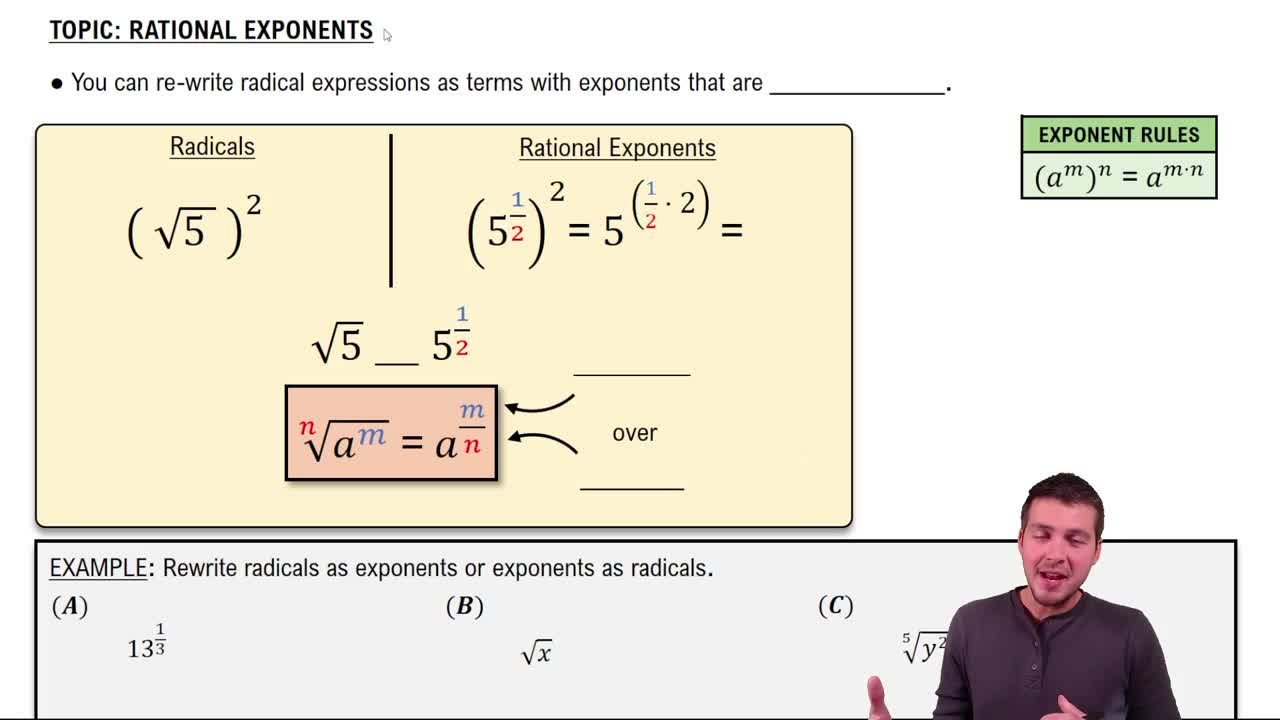
Rational exponents are a way to express roots using fractional powers. For example, x^(1/n) represents the n-th root of x. In the given equation, the terms 2x^(2/3) and 5x^(1/3) utilize rational exponents, which can be rewritten in radical form to facilitate solving the equation.
Video consigliato:
04:06
Rational Exponents

Substitution Method

The substitution method involves replacing a complex expression with a simpler variable to make solving easier. In this case, letting y = x^(1/3) transforms the equation into a quadratic form, allowing for easier application of factoring or the quadratic formula to find solutions.
Video consigliato:
04:03
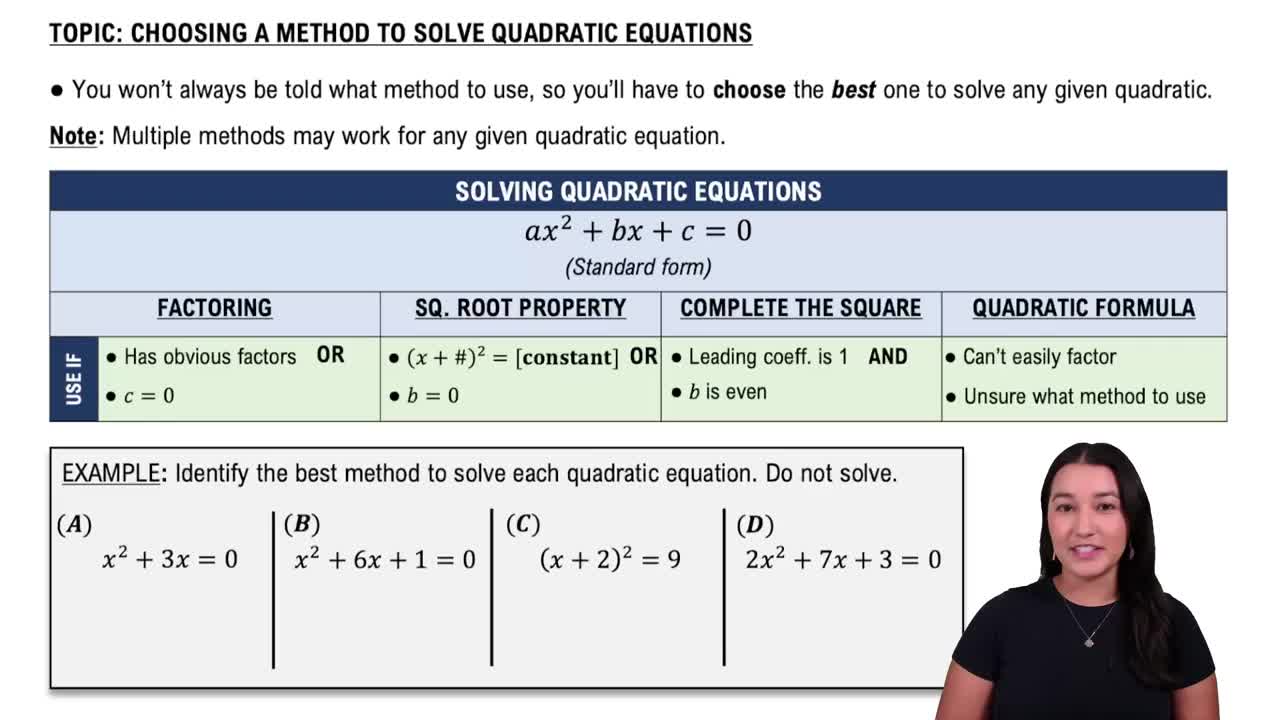
Choosing a Method to Solve Quadratics

Quadratic Equations

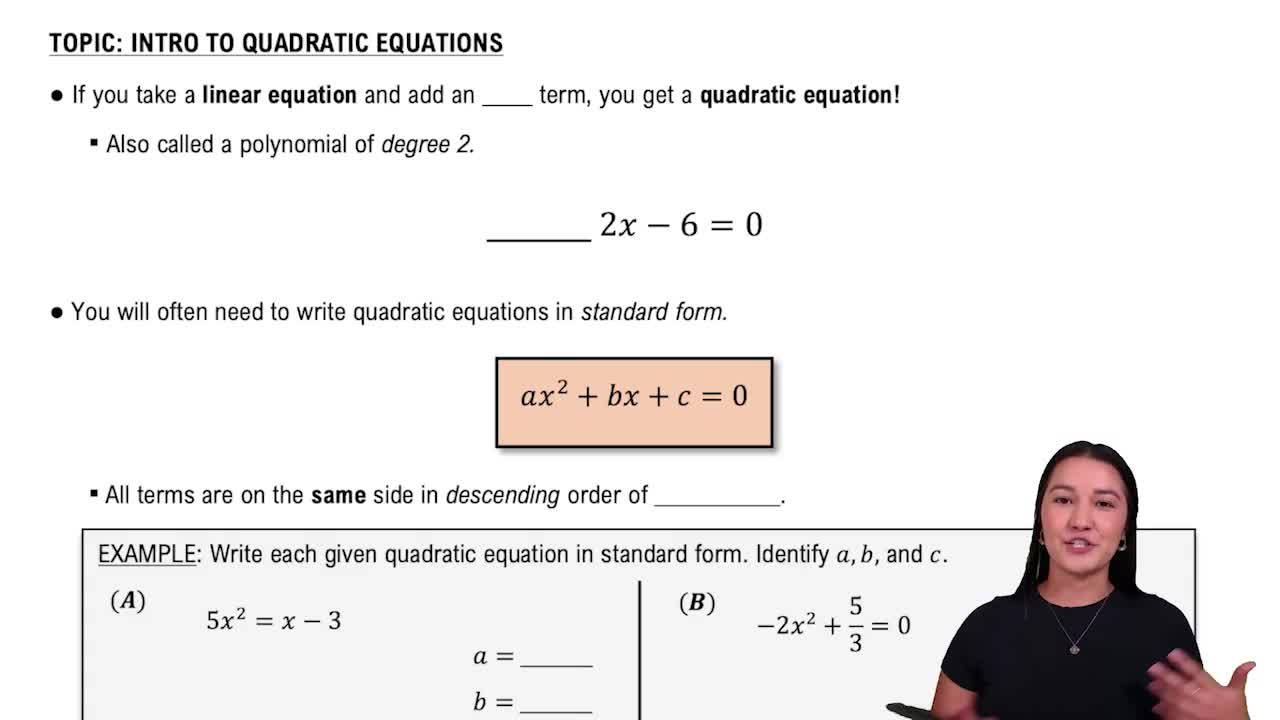
Quadratic equations are polynomial equations of the form ax^2 + bx + c = 0, where a, b, and c are constants. They can be solved using various methods, including factoring, completing the square, or the quadratic formula. Understanding how to manipulate and solve these equations is crucial for finding the roots of the transformed equation in the problem.
Video consigliato:
05:35
Introduction to Quadratic Equations