Ch. 2 - Functions and Graphs
Blitzer - College Algebra 8th Edition
Blitzer8th EditionCollege AlgebraISBN: 9780136970514Non è quello che usi tu?Cambia libro di testo
Capitolo 3, Problema 87a

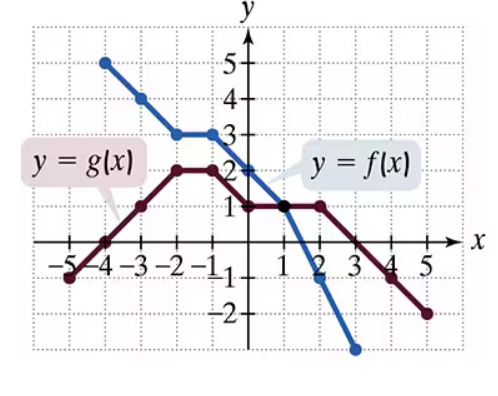
Use the graphs of f and g to solve Exercises 83–90.

Find the domain of ƒ + g.

Guida verificata passo dopo passo
1
Step 1: Understand the problem. The domain of ƒ + g refers to the set of x-values for which both functions ƒ(x) and g(x) are defined. This means we need to identify the overlap of the domains of ƒ(x) and g(x) from the graph.
Step 2: Analyze the graph of ƒ(x) (blue curve). Observe the x-values for which the blue curve exists. These x-values represent the domain of ƒ(x).
Step 3: Analyze the graph of g(x) (red curve). Observe the x-values for which the red curve exists. These x-values represent the domain of g(x).
Step 4: Determine the intersection of the domains of ƒ(x) and g(x). The domain of ƒ + g is the set of x-values where both ƒ(x) and g(x) are defined simultaneously. Look for the x-values where both curves overlap on the graph.
Step 5: Write the domain of ƒ + g as an interval or union of intervals based on the overlapping x-values identified in Step 4.

Risposta video verificata per un problema simile:

Questa soluzione video è stata consigliata dai nostri tutor come utile per risolvere questo problema.
Durata del video:
2m

Concetti chiave

Ecco i concetti essenziali che devi comprendere per rispondere correttamente alla domanda.

Domain of a Function

The domain of a function is the set of all possible input values (x-values) for which the function is defined. For functions f and g, the domain is determined by the x-values for which the graphs of these functions exist. When combining functions, such as in f + g, the domain is restricted to the intersection of the individual domains of f and g.
Video consigliato:
3:51
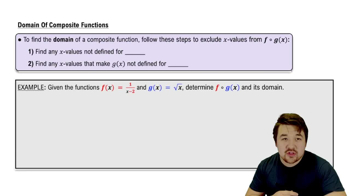
Domain Restrictions of Composed Functions

Graphical Representation of Functions

Graphs visually represent functions, showing the relationship between input values (x) and output values (y). In the provided graph, f(x) is depicted in blue and g(x) in red. Analyzing these graphs helps identify where each function is defined, which is crucial for determining the domain of their sum, f + g.
Video consigliato:
5:20
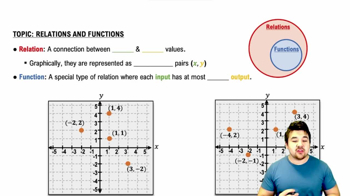
Relations and Functions

Addition of Functions

The addition of functions, denoted as (f + g)(x), involves combining the output values of f and g for each input x. To find the domain of f + g, one must consider where both functions are defined simultaneously. This means identifying the x-values that are present in both the domain of f and the domain of g, ensuring that the sum is valid.
Video consigliato:
4:46
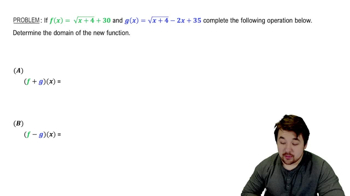
Adding & Subtracting Functions Example 1