In Exercises 19–24, (a) Use the Leading Coefficient Test to determine the graph's end behavior. (b) Determine whether the graph has y-axis symmetry, origin symmetry, or neither. (c) Graph the function.
Ch. 3 - Polynomial and Rational Functions

Capitolo 4, Problema 19
In Exercises 17–24, a) List all possible rational roots. b) List all possible rational roots. c) Use the quotient from part (b) to find the remaining roots and solve the equation. x3−10x−12=0
Guida verificata passo dopo passo1
Identify the polynomial given: \(x^{3} - 10x - 12 = 0\). Notice that the polynomial is cubic, and the constant term is \(-12\), while the leading coefficient is \(1\).
Use the Rational Root Theorem to list all possible rational roots. According to the theorem, possible rational roots are of the form \(\pm \frac{p}{q}\), where \(p\) divides the constant term and \(q\) divides the leading coefficient. Since the leading coefficient is 1, possible roots are the divisors of \(-12\): \(\pm 1, \pm 2, \pm 3, \pm 4, \pm 6, \pm 12\).
Test each possible rational root by substituting into the polynomial to find which one(s) yield zero. This can be done by direct substitution or synthetic division.
Once a root is found, use synthetic division (or polynomial long division) to divide the original polynomial by \((x - r)\), where \(r\) is the root found. This will give a quadratic quotient.
Solve the quadratic quotient using factoring, completing the square, or the quadratic formula to find the remaining roots of the equation.

Risposta video verificata per un problema simile:
Questa soluzione video è stata consigliata dai nostri tutor come utile per risolvere questo problema.
Durata del video:
5mConcetti chiave
Ecco i concetti essenziali che devi comprendere per rispondere correttamente alla domanda.
Rational Root Theorem
The Rational Root Theorem helps identify all possible rational roots of a polynomial equation by considering factors of the constant term and the leading coefficient. These possible roots are expressed as ±(factors of constant term)/(factors of leading coefficient). This theorem narrows down candidates for testing actual roots.
Video consigliato:
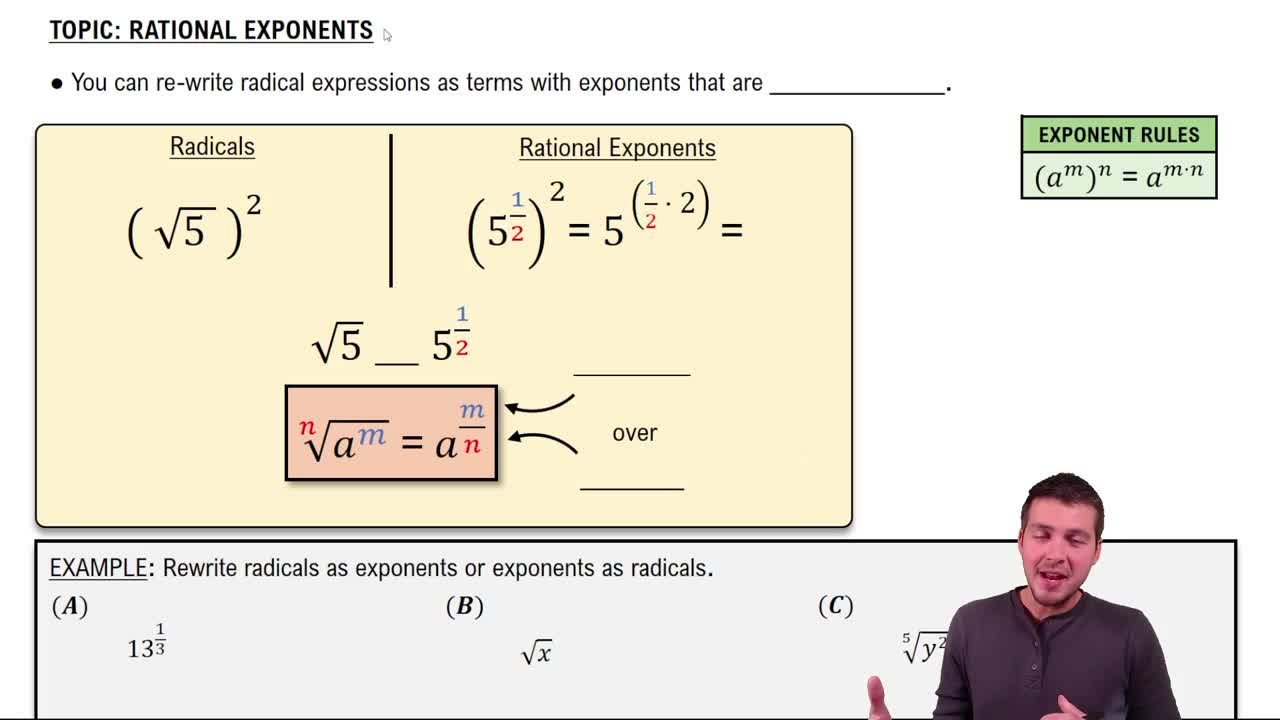
Rational Exponents
Polynomial Division (Synthetic or Long Division)
Polynomial division is used to divide a polynomial by a binomial of the form (x - r), where r is a root. This process simplifies the polynomial to a lower degree, making it easier to find remaining roots. Synthetic division is a streamlined method often used for this purpose.
Video consigliato:
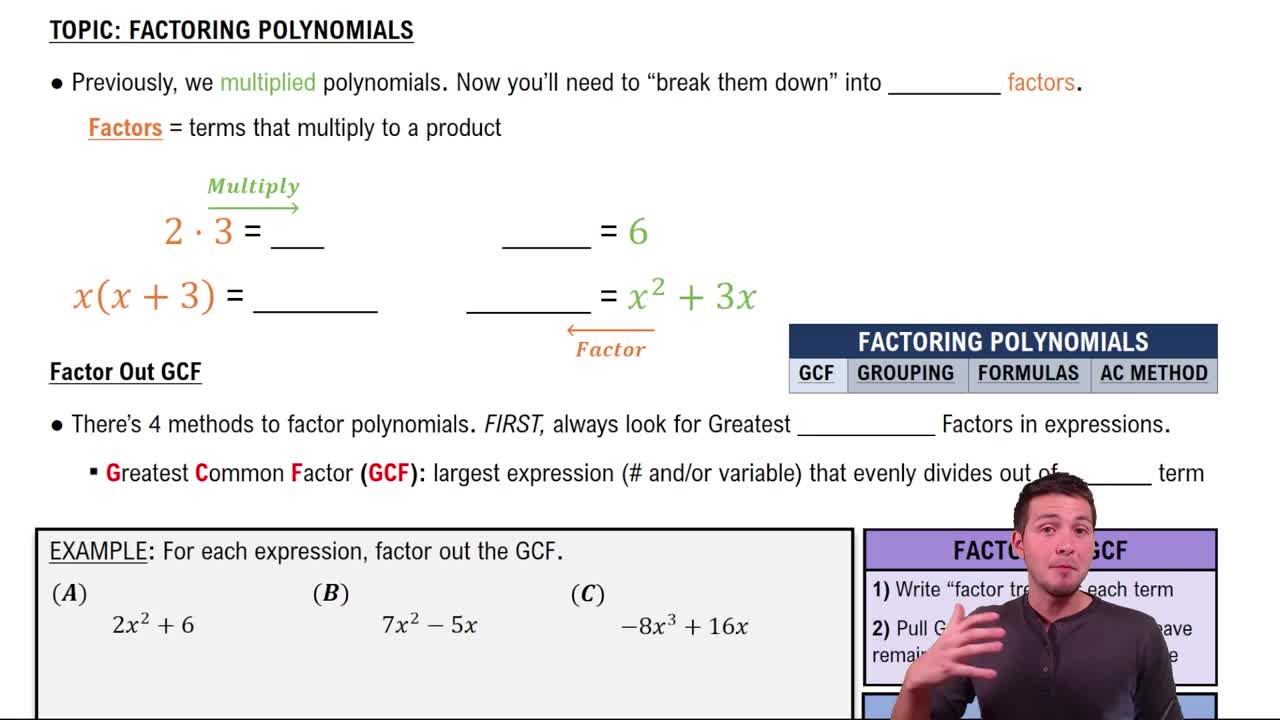
Introduction to Factoring Polynomials
Solving Polynomial Equations
After factoring the polynomial using known roots, the remaining polynomial can be solved by factoring further or applying methods like the quadratic formula. This step finds all roots, including irrational or complex ones, completing the solution to the equation.
Video consigliato:
Solving Logarithmic Equations
Pratica correlata
Domanda del libro di testo
969
views
Domanda del libro di testo
Use the Leading Coefficient Test to determine the end behavior of the graph of the polynomial function.
1091
views
Domanda del libro di testo
Divide using synthetic division. (3x2+7x−20)÷(x+5)
563
views
Domanda del libro di testo
Write an equation that expresses each relationship. Then solve the equation for y. x varies directly as z and inversely as the difference between y and w.
549
views
Domanda del libro di testo
In Exercises 19–24, (a) Use the Leading Coefficient Test to determine the graph's end behavior. (b) Determine whether the graph has y-axis symmetry, origin symmetry, or neither. (c) Graph the function.
1426
views
Domanda del libro di testo
Write an equation that expresses each relationship. Then solve the equation for y. x varies directly as z and inversely as the sum of y and w.
571
views