Use the Leading Coefficient Test to determine the end behavior of the graph of the polynomial function.
Ch. 3 - Polynomial and Rational Functions

Capitolo 4, Problema 19
Use the Leading Coefficient Test to determine the end behavior of the graph of the polynomial function.
Guida verificata passo dopo passo1
Identify the degree of the polynomial function \(f(x) = 5x^3 + 7x^2 - x + 9\). The degree is the highest power of \(x\), which is 3 in this case.
Determine the leading coefficient, which is the coefficient of the term with the highest degree. Here, the leading coefficient is 5.
Recall the Leading Coefficient Test rules for end behavior: For an odd degree polynomial, if the leading coefficient is positive, as \(x \to \infty\), \(f(x) \to \infty\) and as \(x \to -\infty\), \(f(x) \to -\infty\).
Apply the test to this polynomial: Since the degree is 3 (odd) and the leading coefficient is 5 (positive), the graph will rise to the right and fall to the left.
Summarize the end behavior: As \(x\) approaches positive infinity, \(f(x)\) approaches positive infinity; as \(x\) approaches negative infinity, \(f(x)\) approaches negative infinity.

Risposta video verificata per un problema simile:
Questa soluzione video è stata consigliata dai nostri tutor come utile per risolvere questo problema.
Durata del video:
1mConcetti chiave
Ecco i concetti essenziali che devi comprendere per rispondere correttamente alla domanda.
Polynomial Functions
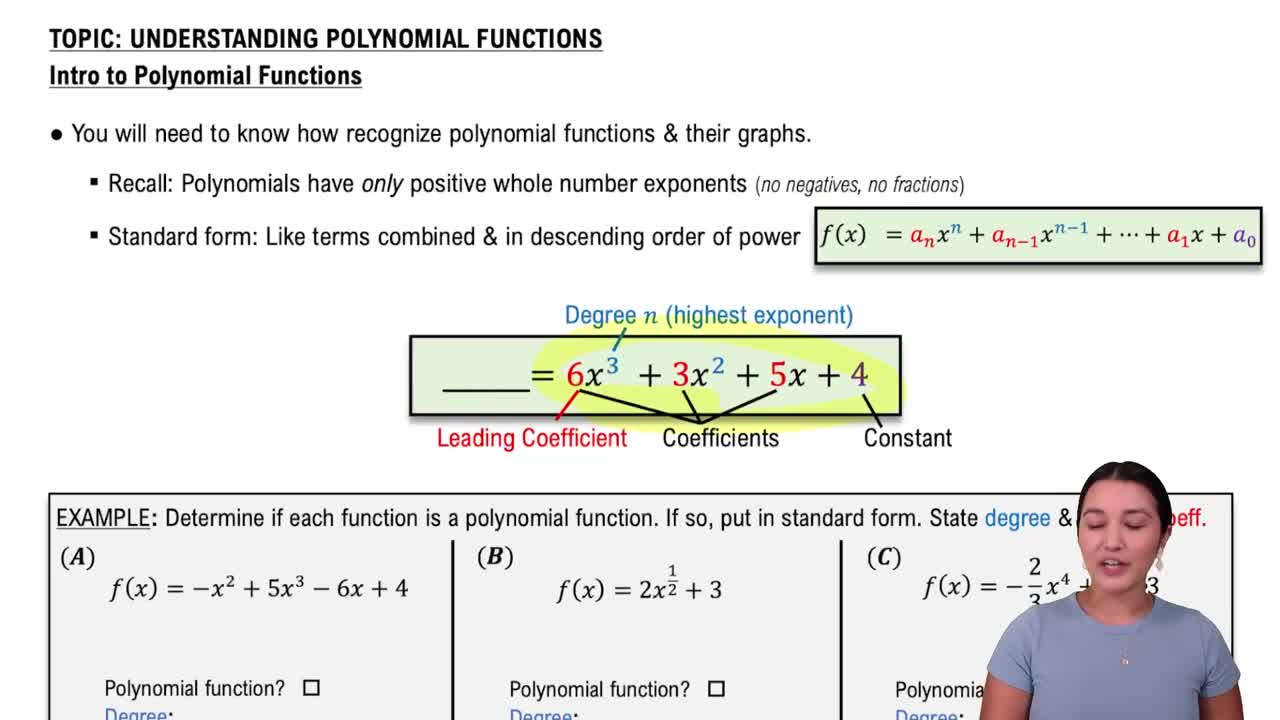
A polynomial function is an expression consisting of variables raised to whole-number exponents and coefficients, combined using addition, subtraction, and multiplication. Understanding the general form and degree of a polynomial helps in analyzing its graph and behavior.
Video consigliato:
Introduction to Polynomial Functions
Leading Coefficient Test
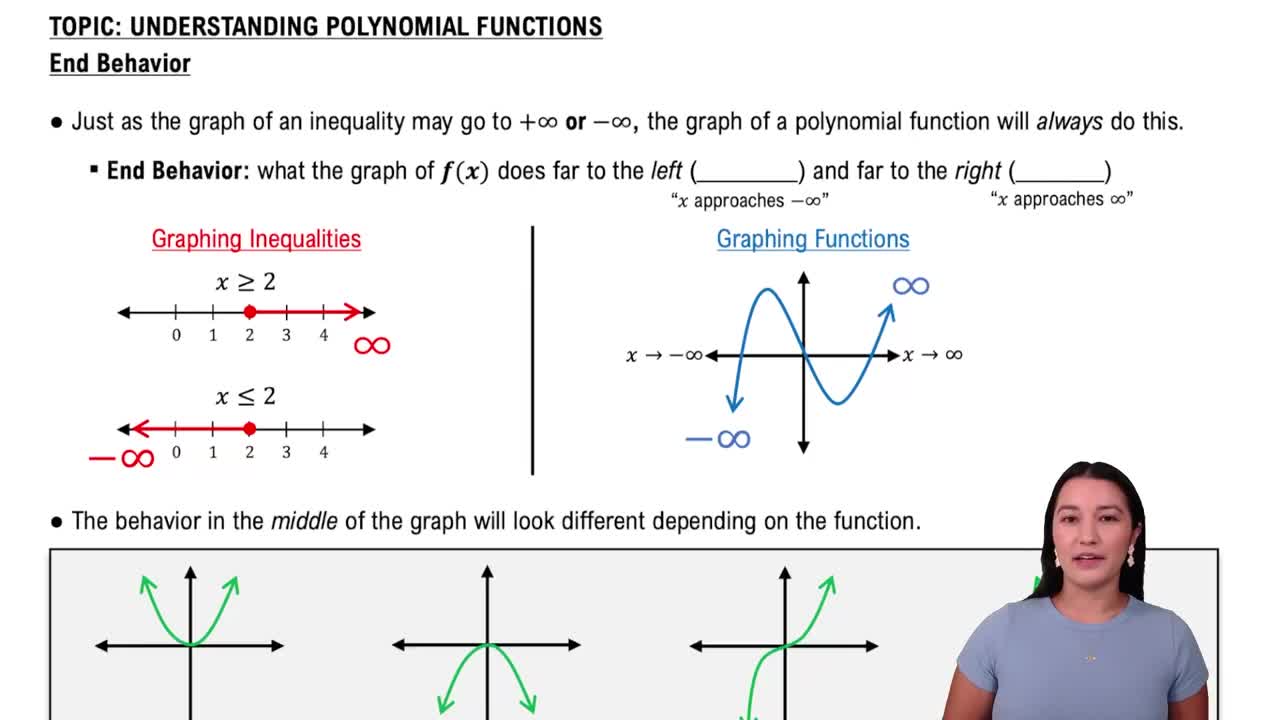
The Leading Coefficient Test uses the degree and leading coefficient of a polynomial to determine the end behavior of its graph. Specifically, it predicts how the function behaves as x approaches positive or negative infinity based on whether the degree is even or odd and the sign of the leading coefficient.
Video consigliato:
End Behavior of Polynomial Functions
End Behavior of Functions
End behavior describes how the values of a function behave as the input x becomes very large or very small. For polynomials, this is determined by the highest-degree term, which dominates the function's growth or decline at the extremes of the x-axis.
Video consigliato:
End Behavior of Polynomial Functions
Pratica correlata
Domanda del libro di testo
660
views
Domanda del libro di testo
Use the graph of the rational function in the figure shown to complete each statement in Exercises 15–20.
As _____
619
views
Domanda del libro di testo
Divide using synthetic division. (3x2+7x−20)÷(x+5)
563
views
Domanda del libro di testo
Solve each polynomial inequality in Exercises 1–42 and graph the solution set on a real number line. Express each solution set in interval notation.
639
views
Domanda del libro di testo
In Exercises 17–24, a) List all possible rational roots. b) List all possible rational roots. c) Use the quotient from part (b) to find the remaining roots and solve the equation. x3−10x−12=0
863
views
Domanda del libro di testo
Use the vertex and intercepts to sketch the graph of each quadratic function. Give the equation of the parabola's axis of symmetry. Use the graph to determine the function's domain and range. f(x)=(x−1)2+2
838
views