Ch. 3 - Polynomial and Rational Functions
Blitzer - College Algebra 8th Edition
Blitzer8th EditionCollege AlgebraISBN: 9780136970514Non è quello che usi tu?Cambia libro di testo
Capitolo 4, Problema 29

Divide using synthetic division. (x4−256)/(x−4)

Guida verificata passo dopo passo
1
Identify the divisor and the dividend. Here, the divisor is \(x - 4\), and the dividend is \(x^{4} - 256\).
Set up the synthetic division by writing the zero of the divisor \(x - 4\), which is \(4\), to the left.
Write the coefficients of the dividend polynomial \(x^{4} - 256\). Since some terms are missing, include zeros for those terms: coefficients are \(1\) (for \(x^{4}\)), \(0\) (for \(x^{3}\)), \(0\) (for \(x^{2}\)), \(0\) (for \(x\)), and \(-256\) (constant term).
Perform synthetic division: bring down the first coefficient, multiply it by \(4\), add to the next coefficient, and repeat this process across all coefficients.
Write the quotient polynomial using the results from synthetic division, noting that the degree of the quotient is one less than the dividend, and identify any remainder if present.

Risposta video verificata per un problema simile:

Questa soluzione video è stata consigliata dai nostri tutor come utile per risolvere questo problema.
Durata del video:
4m

Concetti chiave

Ecco i concetti essenziali che devi comprendere per rispondere correttamente alla domanda.

Synthetic Division

Synthetic division is a shortcut method for dividing a polynomial by a linear binomial of the form (x - c). It simplifies the long division process by using only the coefficients of the polynomial and performing arithmetic operations in a tabular form.
Video consigliato:
05:10
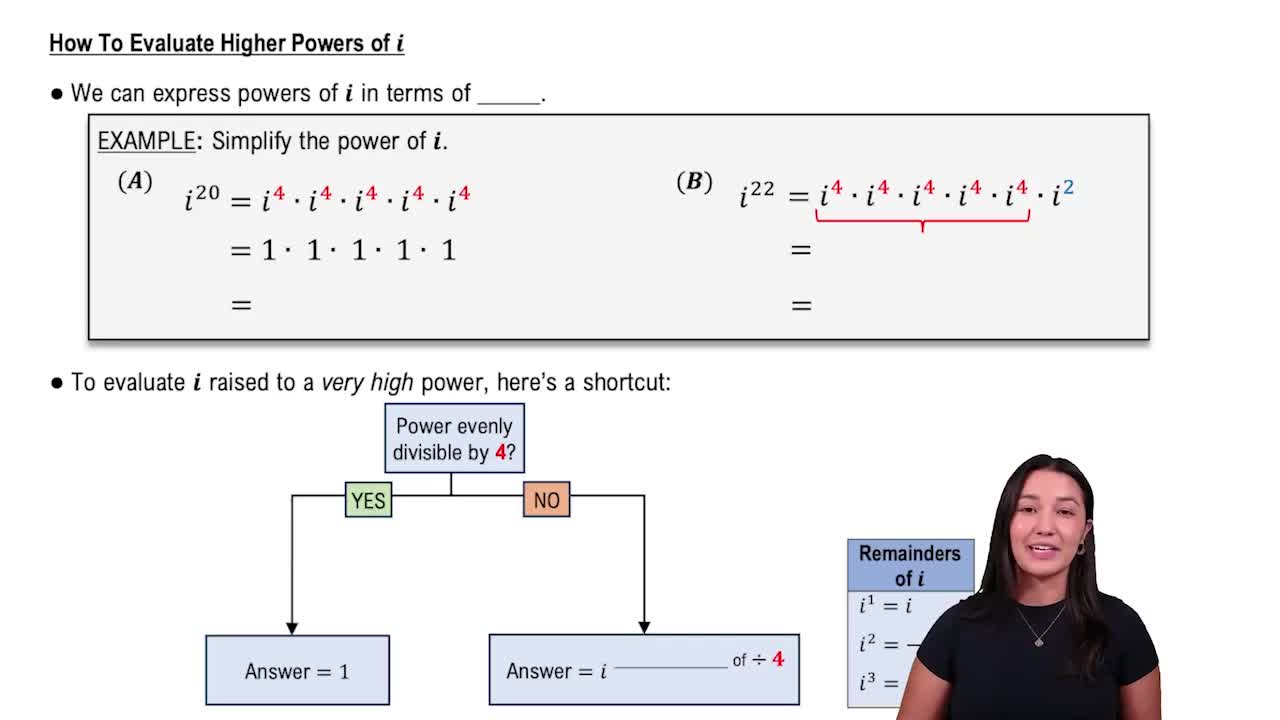
Higher Powers of i

Polynomial Coefficients

When using synthetic division, it is essential to identify and list the coefficients of the polynomial in descending order of degree. Missing terms must be represented by zero coefficients to maintain the correct alignment during the division process.
Video consigliato:
05:16
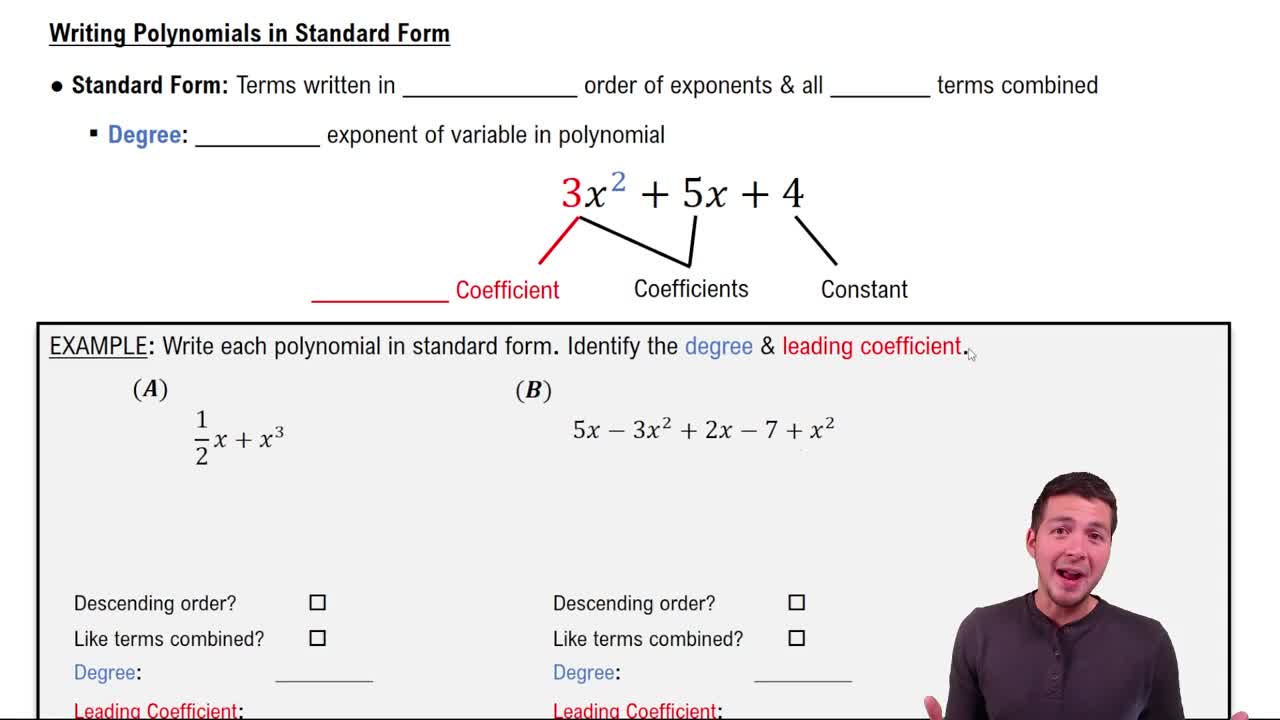
Standard Form of Polynomials

Remainder and Quotient Interpretation

The result of synthetic division includes a quotient polynomial and possibly a remainder. The quotient has a degree one less than the original polynomial, and the remainder is a constant. Understanding how to interpret these results is key to completing the division.
Video consigliato:
3:49
Product, Quotient, and Power Rules of Logs