Ch. 3 - Polynomial and Rational Functions
Blitzer - College Algebra 8th Edition
Blitzer8th EditionCollege AlgebraISBN: 9780136970514Non è quello che usi tu?Cambia libro di testo
Capitolo 4, Problema 28

Find the zeros for each polynomial function and give the multiplicity for each zero. State whether the graph crosses the x-axis, or touches the x-axis and turns around, at each zero. f(x)=−3(x+1/2)(x−4)3

Guida verificata passo dopo passo
1
Identify the zeros of the polynomial function by setting each factor equal to zero. For the function \(f(x) = -3\left(x + \frac{1}{2}\right)\left(x - 4\right)^3\), the zeros come from solving \(x + \frac{1}{2} = 0\) and \(x - 4 = 0\).
Solve each equation to find the zeros: \(x + \frac{1}{2} = 0\) gives \(x = -\frac{1}{2}\), and \(x - 4 = 0\) gives \(x = 4\).
Determine the multiplicity of each zero by looking at the exponent on each factor. The factor \(\left(x + \frac{1}{2}\right)\) has an implied exponent of 1, so its multiplicity is 1. The factor \(\left(x - 4\right)^3\) has an exponent of 3, so its multiplicity is 3.
Use the multiplicity to describe the behavior of the graph at each zero: if the multiplicity is odd (like 1 or 3), the graph crosses the x-axis at that zero. If the multiplicity were even, the graph would touch the x-axis and turn around at that zero.
Summarize the results: at \(x = -\frac{1}{2}\) (multiplicity 1), the graph crosses the x-axis; at \(x = 4\) (multiplicity 3), the graph also crosses the x-axis but with a flatter, cubic behavior near the zero.

Risposta video verificata per un problema simile:

Questa soluzione video è stata consigliata dai nostri tutor come utile per risolvere questo problema.
Durata del video:
3m

Concetti chiave

Ecco i concetti essenziali che devi comprendere per rispondere correttamente alla domanda.

Zeros of a Polynomial Function

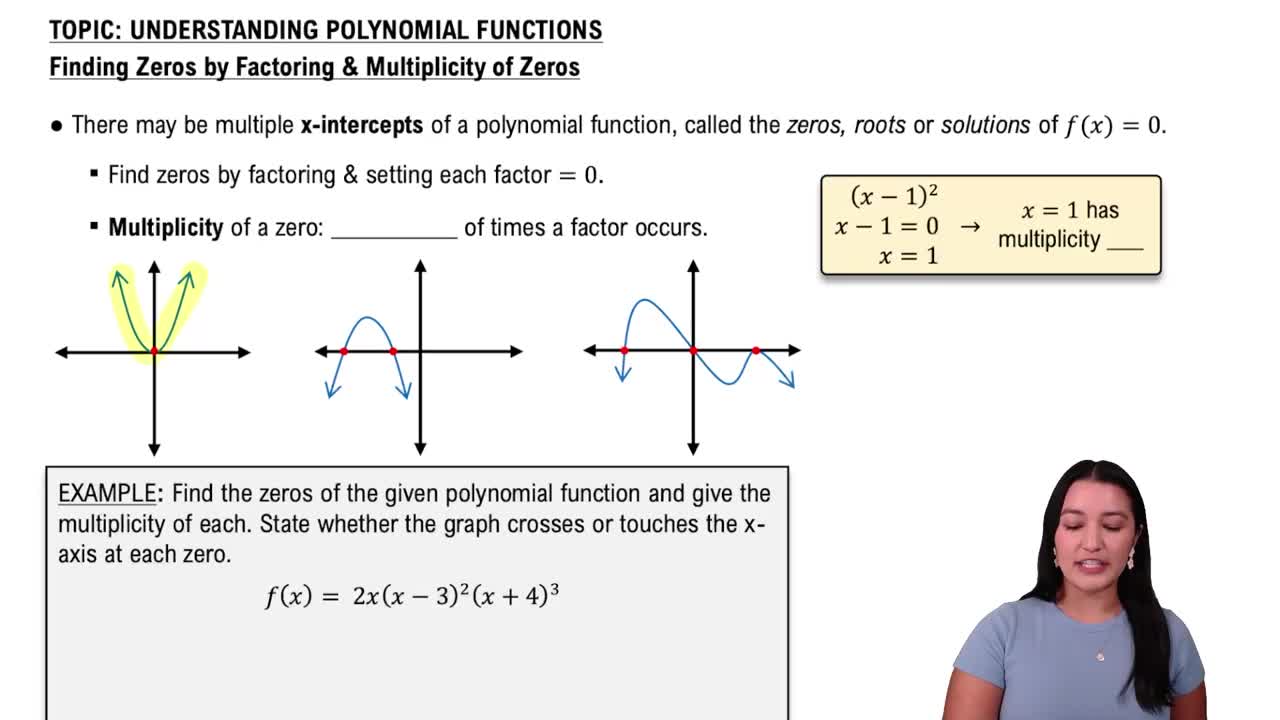
Zeros of a polynomial are the values of x that make the function equal to zero. They correspond to the x-intercepts of the graph. Finding zeros involves setting the polynomial equal to zero and solving for x, often by factoring or using the zero-product property.
Video consigliato:
03:42
Finding Zeros & Their Multiplicity

Multiplicity of Zeros

Multiplicity refers to the number of times a particular zero appears as a factor in the polynomial. If a zero has an odd multiplicity, the graph crosses the x-axis at that zero; if even, the graph touches and turns around without crossing.
Video consigliato:
03:42
Finding Zeros & Their Multiplicity

Behavior of the Graph at Zeros

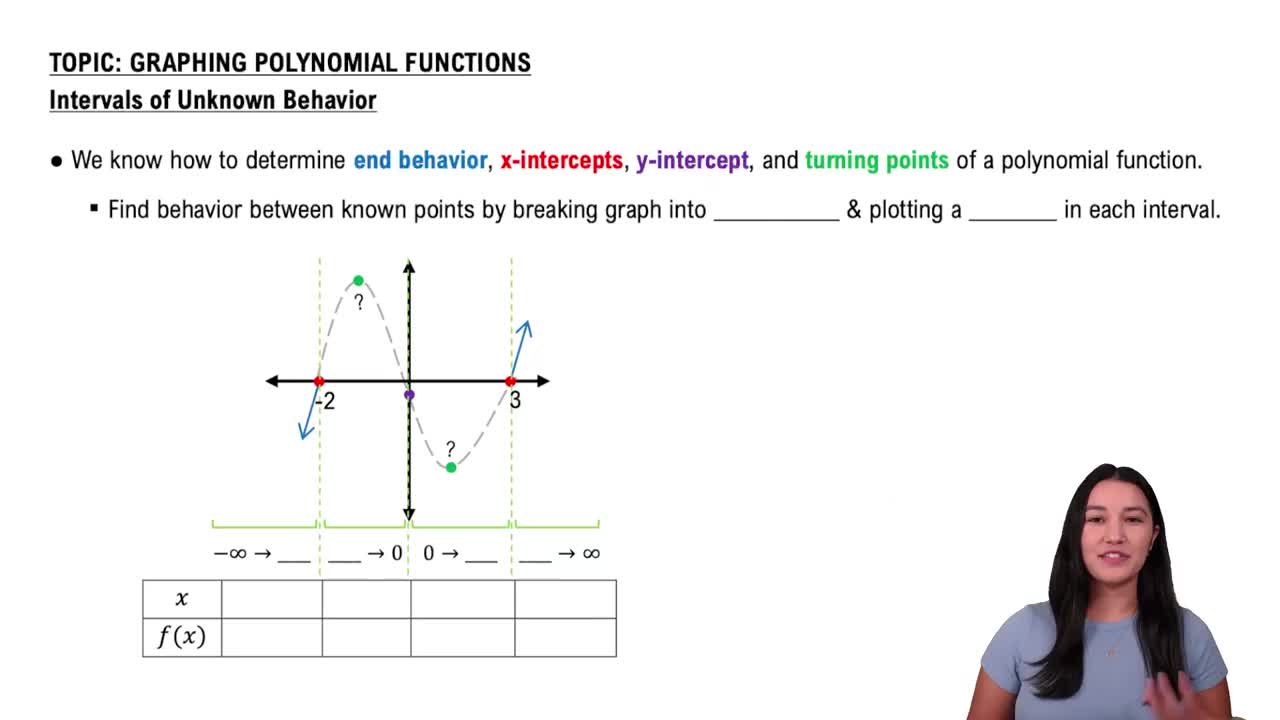
The graph's behavior at each zero depends on the zero's multiplicity. For odd multiplicities, the graph crosses the x-axis, while for even multiplicities, it only touches and reverses direction. This helps in sketching the polynomial's graph accurately.
Video consigliato:
05:01
Identifying Intervals of Unknown Behavior