Ch. 3 - Polynomial and Rational Functions
Blitzer - College Algebra 8th Edition
Blitzer8th EditionCollege AlgebraISBN: 9780136970514Non è quello che usi tu?Cambia libro di testo
Capitolo 4, Problema 27

Find an nth-degree polynomial function with real coefficients satisfying the given conditions. If you are using a graphing utility, use it to graph the function and verify the real zeros and the given function value. n=3; -5 and 4+3i are zeros; f(2) = 91

Guida verificata passo dopo passo
1
Identify the given zeros of the polynomial. Since the polynomial has real coefficients and one zero is complex (4 + 3i), its complex conjugate (4 - 3i) must also be a zero. So, the zeros are -5, 4 + 3i, and 4 - 3i.
Write the factors corresponding to each zero. For zero -5, the factor is \((x + 5)\). For zeros \(4 + 3i\) and \(4 - 3i\), the factors are \((x - (4 + 3i))\) and \((x - (4 - 3i))\) respectively.
Multiply the complex conjugate factors to get a quadratic factor with real coefficients: \[(x - (4 + 3i))(x - (4 - 3i)) = (x - 4 - 3i)(x - 4 + 3i)\] Use the difference of squares formula to simplify this product.
Express the polynomial function as \(f(x) = a(x + 5)(x^2 - 8x + 25)\), where \(a\) is a real number constant to be determined.
Use the given function value \(f(2) = 91\) to find \(a\). Substitute \(x = 2\) into the polynomial and set the expression equal to 91, then solve for \(a\).

Risposta video verificata per un problema simile:

Questa soluzione video è stata consigliata dai nostri tutor come utile per risolvere questo problema.
Durata del video:
7m

Concetti chiave

Ecco i concetti essenziali che devi comprendere per rispondere correttamente alla domanda.

Polynomial Zeros and Complex Conjugates

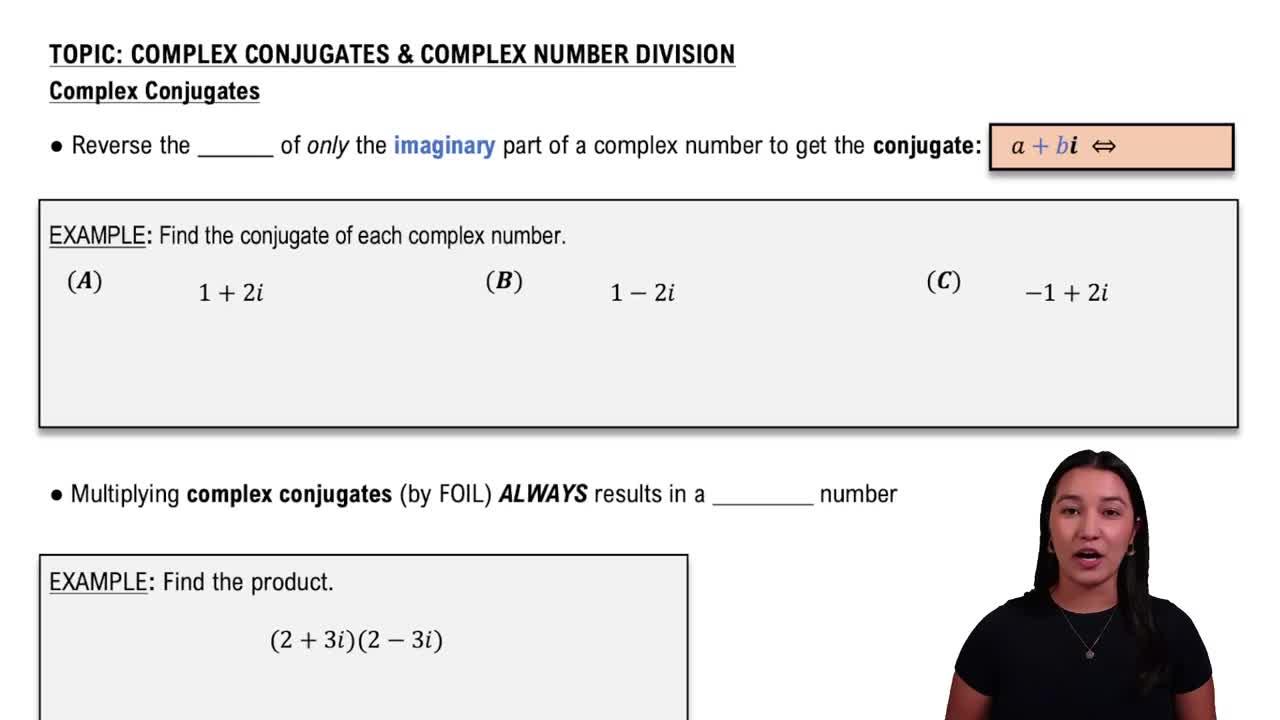
For polynomials with real coefficients, non-real zeros always come in conjugate pairs. Given a zero like 4 + 3i, its conjugate 4 - 3i must also be a zero. This ensures the polynomial remains with real coefficients when expanded.
Video consigliato:
05:33
Complex Conjugates

Constructing a Polynomial from Zeros

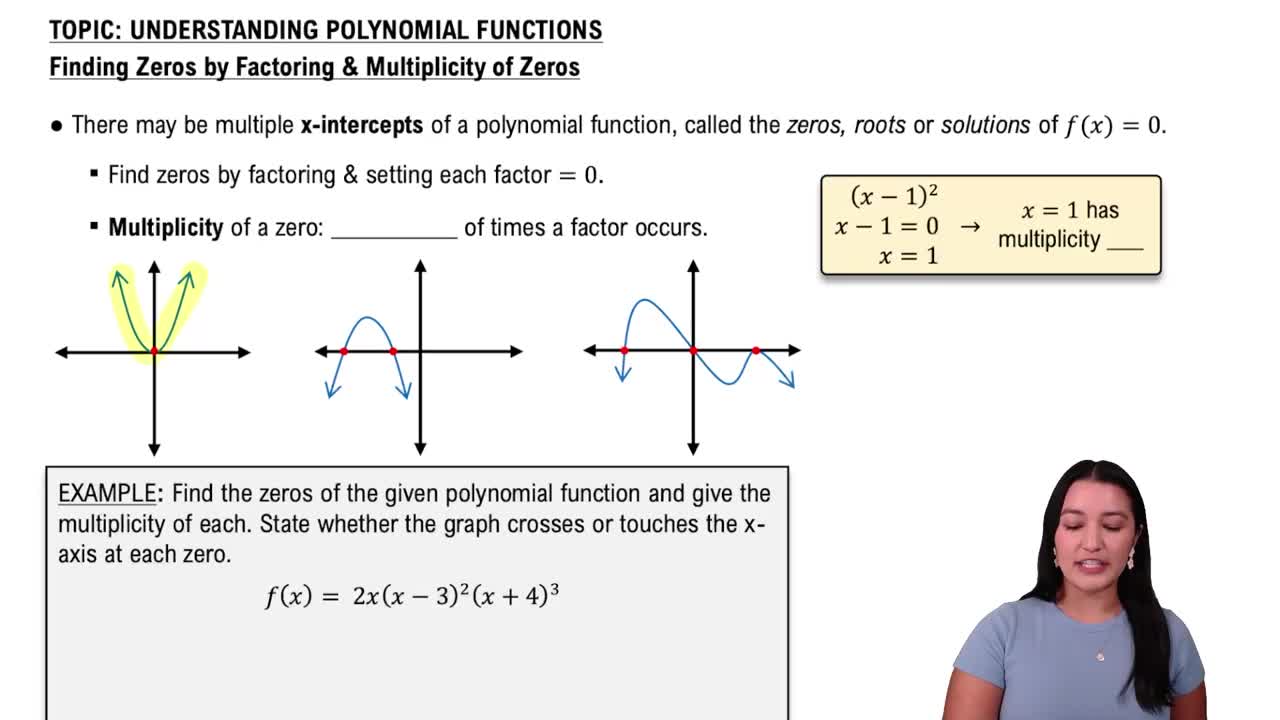
A polynomial can be formed by multiplying factors corresponding to its zeros. For zeros r1, r2, and r3, the polynomial is f(x) = a(x - r1)(x - r2)(x - r3), where 'a' is a leading coefficient determined by additional conditions.
Video consigliato:
03:42
Finding Zeros & Their Multiplicity

Using Function Values to Determine Leading Coefficient

Given a specific function value like f(2) = 91, substitute x = 2 into the polynomial expression and solve for the leading coefficient 'a'. This step ensures the polynomial satisfies all given conditions.
Video consigliato:
5:31
Graphing Rational Functions Using Transformations