Find the vertical asymptotes, if any, and the values of x corresponding to holes, if any, of the graph of each rational function. r(x)=x/(x2+4)
Ch. 3 - Polynomial and Rational Functions

Capitolo 4, Problema 27
Divide using long division.
Guida verificata passo dopo passo1
Set up the long division by writing the dividend \(4x^3 - 3x^2 - 2x + 1\) under the division bar and the divisor \(x + 1\) outside the division bar.
Divide the leading term of the dividend, \$4x^3$, by the leading term of the divisor, $x$, to get the first term of the quotient: \$4x^2$.
Multiply the entire divisor \(x + 1\) by \$4x^2$ to get \(4x^3 + 4x^2\), then subtract this from the dividend to find the new remainder.
Bring down the next term from the original dividend and repeat the process: divide the leading term of the new remainder by \(x\), multiply the divisor by this result, subtract, and continue.
Continue this process until all terms have been brought down and divided, resulting in the quotient and possibly a remainder expressed over the divisor.

Risposta video verificata per un problema simile:
Questa soluzione video è stata consigliata dai nostri tutor come utile per risolvere questo problema.
Durata del video:
5mConcetti chiave
Ecco i concetti essenziali che devi comprendere per rispondere correttamente alla domanda.
Polynomial Long Division
Polynomial long division is a method used to divide a polynomial by another polynomial of lower degree, similar to numerical long division. It involves dividing the leading term of the dividend by the leading term of the divisor, multiplying the divisor by this result, subtracting from the dividend, and repeating the process until the remainder has a lower degree than the divisor.
Video consigliato:
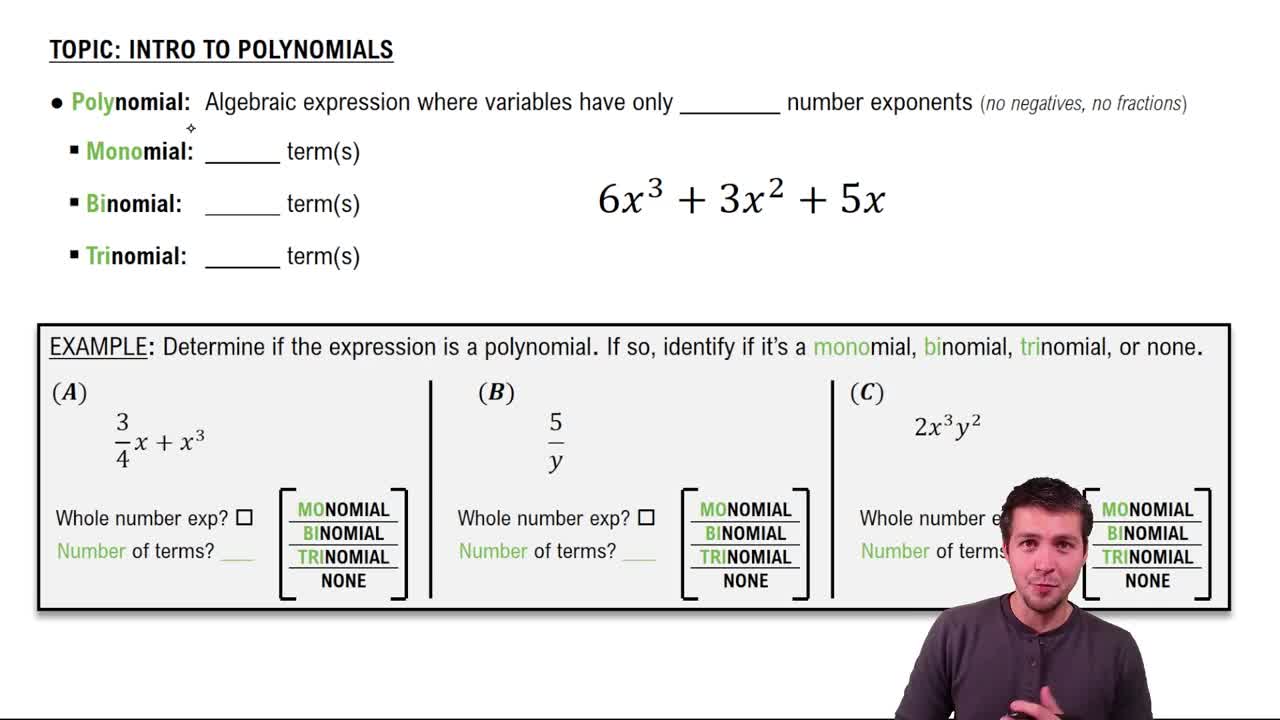
Introduction to Polynomials
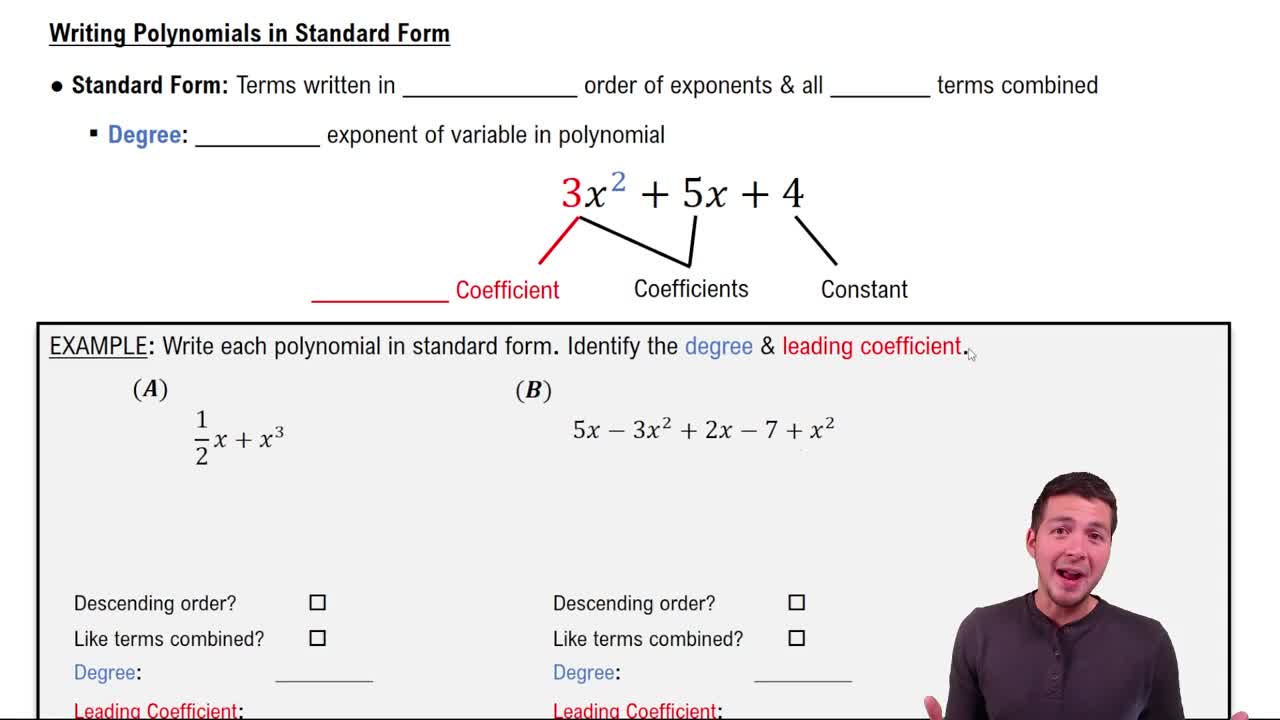
Leading Terms and Degree of Polynomials
The leading term of a polynomial is the term with the highest exponent, and the degree is the exponent of that term. Understanding these helps determine the first step in division and when to stop the process, as division continues until the remainder's degree is less than the divisor's degree.
Video consigliato:
Standard Form of Polynomials
Remainder and Quotient in Polynomial Division
In polynomial division, the quotient is the result of the division, and the remainder is what is left when the division cannot continue. The remainder must have a degree less than the divisor. The division can be expressed as Dividend = Divisor × Quotient + Remainder.
Video consigliato:
Introduction to Polynomials
Pratica correlata
Domanda del libro di testo
601
views
Domanda del libro di testo
Find an nth-degree polynomial function with real coefficients satisfying the given conditions. If you are using a graphing utility, use it to graph the function and verify the real zeros and the given function value. n=3; -5 and 4+3i are zeros; f(2) = 91
2266
views
1
rank
Domanda del libro di testo
Divide using synthetic division. (x7+x5−10x3+12)/(x+2)
693
views
Domanda del libro di testo
Divide using synthetic division. (x5+x3−2)/(x−1)
490
views
Domanda del libro di testo
Use the vertex and intercepts to sketch the graph of each quadratic function. Give the equation of the parabola's axis of symmetry. Use the graph to determine the function's domain and range. f(x)=x2−2x−3
1501
views
Domanda del libro di testo
Solve each polynomial inequality in Exercises 1–42 and graph the solution set on a real number line. Express each solution set in interval notation. 9x2−6x+1<0
673
views