In Exercises 33–40, use the Intermediate Value Theorem to show that each polynomial has a real zero between the given integers. f(x)=x4+6x3−18x2; between 2 and 3
Ch. 3 - Polynomial and Rational Functions

Capitolo 4, Problema 37
Use Descartes's Rule of Signs to determine the possible number of positive and negative real zeros for each given function. f(x)=2x4−5x3−x2−6x+4
Guida verificata passo dopo passo1
Write down the given polynomial function: \(f(x) = 2x^{4} - 5x^{3} - x^{2} - 6x + 4\).
To find the possible number of positive real zeros, count the number of sign changes in the coefficients of \(f(x)\). The coefficients are: \(2, -5, -1, -6, 4\).
Identify the sign changes between consecutive coefficients: from \(2\) to \(-5\) (change), \(-5\) to \(-1\) (no change), \(-1\) to \(-6\) (no change), \(-6\) to \(4\) (change). So, there are 2 sign changes.
According to Descartes's Rule of Signs, the number of positive real zeros is either equal to the number of sign changes or less than that by an even number. So, possible positive zeros are 2 or 0.
To find the possible number of negative real zeros, evaluate \(f(-x)\) and count the sign changes in its coefficients. Replace \(x\) by \(-x\) in \(f(x)\) and simplify to get \(f(-x)\), then count the sign changes in the coefficients of \(f(-x)\).

Risposta video verificata per un problema simile:
Questa soluzione video è stata consigliata dai nostri tutor come utile per risolvere questo problema.
Durata del video:
3mConcetti chiave
Ecco i concetti essenziali che devi comprendere per rispondere correttamente alla domanda.
Descartes's Rule of Signs
Descartes's Rule of Signs is a method used to determine the possible number of positive and negative real zeros of a polynomial function by counting the sign changes in the coefficients of f(x) and f(-x). The number of positive real zeros is equal to the number of sign changes in f(x) or less than that by an even number. Similarly, the number of negative real zeros is found by applying the rule to f(-x).
Video consigliato:
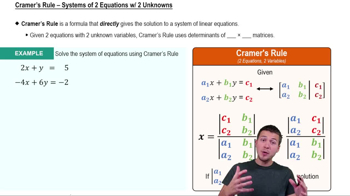
Cramer's Rule - 2 Equations with 2 Unknowns
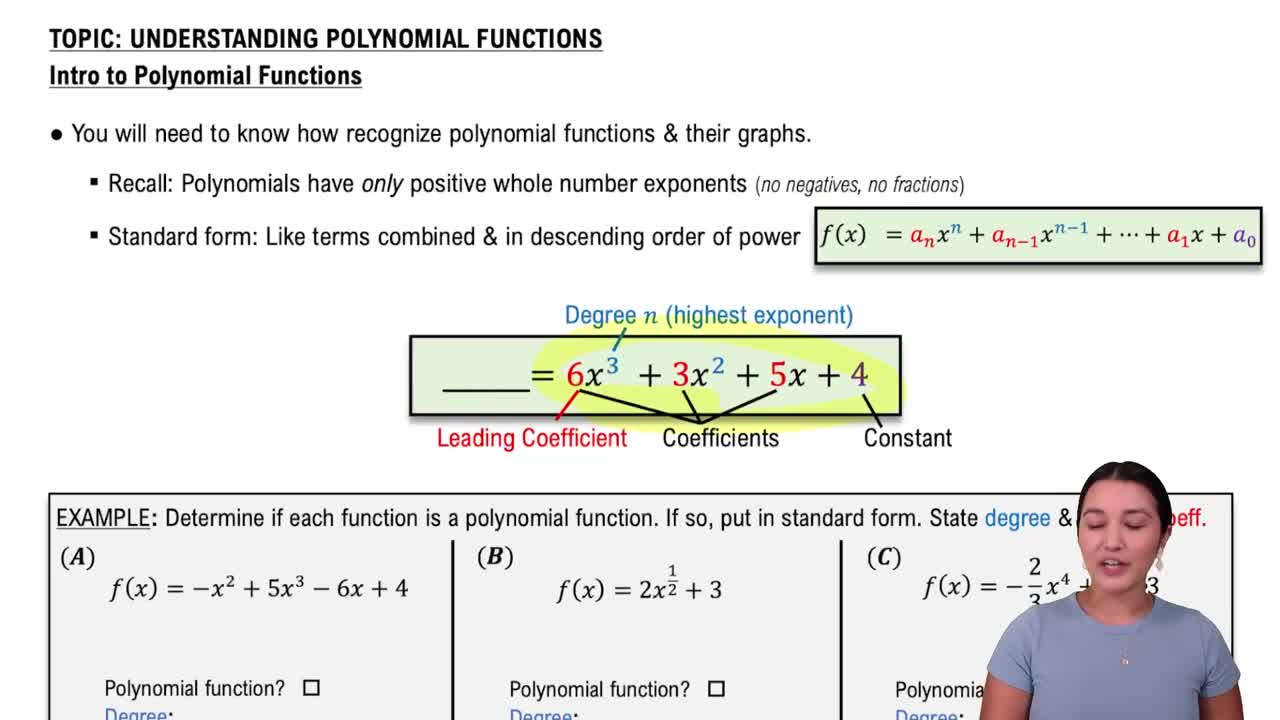
Polynomial Functions and Their Coefficients
A polynomial function is an expression consisting of variables raised to whole-number exponents and coefficients. Understanding the arrangement and signs of coefficients is essential for applying Descartes's Rule of Signs, as the rule depends on counting sign changes between consecutive terms. For example, in f(x) = 2x^4 - 5x^3 - x^2 - 6x + 4, the coefficients are 2, -5, -1, -6, and 4.
Video consigliato:
Introduction to Polynomial Functions
Evaluating f(-x) to Find Negative Zeros
To determine the possible number of negative real zeros, substitute -x into the polynomial to get f(-x). This changes the signs of terms with odd powers of x. Then, count the sign changes in the coefficients of f(-x) to apply Descartes's Rule of Signs for negative zeros. This step is crucial because it transforms the problem of finding negative zeros into a similar sign-change counting process.
Video consigliato:
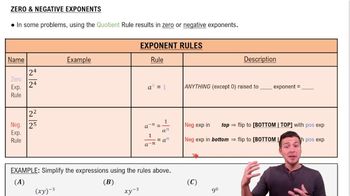
Zero and Negative Rules
Pratica correlata
Domanda del libro di testo
1187
views
Domanda del libro di testo
Use synthetic division and the Remainder Theorem to find the indicated function value. f(x)=x4+5x3+5x2−5x−6;f(3)
517
views
Domanda del libro di testo
Solve each polynomial inequality in Exercises 1–42 and graph the solution set on a real number line. Express each solution set in interval notation.
512
views
Domanda del libro di testo
Use the Intermediate Value Theorem to show that each polynomial has a real zero between the given integers. f(x)=x3+x2−2x+1; between -3 and -2
863
views
Domanda del libro di testo
Find the horizontal asymptote, if there is one, of the graph of each rational function. f(x)=12x/(3x2+1)
1051
views
Domanda del libro di testo
Use Descartes's Rule of Signs to determine the possible number of positive and negative real zeros for each given function.
568
views