Use Descartes's Rule of Signs to determine the possible number of positive and negative real zeros for each given function. f(x)=2x4−5x3−x2−6x+4
Ch. 3 - Polynomial and Rational Functions

Capitolo 4, Problema 37
Use synthetic division and the Remainder Theorem to find the indicated function value. f(x)=x4+5x3+5x2−5x−6;f(3)
Guida verificata passo dopo passo1
Identify the polynomial function and the value at which you need to evaluate it: \(f(x) = x^{4} + 5x^{3} + 5x^{2} - 5x - 6\) and you want to find \(f(3)\).
Set up synthetic division by writing down the coefficients of the polynomial: \(1\) (for \(x^{4}\)), \(5\) (for \(x^{3}\)), \(5\) (for \(x^{2}\)), \(-5\) (for \(x\)), and \(-6\) (constant term).
Write the value \(3\) (the input for \(f(3)\)) to the left of the synthetic division setup.
Perform synthetic division by bringing down the first coefficient, then multiply it by \(3\), add this result to the next coefficient, and repeat this process across all coefficients.
The final number you obtain after completing synthetic division is the remainder, which equals \(f(3)\) by the Remainder Theorem.

Risposta video verificata per un problema simile:
Questa soluzione video è stata consigliata dai nostri tutor come utile per risolvere questo problema.
Durata del video:
4mConcetti chiave
Ecco i concetti essenziali che devi comprendere per rispondere correttamente alla domanda.
Synthetic Division
Synthetic division is a shortcut method for dividing a polynomial by a linear binomial of the form (x - c). It simplifies the long division process by using only the coefficients of the polynomial, making it faster and less error-prone. This method helps find the quotient and remainder efficiently.
Video consigliato:
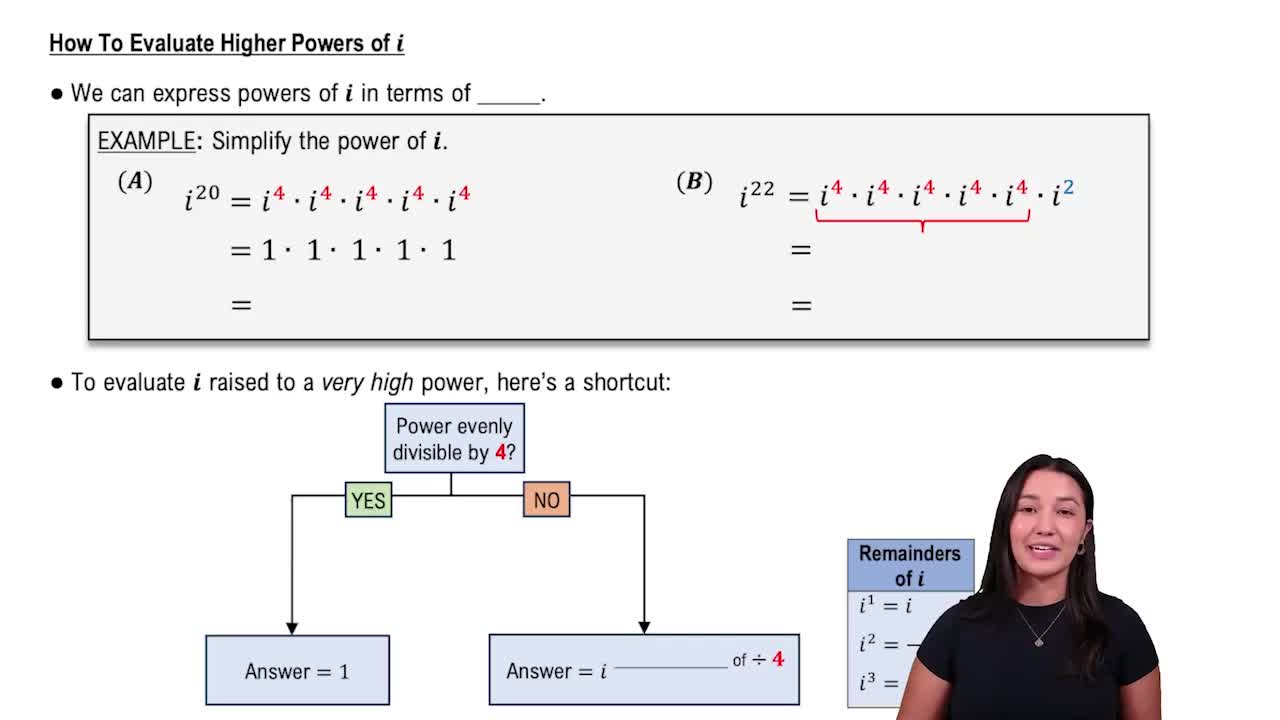
Higher Powers of i
Remainder Theorem
The Remainder Theorem states that when a polynomial f(x) is divided by (x - c), the remainder is equal to f(c). This means evaluating the polynomial at x = c gives the remainder directly, which is useful for quickly finding function values or checking factors.
Video consigliato:
Higher Powers of i
Polynomial Evaluation
Polynomial evaluation involves calculating the value of a polynomial function at a specific input x = c. Using synthetic division or direct substitution, you can find f(c), which represents the output of the polynomial for that input. This is essential for understanding function behavior and solving related problems.
Video consigliato:
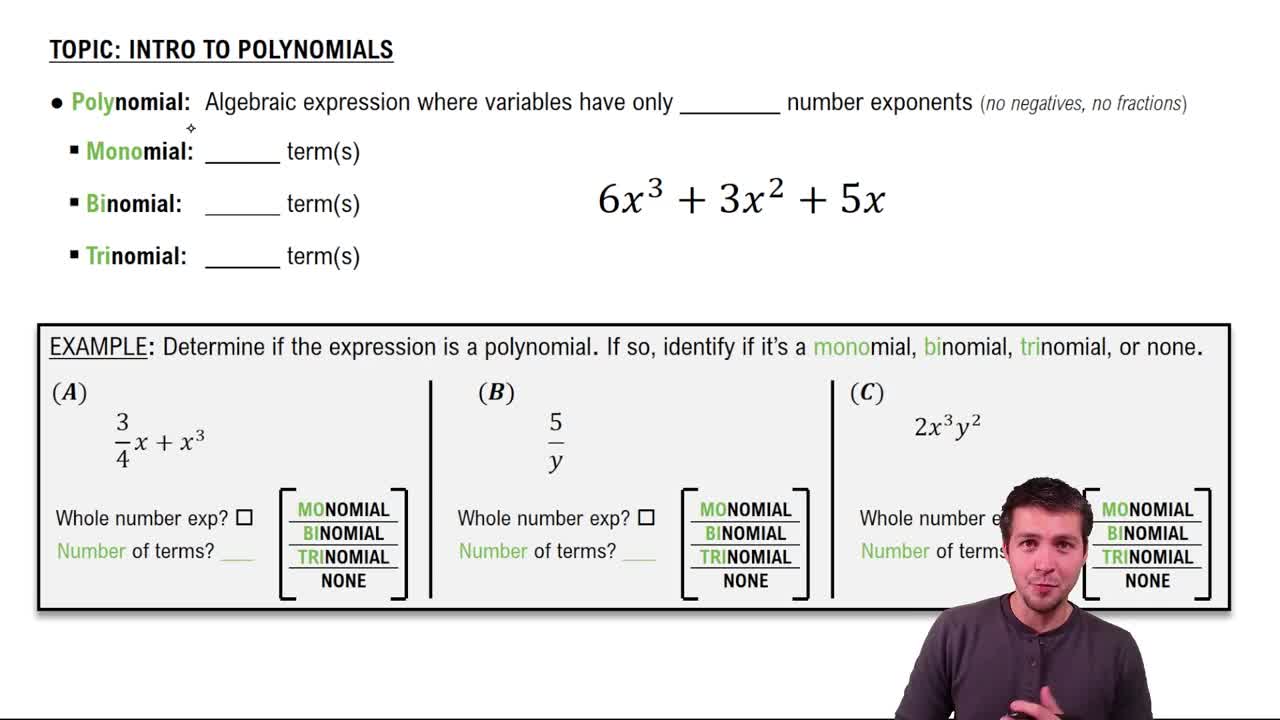
Introduction to Polynomials
Pratica correlata
Domanda del libro di testo
883
views
Domanda del libro di testo
In Exercises 17–38, use the vertex and intercepts to sketch the graph of each quadratic function. Give the equation of the parabola's axis of symmetry. Use the graph to determine the function's domain and range. f(x)=2x−x2−2
1012
views
Domanda del libro di testo
Use the Intermediate Value Theorem to show that each polynomial has a real zero between the given integers. f(x)=x3+x2−2x+1; between -3 and -2
863
views
Domanda del libro di testo
Solve each polynomial inequality in Exercises 1–42 and graph the solution set on a real number line. Express each solution set in interval notation.
618
views
Domanda del libro di testo
Find the horizontal asymptote, if there is one, of the graph of each rational function. f(x)=12x/(3x2+1)
1051
views
Domanda del libro di testo
Use Descartes's Rule of Signs to determine the possible number of positive and negative real zeros for each given function.
568
views