In Exercises 39–52, find all zeros of the polynomial function or solve the given polynomial equation. Use the Rational Zero Theorem, Descartes's Rule of Signs, and possibly the graph of the polynomial function shown by a graphing utility as an aid in obtaining the first zero or the first root. f(x)=x4−2x3+x2+12x+8

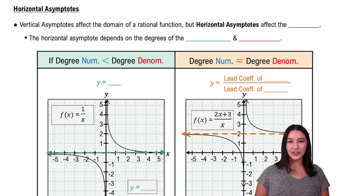
Find the horizontal asymptote, if there is one, of the graph of each rational function. f(x)=(−2x+1)/(3x+5)
Guida verificata passo dopo passo
Risposta video verificata per un problema simile:
Concetti chiave
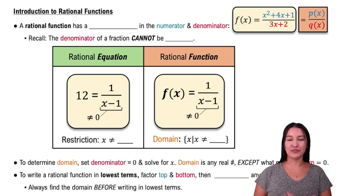
Rational Functions
Horizontal Asymptotes
Degree of Polynomials in Numerator and Denominator
Use transformations of f(x)=1/x or f(x)=1/x2 to graph each rational function. g(x)=1/(x−1)
Solve each rational inequality in Exercises 43–60 and graph the solution set on a real number line. Express each solution set in interval notation. (x+3)/(x+4)<0
An equation of a quadratic function is given. a) Determine, without graphing, whether the function has a minimum value or a maximum value. b) Find the minimum or maximum value and determine where it occurs. c) Identify the function's domain and its range. f(x)=5x2−5x
Solve the equation 2x3−3x2−11x+6=0 given that -2 is a zero of f(x)=2x3−3x2−11x+6.
Solve each rational inequality in Exercises 43–60 and graph the solution set on a real number line. Express each solution set in interval notation. (x−4)/(x+3) > 0
