In Exercises 39–52, find all zeros of the polynomial function or solve the given polynomial equation. Use the Rational Zero Theorem, Descartes's Rule of Signs, and possibly the graph of the polynomial function shown by a graphing utility as an aid in obtaining the first zero or the first root. f(x)=x4−2x3+x2+12x+8
Ch. 3 - Polynomial and Rational Functions

Capitolo 4, Problema 43
Solve each rational inequality in Exercises 43–60 and graph the solution set on a real number line. Express each solution set in interval notation. (x−4)/(x+3) > 0
Guida verificata passo dopo passo1
Identify the critical points by setting the numerator and denominator equal to zero separately: solve \( x - 4 = 0 \) and \( x + 3 = 0 \). These points divide the number line into intervals.
Determine the intervals based on the critical points found: \( (-\infty, -3) \), \( (-3, 4) \), and \( (4, \infty) \).
Test a sample value from each interval in the inequality \( \frac{x - 4}{x + 3} > 0 \) to check whether the expression is positive or negative in that interval.
Remember that the inequality is strict (greater than zero), so exclude points where the expression equals zero or is undefined (i.e., exclude \( x = 4 \) and \( x = -3 \)).
Combine the intervals where the inequality holds true and express the solution set in interval notation, then graph these intervals on the real number line.

Risposta video verificata per un problema simile:
Questa soluzione video è stata consigliata dai nostri tutor come utile per risolvere questo problema.
Durata del video:
5mConcetti chiave
Ecco i concetti essenziali che devi comprendere per rispondere correttamente alla domanda.
Rational Inequalities
Rational inequalities involve expressions where one polynomial is divided by another, and the inequality compares this ratio to zero or another value. Solving them requires finding where the expression is positive, negative, or zero, considering the domain restrictions where the denominator is not zero.
Video consigliato:
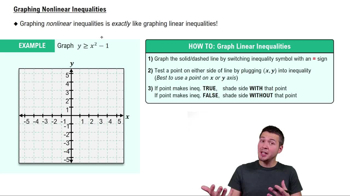
Nonlinear Inequalities
Critical Points and Sign Analysis
Critical points are values that make the numerator or denominator zero, dividing the number line into intervals. By testing values in each interval, you determine the sign of the rational expression, which helps identify where the inequality holds true.
Video consigliato:
Point-Slope Form
Interval Notation and Graphing on a Number Line
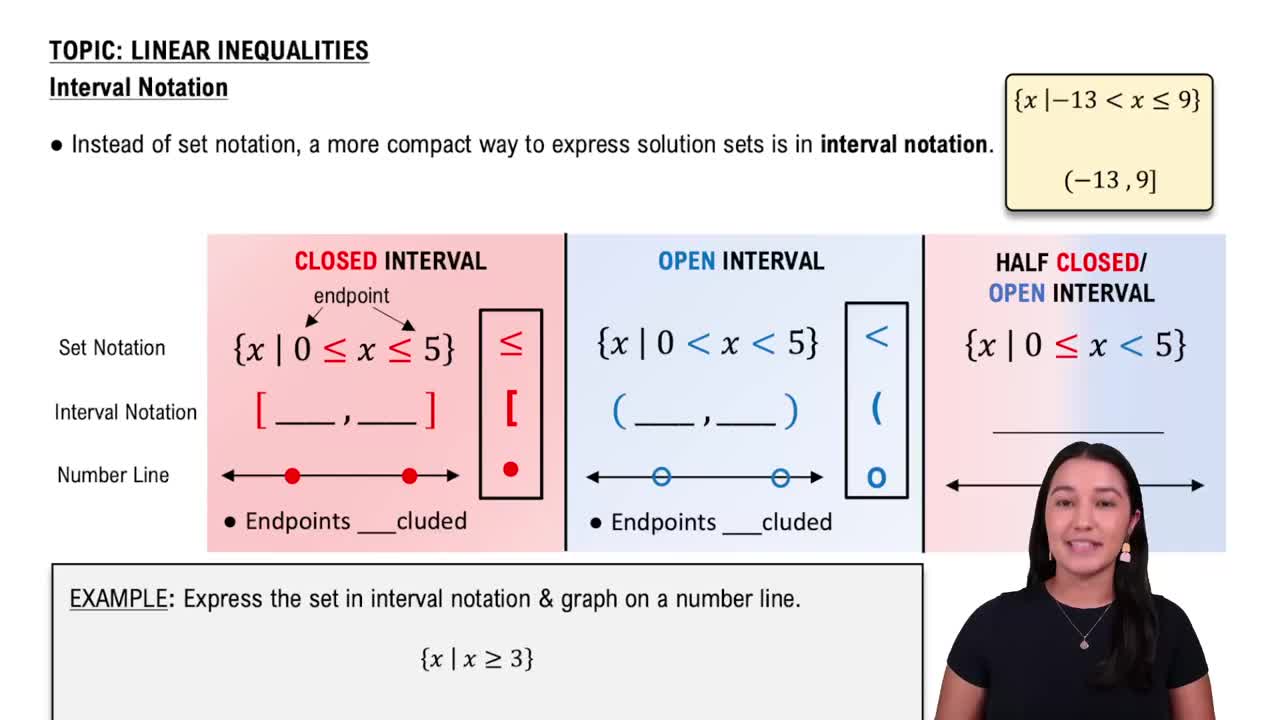
Interval notation concisely represents solution sets using parentheses and brackets to indicate open or closed intervals. Graphing on a number line visually shows these intervals, highlighting where the inequality is satisfied and marking excluded points such as zeros of the denominator.
Video consigliato:
Interval Notation
Pratica correlata
Domanda del libro di testo
568
views
Domanda del libro di testo
Solve each polynomial inequality in Exercises 1–42 and graph the solution set on a real number line. Express each solution set in interval notation. x3≤4x2
508
views
Domanda del libro di testo
An equation of a quadratic function is given. a) Determine, without graphing, whether the function has a minimum value or a maximum value. b) Find the minimum or maximum value and determine where it occurs. c) Identify the function's domain and its range. f(x)=5x2−5x
969
views
Domanda del libro di testo
Find the horizontal asymptote, if there is one, of the graph of each rational function. f(x)=(−2x+1)/(3x+5)
676
views
Domanda del libro di testo
Solve the equation 2x3−3x2−11x+6=0 given that -2 is a zero of f(x)=2x3−3x2−11x+6.
1079
views
Domanda del libro di testo
Use synthetic division to divide f(x)=x3−4x2+x+6 by x+1. Use the result to find all zeros of f.
1686
views
1
comments
