Ch. 3 - Polynomial and Rational Functions
Blitzer - College Algebra 8th Edition
Blitzer8th EditionCollege AlgebraISBN: 9780136970514Non è quello che usi tu?Cambia libro di testo
Capitolo 4, Problema 49

Find all zeros of the polynomial function or solve the given polynomial equation. Use the Rational Zero Theorem, Descartes's Rule of Signs, and possibly the graph of the polynomial function shown by a graphing utility as an aid in obtaining the first zero or the first root. 4x4−x3+5x2−2x−6=0

Guida verificata passo dopo passo
1
Identify the polynomial equation: \(4x^{4} - x^{3} + 5x^{2} - 2x - 6 = 0\).
Apply the Rational Zero Theorem to list all possible rational zeros. These are of the form \(\pm \frac{p}{q}\), where \(p\) divides the constant term \(-6\) and \(q\) divides the leading coefficient \(4\). So, possible values of \(p\) are \(\pm1, \pm2, \pm3, \pm6\) and possible values of \(q\) are \(\pm1, \pm2, \pm4\).
Use Descartes's Rule of Signs to estimate the number of positive and negative real zeros. Count the sign changes in \(f(x)\) for positive zeros and in \(f(-x)\) for negative zeros to narrow down the possibilities.
Test the possible rational zeros from step 2 by substituting them into the polynomial or using synthetic division to find a root that makes the polynomial equal to zero.
Once a root is found, perform polynomial division (either synthetic or long division) to divide the original polynomial by the corresponding factor \((x - r)\), reducing the polynomial's degree. Then repeat the process on the resulting polynomial to find all zeros.

Risposta video verificata per un problema simile:

Questa soluzione video è stata consigliata dai nostri tutor come utile per risolvere questo problema.
Durata del video:
9m

Concetti chiave

Ecco i concetti essenziali che devi comprendere per rispondere correttamente alla domanda.

Rational Zero Theorem

The Rational Zero Theorem helps identify possible rational roots of a polynomial by considering factors of the constant term and the leading coefficient. These candidates can be tested to find actual zeros, simplifying the process of solving polynomial equations.
Video consigliato:
02:58
Rationalizing Denominators

Descartes's Rule of Signs

Descartes's Rule of Signs provides a way to estimate the number of positive and negative real zeros of a polynomial by counting sign changes in the polynomial and its transformed version. This helps narrow down the possible roots before testing.
Video consigliato:
6:54
Cramer's Rule - 2 Equations with 2 Unknowns

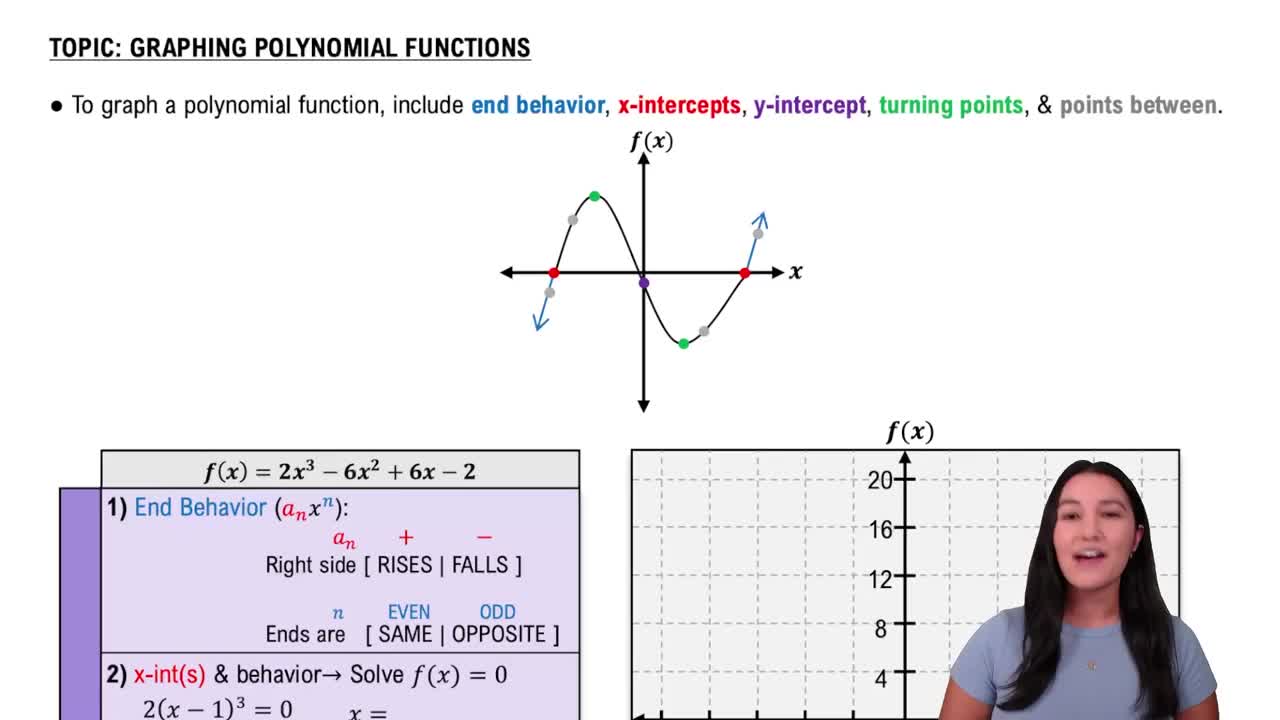
Graphing Polynomial Functions

Graphing a polynomial function using a graphing utility visually reveals approximate locations of zeros and the behavior of the function. This aids in selecting initial guesses for roots and understanding the multiplicity and nature of zeros.
Video consigliato:
05:25
Graphing Polynomial Functions