Exercises 82–84 will help you prepare for the material covered in the next section. Let f(x)=an(x4−3x2−4). If f(3)=−150, determine the value of a_n.
Ch. 3 - Polynomial and Rational Functions

Capitolo 4, Problema 85
In Exercises 81–88, a. Find the slant asymptote of the graph of each rational function and b. Follow the seven-step strategy and use the slant asymptote to graph each rational function. f(x)=(x2+x−6)/(x−3)
Guida verificata passo dopo passo1
Identify the given rational function: . We want to find the slant (oblique) asymptote, which occurs when the degree of the numerator is exactly one more than the degree of the denominator.
Perform polynomial long division of the numerator by the denominator . This will help us express as a quotient plus a remainder over the divisor, which reveals the slant asymptote.
Set up the division: divide the leading term of the numerator by the leading term of the denominator to get the first term of the quotient. Then multiply the entire divisor by this term and subtract from the numerator. Repeat this process until the degree of the remainder is less than the degree of the divisor.
The quotient obtained from the division (ignoring the remainder) represents the equation of the slant asymptote. Write this quotient as a linear function where and come from the division result.
For graphing, use the seven-step strategy: (1) find the domain, (2) find intercepts, (3) find vertical asymptotes (where denominator is zero), (4) find the slant asymptote from the division, (5) analyze end behavior using the slant asymptote, (6) plot points around the vertical asymptote and near the slant asymptote, and (7) sketch the graph showing the behavior near asymptotes and intercepts.

Risposta video verificata per un problema simile:
Questa soluzione video è stata consigliata dai nostri tutor come utile per risolvere questo problema.
Durata del video:
20mConcetti chiave
Ecco i concetti essenziali che devi comprendere per rispondere correttamente alla domanda.
Rational Functions
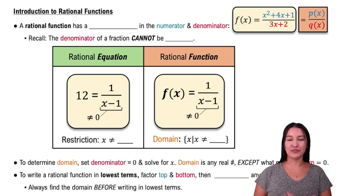
A rational function is a ratio of two polynomials, expressed as f(x) = P(x)/Q(x), where Q(x) ≠ 0. Understanding the behavior of rational functions, including their domains and discontinuities, is essential for analyzing their graphs and asymptotes.
Video consigliato:
Intro to Rational Functions
Slant (Oblique) Asymptotes
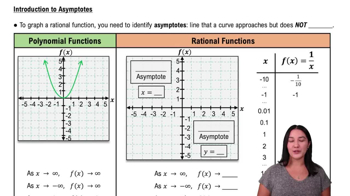
Slant asymptotes occur when the degree of the numerator is exactly one more than the degree of the denominator. They represent the line that the graph approaches as x approaches infinity or negative infinity, found by performing polynomial division.
Video consigliato:
Introduction to Asymptotes
Polynomial Division
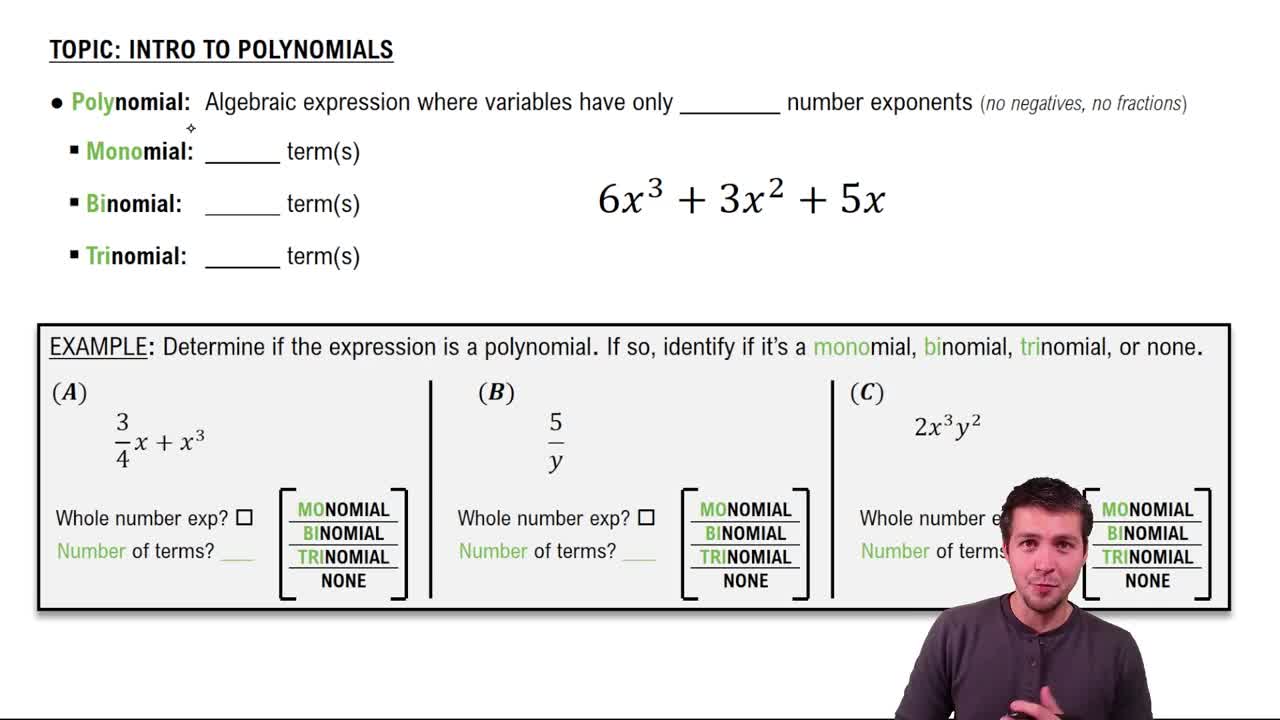
Polynomial division is a method used to divide one polynomial by another, similar to long division with numbers. It helps find the quotient and remainder, where the quotient gives the equation of the slant asymptote for rational functions with numerator degree one higher than denominator.
Video consigliato:
Introduction to Polynomials
Pratica correlata
Domanda del libro di testo
370
views
Domanda del libro di testo
Solve each inequality in Exercises 86–91 using a graphing utility. 2x2 + 5x - 3 ≤ 0
577
views
Domanda del libro di testo
In Exercises 81–88, a. Find the slant asymptote of the graph of each rational function and b. Follow the seven-step strategy and use the slant asymptote to graph each rational function. f(x)=(x3+1)/(x2+2x)
601
views
Domanda del libro di testo
In Exercises 81–88, a. Find the slant asymptote of the graph of each rational function and b. Follow the seven-step strategy and use the slant asymptote to graph each rational function. f(x)=(x2+1)/x
604
views
Domanda del libro di testo
Exercises 82–84 will help you prepare for the material covered in the next section. Solve: x2+4x+6=0
359
views
Domanda del libro di testo
Solve each inequality in Exercises 86–91 using a graphing utility. x2 + 3x - 10 > 0
573
views