Ch. 3 - Polynomial and Rational Functions
Blitzer - College Algebra 8th Edition
Blitzer8th EditionCollege AlgebraISBN: 9780136970514Non è quello che usi tu?Cambia libro di testo
Capitolo 4, Problema 13

In Exercises 9–16, a) List all possible rational zeros. b) Use synthetic division to test the possible rational zeros and find an actual zero. c) Use the quotient from part (b) to find the remaining zeros of the polynomial function. f(x)=x3+4x2−3x−6f(x)=x^3+4x^2−3x−6

Guida verificata passo dopo passo
1
Identify the polynomial function: \(f(x) = x^3 + 4x^2 - 3x - 6\).
List all possible rational zeros using the Rational Root Theorem. The possible rational zeros are of the form \(\pm \frac{p}{q}\), where \(p\) divides the constant term \(-6\) and \(q\) divides the leading coefficient \(1\). So, possible zeros are \(\pm 1, \pm 2, \pm 3, \pm 6\).
Use synthetic division to test each possible rational zero by dividing the polynomial by \((x - r)\) where \(r\) is a candidate zero. Perform synthetic division step-by-step until you find a zero that gives a remainder of zero.
Once you find an actual zero \(r\), write the quotient polynomial from the synthetic division. This quotient will be a quadratic polynomial.
Solve the quadratic quotient polynomial using factoring, completing the square, or the quadratic formula to find the remaining zeros of the original polynomial.

Risposta video verificata per un problema simile:

Questa soluzione video è stata consigliata dai nostri tutor come utile per risolvere questo problema.
Durata del video:
5m

Concetti chiave

Ecco i concetti essenziali che devi comprendere per rispondere correttamente alla domanda.

Rational Root Theorem

The Rational Root Theorem helps identify all possible rational zeros of a polynomial by considering factors of the constant term and the leading coefficient. These possible roots are expressed as ±(factors of constant term)/(factors of leading coefficient), providing a finite list to test.
Video consigliato:
04:06
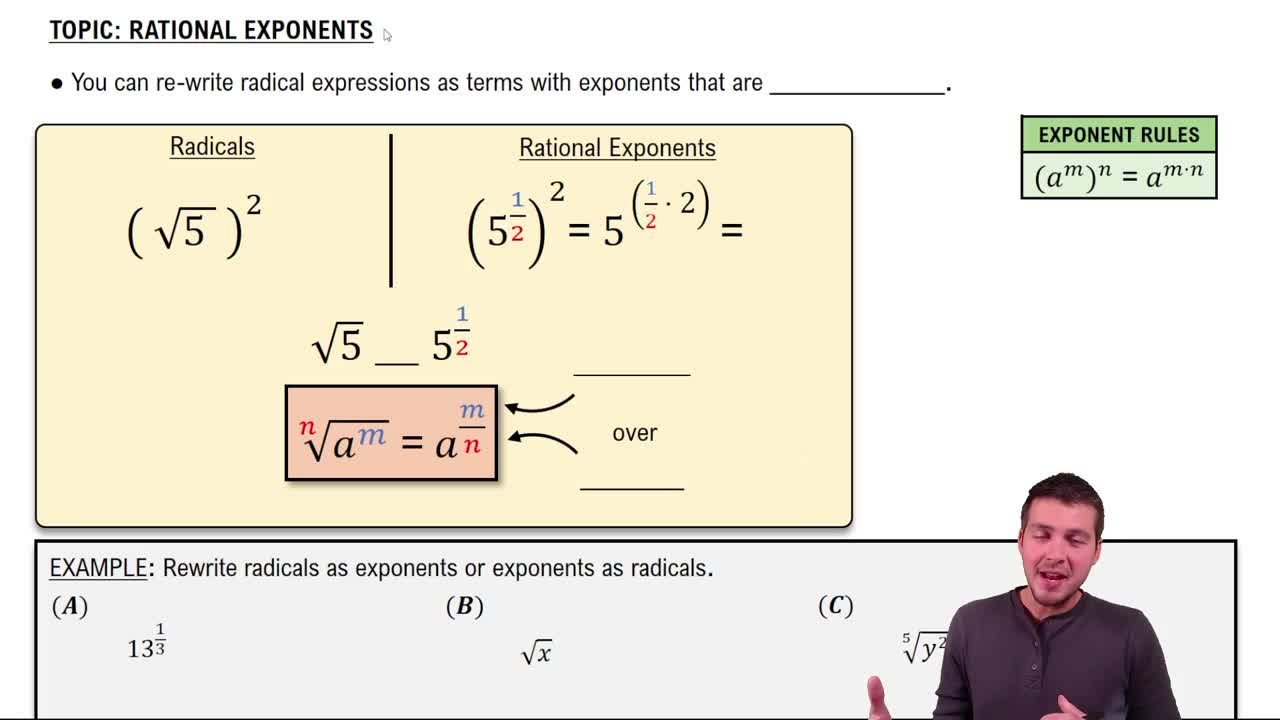
Rational Exponents

Synthetic Division

Synthetic division is a shortcut method for dividing a polynomial by a linear factor of the form (x - c). It simplifies the process of evaluating whether a candidate root is an actual zero by checking if the remainder is zero, and it produces the quotient polynomial for further factorization.
Video consigliato:
05:10
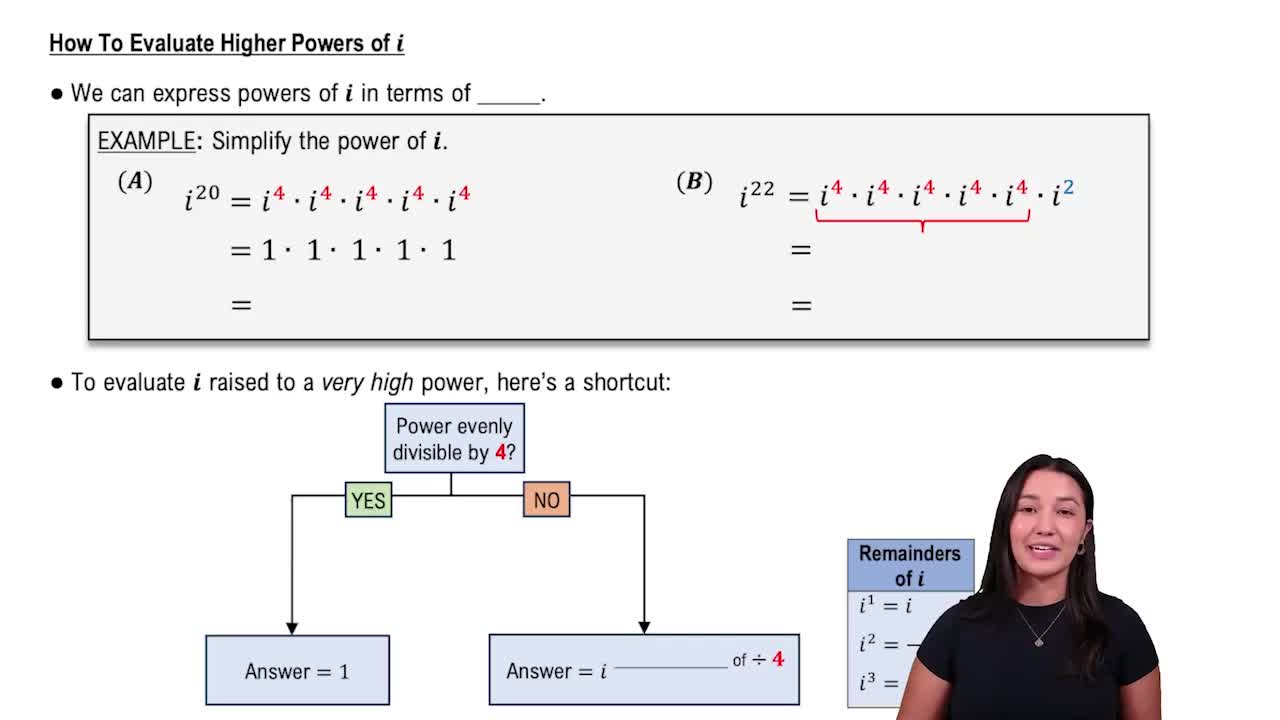
Higher Powers of i

Factoring and Finding Remaining Zeros

Once a zero is found using synthetic division, the quotient polynomial can be factored further or solved using other methods (like quadratic formula) to find the remaining zeros. This step breaks down the polynomial into simpler factors to identify all roots.
Video consigliato:
03:42
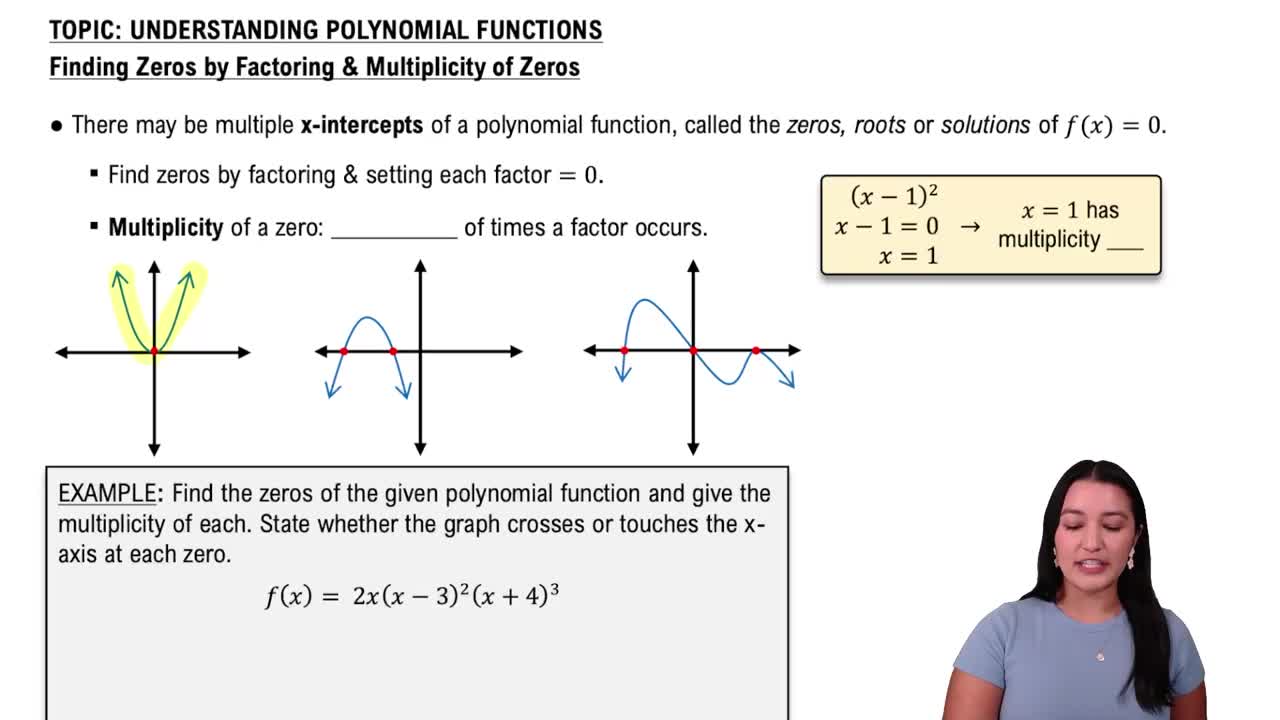
Finding Zeros & Their Multiplicity