Ch. 3 - Polynomial and Rational Functions
Blitzer - College Algebra 8th Edition
Blitzer8th EditionCollege AlgebraISBN: 9780136970514Non è quello che usi tu?Cambia libro di testo
Capitolo 4, Problema 30

Solve each polynomial inequality in Exercises 1–42 and graph the solution set on a real number line. Express each solution set in interval notation. (x+1)(x+2)(x+3)≥0

Guida verificata passo dopo passo
1
First, identify the critical points by setting each factor equal to zero: solve \(x+1=0\), \(x+2=0\), and \(x+3=0\). These points divide the real number line into intervals.
The critical points are \(x = -1\), \(x = -2\), and \(x = -3\). These points split the number line into four intervals: \(( -\infty, -3 )\), \(( -3, -2 )\), \(( -2, -1 )\), and \(( -1, \infty )\).
Choose a test point from each interval and substitute it into the inequality \((x+1)(x+2)(x+3) \geq 0\) to determine if the product is positive or negative in that interval.
Based on the sign of the product in each interval, determine which intervals satisfy the inequality \(\geq 0\). Remember to include the critical points where the product equals zero because the inequality is \(\geq 0\), not just \(>0\).
Express the solution set as a union of intervals where the inequality holds true, and then graph these intervals on the real number line, marking included endpoints with solid dots.

Risposta video verificata per un problema simile:

Questa soluzione video è stata consigliata dai nostri tutor come utile per risolvere questo problema.
Durata del video:
6m

Concetti chiave

Ecco i concetti essenziali che devi comprendere per rispondere correttamente alla domanda.

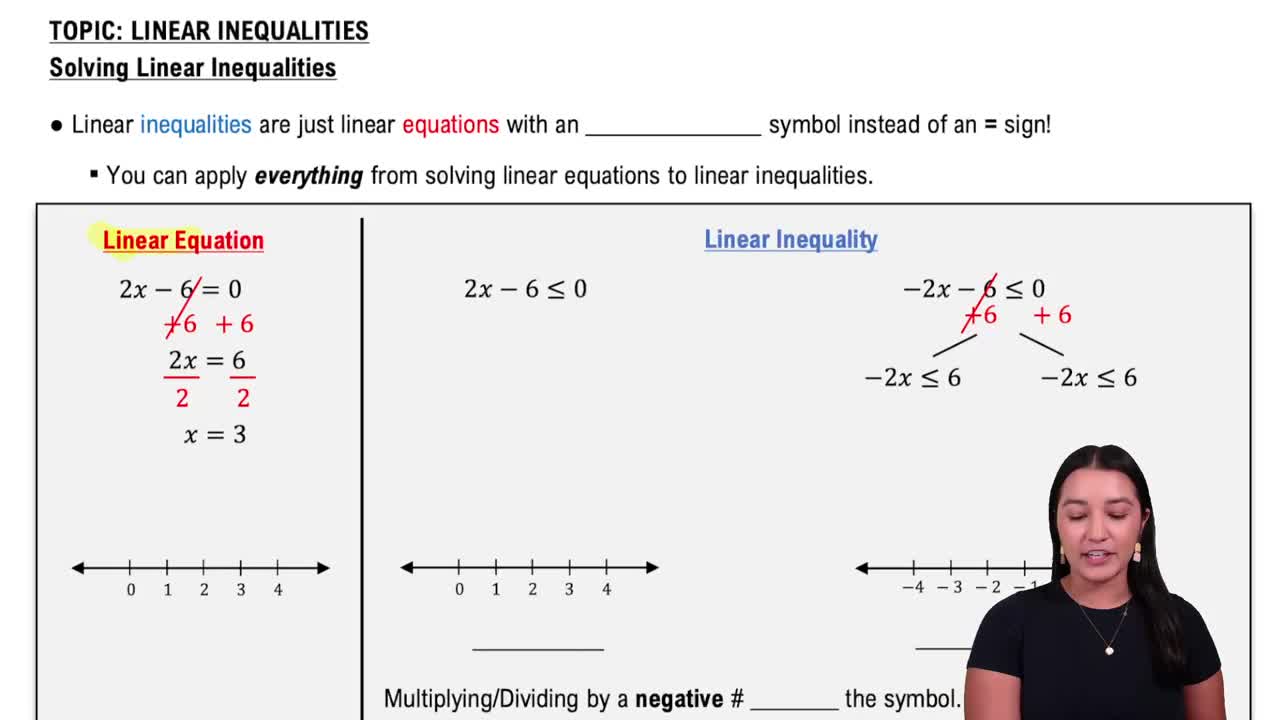
Polynomial Inequalities

Polynomial inequalities involve expressions where a polynomial is compared to zero or another value using inequality symbols (>, <, ≥, ≤). Solving them requires finding the values of the variable that make the inequality true, often by analyzing the sign of the polynomial over different intervals.
Video consigliato:
06:07
Linear Inequalities

Critical Points and Sign Analysis

Critical points are the values of the variable that make each factor of the polynomial zero. These points divide the number line into intervals. By testing values from each interval, you determine whether the polynomial is positive or negative there, which helps identify where the inequality holds.
Video consigliato:
05:46
Point-Slope Form

Interval Notation and Graphing Solutions

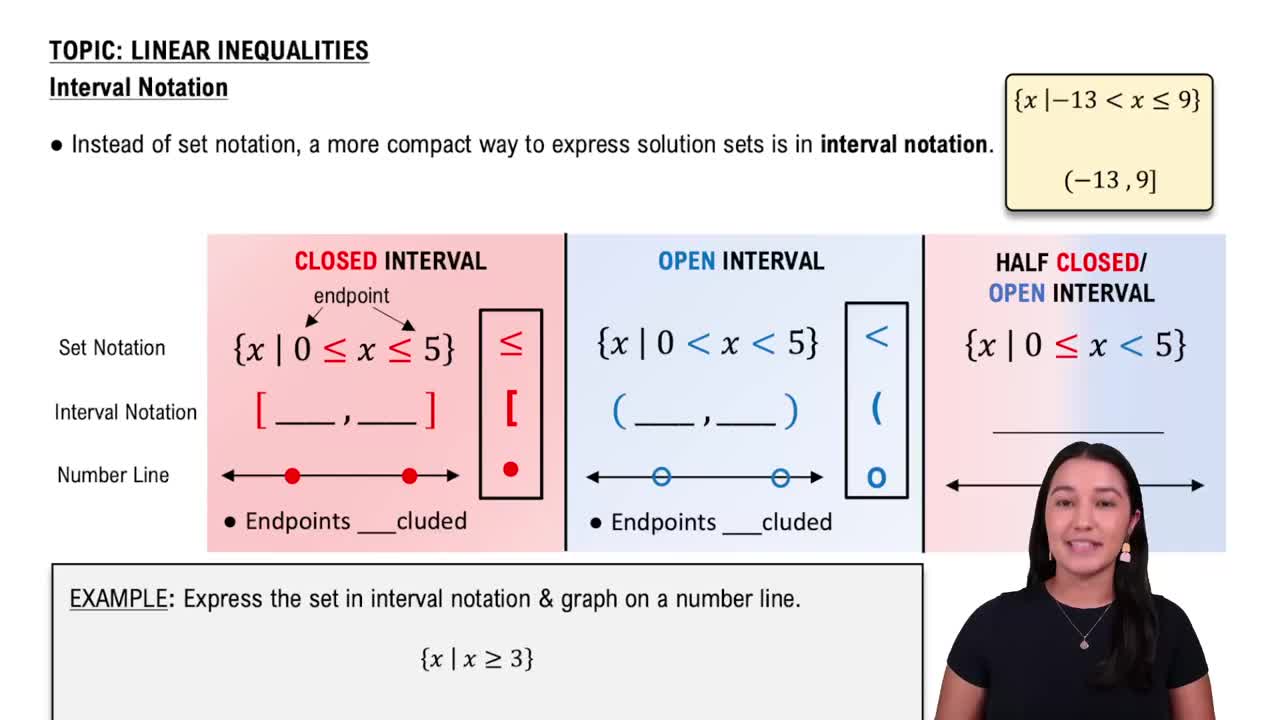
Interval notation expresses the solution set as intervals on the real number line, using parentheses for excluded endpoints and brackets for included ones. Graphing the solution on a number line visually represents these intervals, showing where the polynomial inequality is satisfied.
Video consigliato:
05:18
Interval Notation