Give the domain and the range of each quadratic function whose graph is described. The vertex is and the parabola opens up.
Ch. 3 - Polynomial and Rational Functions

Capitolo 4, Problema 45
Solve the equation 12x3+16x2−5x−3=0 given that -3/2 is a root.
Guida verificata passo dopo passo1
Since \(-\frac{3}{2}\) is a root of the polynomial \(12x^{3} + 16x^{2} - 5x - 3 = 0\), use polynomial division or synthetic division to divide the cubic polynomial by the factor \(\left(x + \frac{3}{2}\right)\).
To perform synthetic division, rewrite the root \(-\frac{3}{2}\) as \(-1.5\) and set up the coefficients of the polynomial: 12, 16, -5, and -3.
Carry out the synthetic division process step-by-step to find the quotient polynomial, which will be a quadratic expression.
Once you have the quadratic quotient, set it equal to zero and solve for \(x\) using the quadratic formula: \[x = \frac{-b \pm \sqrt{b^{2} - 4ac}}{2a}\], where \(a\), \(b\), and \(c\) are the coefficients of the quadratic.
Combine the root \(-\frac{3}{2}\) with the solutions from the quadratic to write the complete solution set for the original cubic equation.

Risposta video verificata per un problema simile:
Questa soluzione video è stata consigliata dai nostri tutor come utile per risolvere questo problema.
Durata del video:
5mConcetti chiave
Ecco i concetti essenziali che devi comprendere per rispondere correttamente alla domanda.
Polynomial Roots and Factor Theorem
The Factor Theorem states that if a polynomial f(x) has a root r, then (x - r) is a factor of f(x). Given that -3/2 is a root, (x + 3/2) must be a factor of the polynomial, which helps in factoring and simplifying the equation.
Video consigliato:
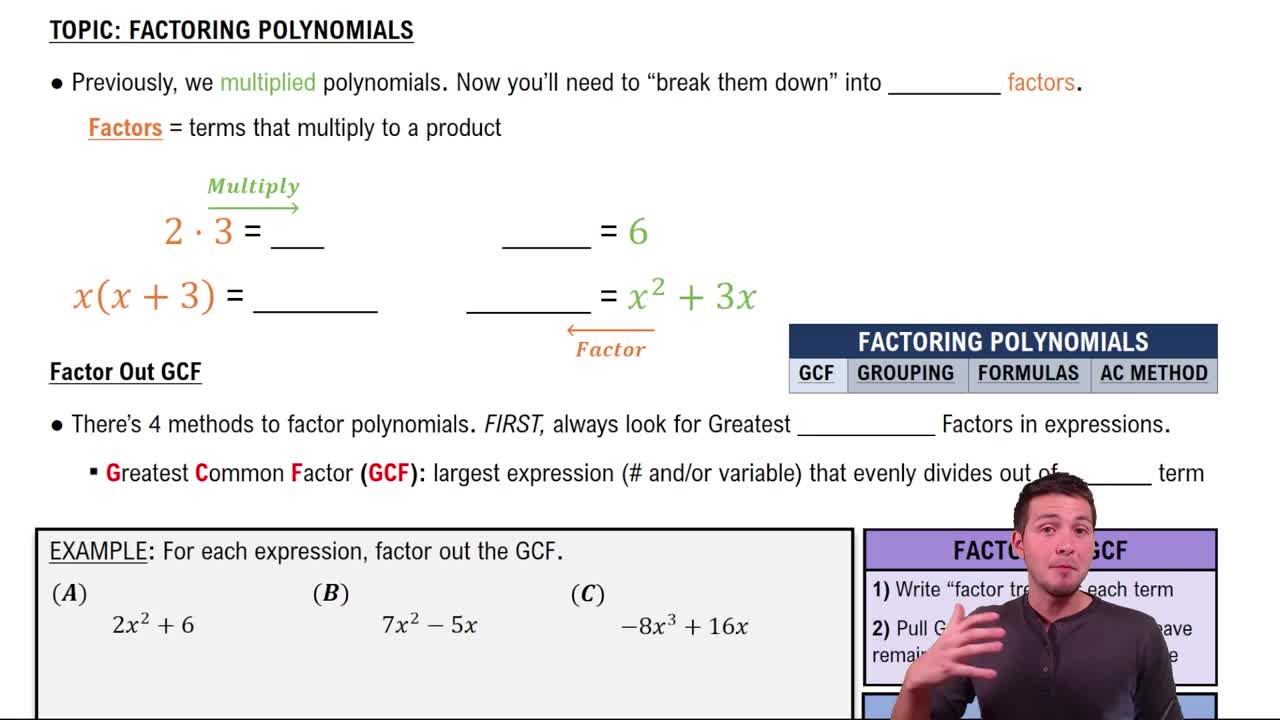
Introduction to Factoring Polynomials
Polynomial Division
Polynomial division, either long division or synthetic division, is used to divide the original polynomial by the factor corresponding to the known root. This process reduces the polynomial's degree, making it easier to solve the remaining equation.
Video consigliato:
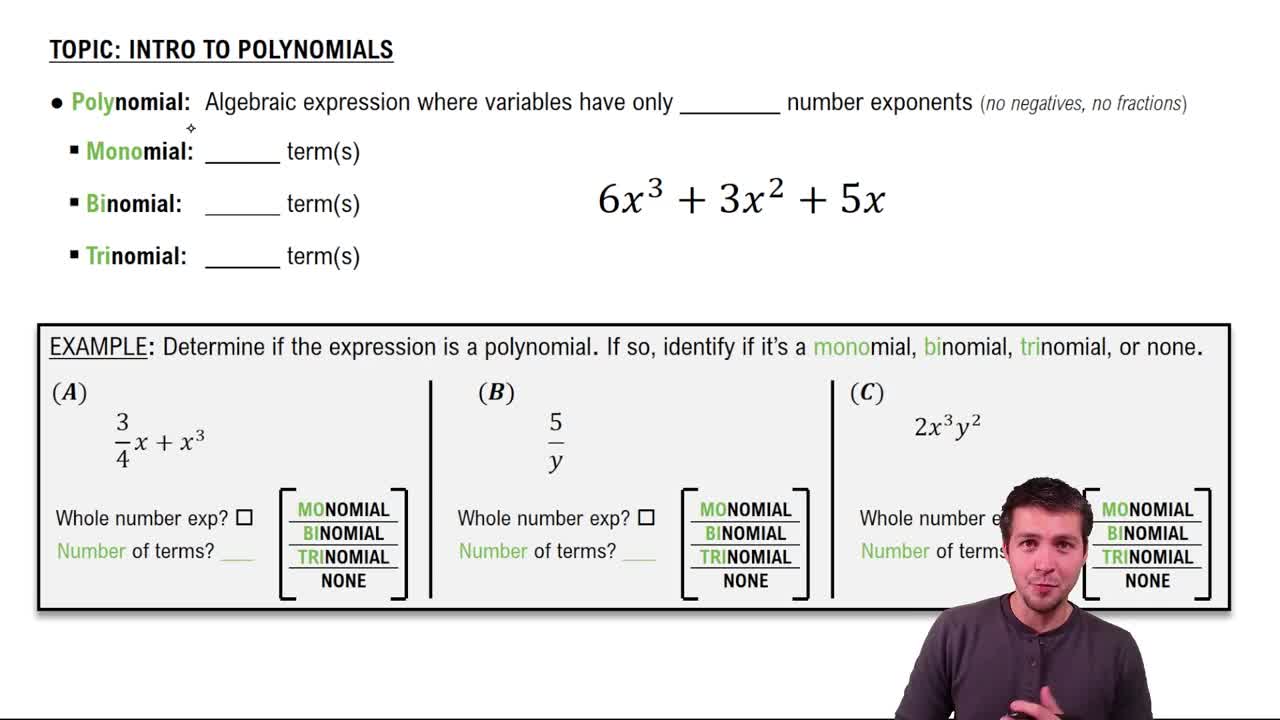
Introduction to Polynomials
Solving Quadratic Equations
After factoring out the known root, the remaining polynomial is quadratic. Solving this quadratic equation using methods like factoring, completing the square, or the quadratic formula yields the other roots of the original cubic equation.
Video consigliato:
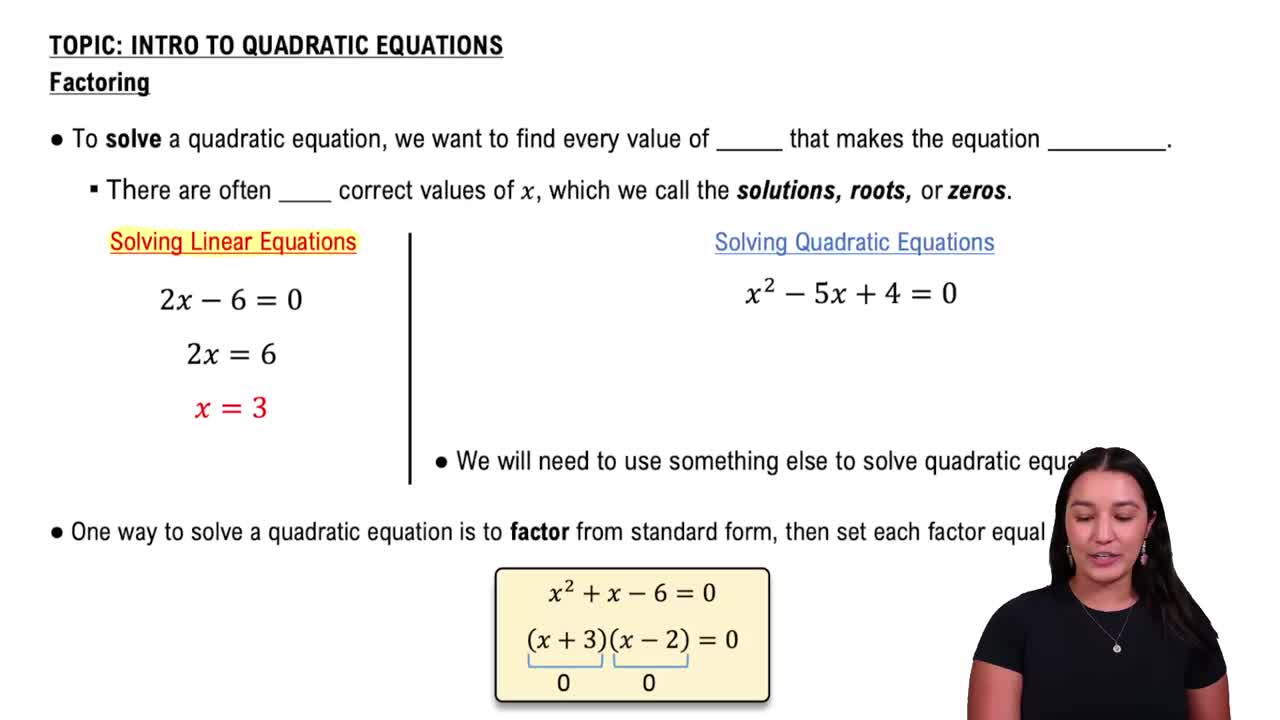
Solving Quadratic Equations by Factoring
Pratica correlata
Domanda del libro di testo
1137
views
Domanda del libro di testo
Solve each rational inequality in Exercises 43–60 and graph the solution set on a real number line. Express each solution set in interval notation. (x+3)/(x+4)<0
554
views
Domanda del libro di testo
In Exercises 39–52, find all zeros of the polynomial function or solve the given polynomial equation. Use the Rational Zero Theorem, Descartes's Rule of Signs, and possibly the graph of the polynomial function shown by a graphing utility as an aid in obtaining the first zero or the first root. x4−3x3−20x2−24x−8=0
440
views
Domanda del libro di testo
Find the horizontal asymptote, if there is one, of the graph of each rational function. f(x)=(−2x+1)/(3x+5)
676
views
Domanda del libro di testo
Solve the equation 2x3−3x2−11x+6=0 given that -2 is a zero of f(x)=2x3−3x2−11x+6.
1079
views
Domanda del libro di testo
Describe in words the variation shown by the given equation.
612
views