Ch. 4 - Exponential and Logarithmic Functions
Blitzer - College Algebra 8th Edition
Blitzer8th EditionCollege AlgebraISBN: 9780136970514Non è quello che usi tu?Cambia libro di testo
Capitolo 5, Problema 139

Exercises 137–139 will help you prepare for the material covered in the next section. Solve: (x + 2)/(4x + 3) = 1/x

Guida verificata passo dopo passo
1
Start with the given equation: x+24x+3 = 1x.
To eliminate the fractions, cross-multiply both sides: multiply the numerator of the left fraction by the denominator of the right fraction and set it equal to the numerator of the right fraction times the denominator of the left fraction. This gives: (x + 2) imes x = 1 imes (4x + 3).
Expand both sides: on the left, distribute x over (x + 2) to get x^2 + 2x; on the right, you have 4x + 3.
Set up the equation: x^2 + 2x = 4x + 3. Then, bring all terms to one side to set the equation equal to zero: x^2 + 2x - 4x - 3 = 0, which simplifies to x^2 - 2x - 3 = 0.
Solve the quadratic equation x^2 - 2x - 3 = 0 by factoring, completing the square, or using the quadratic formula to find the values of x.

Risposta video verificata per un problema simile:

Questa soluzione video è stata consigliata dai nostri tutor come utile per risolvere questo problema.
Durata del video:
2m

Concetti chiave

Ecco i concetti essenziali che devi comprendere per rispondere correttamente alla domanda.

Solving Rational Equations

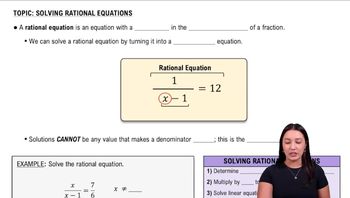
A rational equation involves fractions with polynomials in the numerator and denominator. To solve, find a common denominator or cross-multiply to eliminate fractions, then solve the resulting polynomial equation. Always check for values that make denominators zero, as these are excluded from the solution.
Video consigliato:
05:56
Introduction to Rational Equations

Cross-Multiplication

Cross-multiplication is a method used to solve equations where two fractions are set equal. Multiply the numerator of one fraction by the denominator of the other and set the products equal. This transforms the equation into a simpler polynomial form, making it easier to solve.
Video consigliato:
03:42
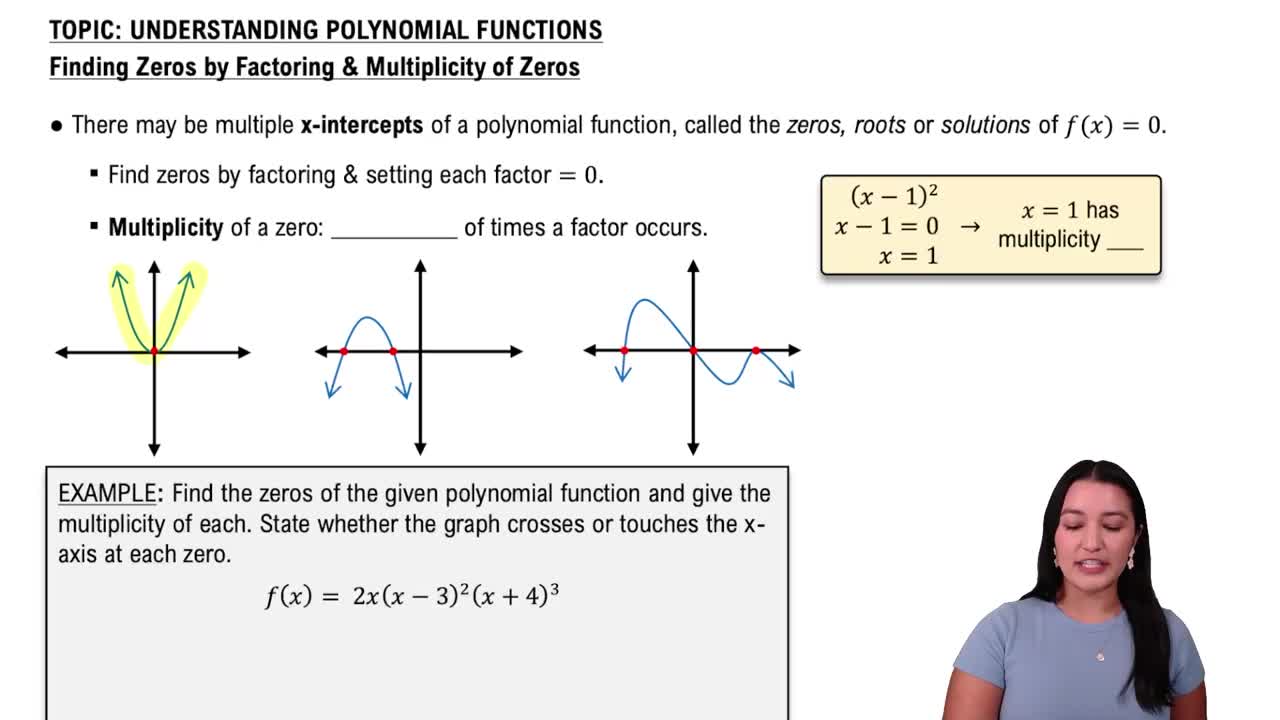
Finding Zeros & Their Multiplicity

Domain Restrictions in Rational Expressions

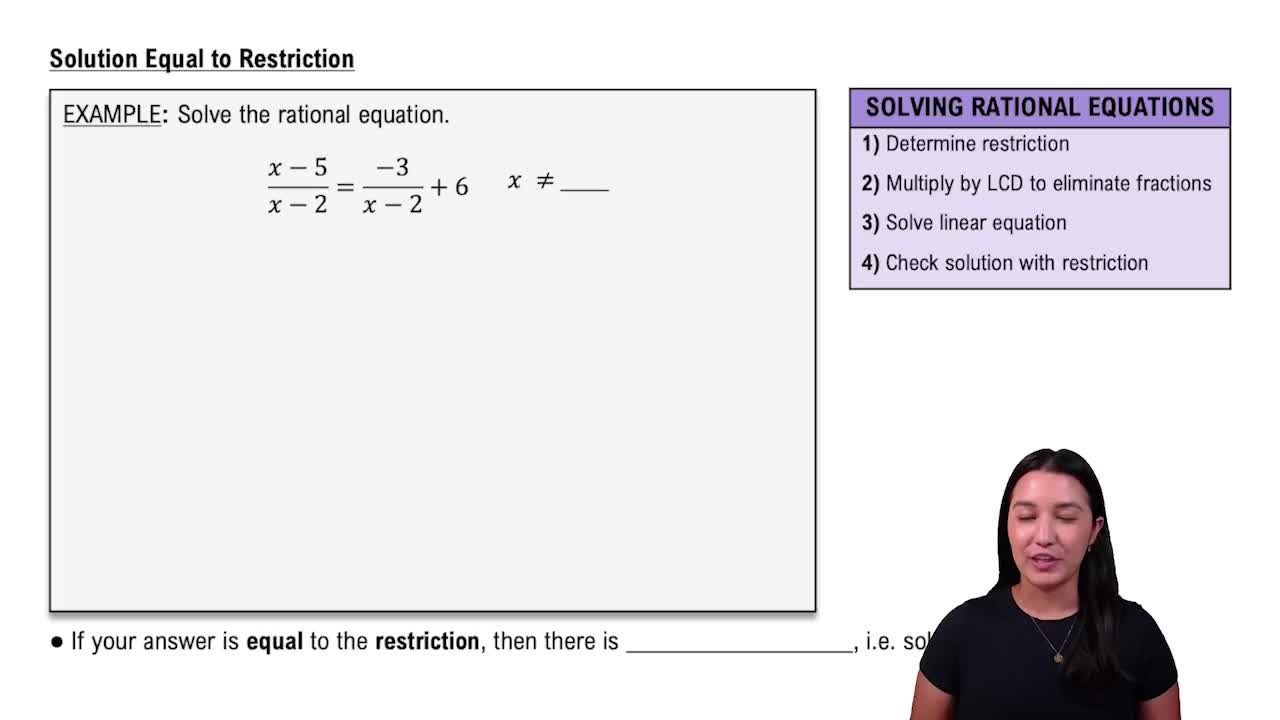
The domain of a rational expression excludes values that make any denominator zero, as division by zero is undefined. When solving rational equations, identify and exclude these values from the solution set to ensure valid answers.
Video consigliato:
05:21
Restrictions on Rational Equations