Ch. 4 - Exponential and Logarithmic Functions
Blitzer - College Algebra 8th Edition
Blitzer8th EditionCollege AlgebraISBN: 9780136970514Non è quello che usi tu?Cambia libro di testo
Capitolo 5, Problema 143

Without using a calculator, find the exact value of: [log3 81 - log𝝅 1]/[log2√2 8 - log 0.001]

Guida verificata passo dopo passo
1
Rewrite each logarithm in terms of simpler expressions or known values. For example, recognize that 81 can be written as a power of 3, and 8 can be written as a power of 2.
Use the logarithm power rule: logabcn = n logabc, to simplify the logarithms of powers.
Apply the logarithm subtraction rule: logabx - logaby = logabxy, to combine the logarithms in the numerator and denominator where possible.
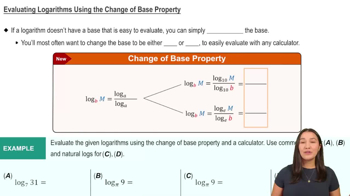
Convert all logarithms to a common base if necessary, using the change of base formula: logabc = logdclogdb, where d is a convenient base such as 10 or e.
After simplifying numerator and denominator separately, divide the two results to find the exact value of the original expression.

Risposta video verificata per un problema simile:

Questa soluzione video è stata consigliata dai nostri tutor come utile per risolvere questo problema.
Durata del video:
5m

Concetti chiave

Ecco i concetti essenziali che devi comprendere per rispondere correttamente alla domanda.

Properties of Logarithms

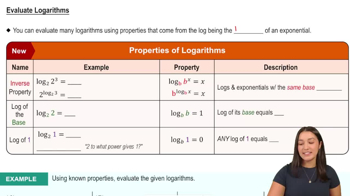
Logarithms have key properties such as the product, quotient, and power rules that simplify expressions. For example, log_b(x) - log_b(y) = log_b(x/y), and log_b(x^k) = k * log_b(x). These properties allow rewriting and simplifying complex logarithmic expressions without a calculator.
Video consigliato:
5:36
Change of Base Property

Change of Base Formula

The change of base formula, log_a(b) = log_c(b) / log_c(a), allows converting logarithms with any base to a common base, often base 10 or e. This is useful for comparing or simplifying logarithms with different bases, especially when exact values are needed without a calculator.
Video consigliato:
5:36
Change of Base Property

Evaluating Logarithms of Powers and Roots

Understanding how to evaluate logarithms of numbers expressed as powers or roots is essential. For example, 81 = 3^4, √2 = 2^(1/2), and 8 = 2^3. Recognizing these forms helps rewrite logarithms in terms of their bases and exponents, enabling exact calculation of their values.
Video consigliato:
5:14
Evaluate Logarithms