Ch. 4 - Exponential and Logarithmic Functions
Blitzer - College Algebra 8th Edition
Blitzer8th EditionCollege AlgebraISBN: 9780136970514Non è quello che usi tu?Cambia libro di testo
Capitolo 5, Problema 19

Use properties of logarithms to expand each logarithmic expression as much as possible. Where possible, evaluate logarithmic expressions without using a calculator. lnx5\(\ln\)\(\sqrt\)[5]{x}

Guida verificata passo dopo passo
1
Recognize that the expression \( \ln 5\sqrt{x} \) can be rewritten using exponent notation. The fifth root of \( x \) is \( x^{\frac{1}{5}} \), so rewrite the expression as \( \ln \left( 5 x^{\frac{1}{5}} \right) \).
Use the logarithm property that \( \ln(ab) = \ln a + \ln b \) to separate the logarithm of the product into a sum: \( \ln 5 + \ln x^{\frac{1}{5}} \).
Apply the power rule of logarithms, which states \( \ln a^{b} = b \ln a \), to the second term: \( \ln x^{\frac{1}{5}} = \frac{1}{5} \ln x \).
Combine the results to express the expanded form as \( \ln 5 + \frac{1}{5} \ln x \).
Since \( \ln 5 \) is a constant, it can be left as is or approximated if needed, but the problem states to expand as much as possible without a calculator, so this is the fully expanded form.

Risposta video verificata per un problema simile:

Questa soluzione video è stata consigliata dai nostri tutor come utile per risolvere questo problema.
Durata del video:
1m

Concetti chiave

Ecco i concetti essenziali che devi comprendere per rispondere correttamente alla domanda.

Properties of Logarithms

Properties of logarithms include rules such as the product, quotient, and power rules. These allow us to expand or condense logarithmic expressions by turning multiplication into addition, division into subtraction, and exponents into coefficients. Understanding these properties is essential for simplifying and expanding logarithmic expressions.
Video consigliato:
5:36
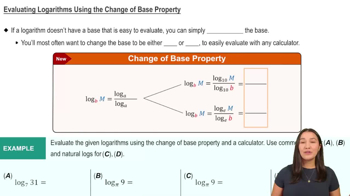
Change of Base Property

Radicals and Exponents

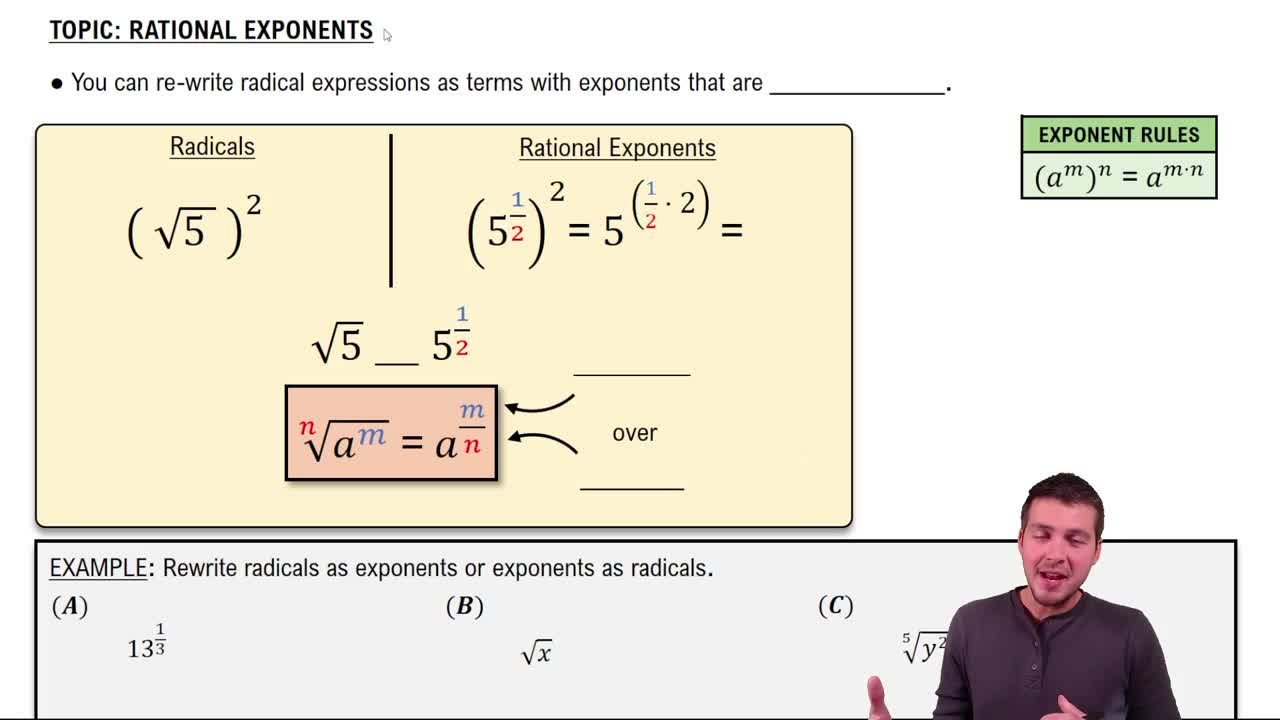
Radicals like the fifth root can be expressed as fractional exponents (e.g., the fifth root of x is x^(1/5)). Converting radicals to exponents helps apply logarithm power rules effectively, making it easier to expand or simplify logarithmic expressions involving roots.
Video consigliato:
04:06
Rational Exponents

Natural Logarithm (ln)

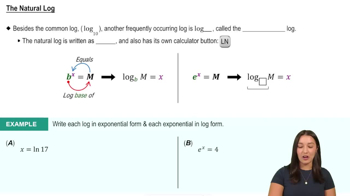
The natural logarithm, denoted ln, is the logarithm with base e, where e is approximately 2.718. It has the same properties as other logarithms but is commonly used in calculus and algebra. Recognizing ln and its properties helps in correctly expanding and evaluating expressions without a calculator.
Video consigliato:
2:51
The Natural Log