Ch. 4 - Exponential and Logarithmic Functions
Blitzer - College Algebra 8th Edition
Blitzer8th EditionCollege AlgebraISBN: 9780136970514Non è quello che usi tu?Cambia libro di testo
Capitolo 5, Problema 21

Solve each exponential equation in Exercises 1–22 by expressing each side as a power of the same base and then equating exponents. e(x+1)=1/e

Guida verificata passo dopo passo
1
Rewrite the right side of the equation \(e^{(x+1)} = \frac{1}{e}\) as a power of \(e\). Since \(\frac{1}{e} = e^{-1}\), the equation becomes \(e^{(x+1)} = e^{-1}\).
Now that both sides have the same base \(e\), set the exponents equal to each other: \(x + 1 = -1\).
Solve the resulting linear equation for \(x\) by isolating \(x\): subtract 1 from both sides to get \(x = -1 - 1\).
Simplify the right side to find the value of \(x\).
Verify your solution by substituting \(x\) back into the original equation to ensure both sides are equal.

Risposta video verificata per un problema simile:

Questa soluzione video è stata consigliata dai nostri tutor come utile per risolvere questo problema.
Durata del video:
1m

Concetti chiave

Ecco i concetti essenziali che devi comprendere per rispondere correttamente alla domanda.

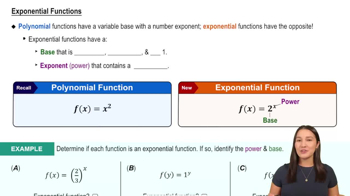
Exponential Functions and Their Properties

An exponential function has the form a^x, where the base a is a positive constant. Understanding how to manipulate and interpret these functions is essential for solving equations involving exponents, especially when the variable is in the exponent.
Video consigliato:
6:13
Exponential Functions

Expressing Both Sides with the Same Base

To solve exponential equations, rewrite each side as powers of the same base. This allows you to set the exponents equal to each other, simplifying the equation to a linear or simpler form that can be solved algebraically.
Video consigliato:
03:42
Linear Inequalities with Fractions & Variables on Both Sides

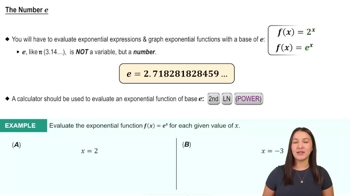
Properties of the Number e and Negative Exponents

The number e is a special irrational constant approximately equal to 2.718. Understanding that 1/e can be written as e^(-1) helps rewrite the equation with the same base, enabling the use of exponent rules to solve for the variable.
Video consigliato:
4:47
The Number e