
Domanda del libro di testo
Evaluate each expression without using a calculator. log2 64
1018
views
1
rank

 Guida verificata passo dopo passo
 2:51
2:51
 4:47
4:47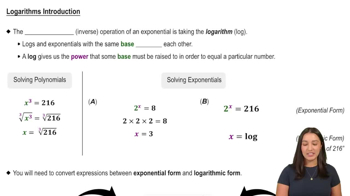 7:30
7:30Evaluate each expression without using a calculator. log2 64
Evaluate each expression without using a calculator. log3 27
Evaluate each expression without using a calculator. log5 (1/5)
Use properties of logarithms to expand each logarithmic expression as much as possible. Where possible, evaluate logarithmic expressions without using a calculator. log6 (36/(√(x+1))
Begin by graphing f(x) = 2x. Then use transformations of this graph to graph the given function. Be sure to graph and give equations of the asymptotes. Use the graphs to determine each function's domain and range. If applicable, use a graphing utility to confirm your hand-drawn graphs. g(x) = 2x+1
Solve each exponential equation in Exercises 23–48. Express the solution set in terms of natural logarithms or common logarithms. Then use a calculator to obtain a decimal approximation, correct to two decimal places, for the solution. ex=5.7