Ch. 4 - Exponential and Logarithmic Functions
Blitzer - College Algebra 8th Edition
Blitzer8th EditionCollege AlgebraISBN: 9780136970514Non è quello che usi tu?Cambia libro di testo
Capitolo 5, Problema 41

Evaluate each expression without using a calculator. 8log8198^{\(\log\)_8 19}

Guida verificata passo dopo passo
1
Recognize that the expression is of the form \(a^{\log_a b}\), where the base of the exponent and the base of the logarithm are the same (in this case, 8).
Recall the logarithmic identity: \(a^{\log_a b} = b\). This identity holds because the logarithm \(\log_a b\) is the exponent to which you raise \(a\) to get \(b\).
Apply this identity directly to the expression \(8^{\log_8 19}\), which simplifies to just 19.
Understand that this simplification works without any calculation because the logarithm and the exponent base cancel each other out.
Therefore, the value of the expression \(8^{\log_8 19}\) is simply 19.

Risposta video verificata per un problema simile:

Questa soluzione video è stata consigliata dai nostri tutor come utile per risolvere questo problema.
Durata del video:
1m

Concetti chiave

Ecco i concetti essenziali che devi comprendere per rispondere correttamente alla domanda.

Logarithmic and Exponential Functions

Logarithms and exponents are inverse operations. The logarithm log_b(a) answers the question: to what power must the base b be raised to get a? Understanding this inverse relationship is key to simplifying expressions like b^(log_b(x)).
Video consigliato:
5:26
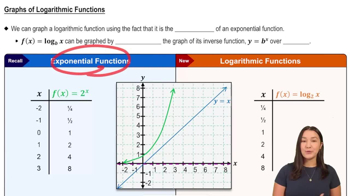
Graphs of Logarithmic Functions

Properties of Logarithms and Exponents

One important property is that b^(log_b(x)) = x, where b is the base of both the exponent and the logarithm. This property allows simplification of expressions where the base of the exponent matches the base of the logarithm.
Video consigliato:
5:36
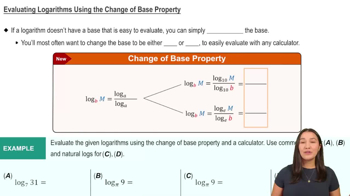
Change of Base Property

Evaluating Expressions Without a Calculator

When evaluating expressions like 8^(log_8 19) without a calculator, use algebraic properties to simplify rather than compute directly. Recognizing patterns and applying properties reduces complex expressions to simpler forms.
Video consigliato:
03:11
Evaluating Algebraic Expressions
Pratica correlata
Domanda del libro di testo

In Exercises 39–40, graph f and g in the same rectangular coordinate system. Use transformations of the graph of f to obtain the graph of g. Graph and give equations of all asymptotes. Use the graphs to determine each function's domain and range. f(x) = log x and g(x) = - log (x+3)

1131
views
Domanda del libro di testo

Use properties of logarithms to condense each logarithmic expression. Write the expression as a single logarithm whose coefficient is 1. Where possible, evaluate logarithmic expressions without using a calculator. log 5 + log 2

1032
views
Domanda del libro di testo

The figure shows the graph of f(x) = ex. In Exercises 35-46, use transformations of this graph to graph each function. Be sure to give equations of the asymptotes. Use the graphs to determine graphs. each function's domain and range. If applicable, use a graphing utility to confirm your hand-drawn g(x) = 2ex

811
views
Domanda del libro di testo

In Exercises 39–40, graph f and g in the same rectangular coordinate system. Use transformations of the graph of f to obtain the graph of g. Graph and give equations of all asymptotes. Use the graphs to determine each function's domain and range. f(x) = ln x and g(x) = - ln (2x)

1144
views
Domanda del libro di testo

The figure shows the graph of f(x) = ex. In Exercises 35-46, use transformations of this graph to graph each function. Be sure to give equations of the asymptotes. Use the graphs to determine graphs. each function's domain and range. If applicable, use a graphing utility to confirm your hand-drawn h(x) = e-x

1039
views
Domanda del libro di testo

Solve each exponential equation in Exercises 23–48. Express the solution set in terms of natural logarithms or common logarithms. Then use a calculator to obtain a decimal approximation, correct to two decimal places, for the solution. 5(2x+3)=3(x−1)

898
views