Ch. 4 - Exponential and Logarithmic Functions
Blitzer - College Algebra 8th Edition
Blitzer8th EditionCollege AlgebraISBN: 9780136970514Non è quello che usi tu?Cambia libro di testo
Capitolo 5, Problema 41

Solve each exponential equation in Exercises 23–48. Express the solution set in terms of natural logarithms or common logarithms. Then use a calculator to obtain a decimal approximation, correct to two decimal places, for the solution. 5(2x+3)=3(x−1)

Guida verificata passo dopo passo
1
Start with the given exponential equation: \(5^{(2x+3)} = 3^{(x-1)}\).
Take the natural logarithm (ln) of both sides to bring down the exponents: \(\ln\left(5^{(2x+3)}\right) = \ln\left(3^{(x-1)}\right)\).
Use the logarithm power rule to move the exponents in front: \((2x+3) \ln(5) = (x-1) \ln(3)\).
Distribute the logarithms: \(2x \ln(5) + 3 \ln(5) = x \ln(3) - \ln(3)\).
Collect all terms involving \(x\) on one side and constants on the other: \(2x \ln(5) - x \ln(3) = - \ln(3) - 3 \ln(5)\), then factor out \(x\) and solve for \(x\).

Risposta video verificata per un problema simile:

Questa soluzione video è stata consigliata dai nostri tutor come utile per risolvere questo problema.
Durata del video:
4m

Concetti chiave

Ecco i concetti essenziali che devi comprendere per rispondere correttamente alla domanda.

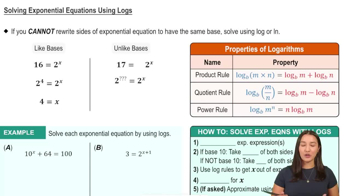
Exponential Equations

Exponential equations involve variables in the exponent, such as 5^(2x+3) = 3^(x−1). Solving these requires rewriting or applying logarithms to isolate the variable. Understanding how to manipulate and equate exponential expressions is essential for finding solutions.
Video consigliato:
5:47
Solving Exponential Equations Using Logs

Logarithms and Their Properties

Logarithms are the inverse operations of exponentials and help solve equations where the variable is an exponent. Using properties like log(a^b) = b·log(a) allows us to bring exponents down and solve for the variable. Both natural (ln) and common (log) logarithms can be used depending on convenience.
Video consigliato:
5:36
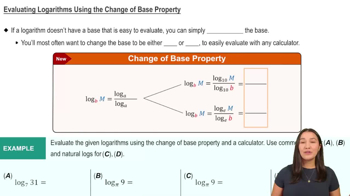
Change of Base Property

Using Calculators for Approximation

After expressing the solution in logarithmic form, calculators are used to find decimal approximations. This step involves evaluating logarithmic expressions and rounding the result to a specified precision, such as two decimal places, to provide a practical numerical answer.
Video consigliato:
5:47
Solving Exponential Equations Using Logs