Ch. 4 - Exponential and Logarithmic Functions
Blitzer - College Algebra 8th Edition
Blitzer8th EditionCollege AlgebraISBN: 9780136970514Non è quello che usi tu?Cambia libro di testo
Capitolo 5, Problema 39

Evaluate each expression without using a calculator. log5 57

Guida verificata passo dopo passo
1
Recognize that the expression is \( \log_5 5^7 \), which is a logarithm with base 5 of \( 5^7 \).
Recall the logarithmic identity: \( \log_b b^x = x \), which means the logarithm of a base raised to a power is just the exponent.
Apply this identity directly to the expression: \( \log_5 5^7 = 7 \).
Therefore, the value of \( \log_5 5^7 \) simplifies to the exponent 7 without further calculation.
This shows how logarithms and exponents are inverse operations, making such expressions straightforward to evaluate.

Risposta video verificata per un problema simile:

Questa soluzione video è stata consigliata dai nostri tutor come utile per risolvere questo problema.
Durata del video:
1m

Concetti chiave

Ecco i concetti essenziali che devi comprendere per rispondere correttamente alla domanda.

Logarithm Definition

A logarithm answers the question: to what exponent must the base be raised to produce a given number? For example, log_b(a) = c means b^c = a. Understanding this definition is essential for evaluating logarithmic expressions.
Video consigliato:
7:30
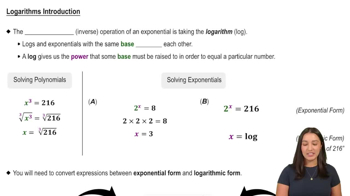
Logarithms Introduction

Logarithm of a Power

The logarithm of a number raised to an exponent can be simplified using the rule log_b(a^c) = c * log_b(a). This property allows you to bring the exponent in front as a multiplier, simplifying the evaluation process.
Video consigliato:
04:10
Powers of i

Logarithm of the Base

When the argument of a logarithm is the same as its base, log_b(b) equals 1 because b^1 = b. This fact helps simplify expressions like log5(5^7) by reducing the inner logarithm to a simple exponent.
Video consigliato:
7:30
Logarithms Introduction
Pratica correlata
Domanda del libro di testo

In Exercises 39–40, graph f and g in the same rectangular coordinate system. Use transformations of the graph of f to obtain the graph of g. Graph and give equations of all asymptotes. Use the graphs to determine each function's domain and range. f(x) = log x and g(x) = - log (x+3)

1131
views
Domanda del libro di testo

The figure shows the graph of f(x) = ex. In Exercises 35-46, use transformations of this graph to graph each function. Be sure to give equations of the asymptotes. Use the graphs to determine graphs. each function's domain and range. If applicable, use a graphing utility to confirm your hand-drawn h(x) = ex-1+2

781
views
Domanda del libro di testo

Use properties of logarithms to expand each logarithmic expression as much as possible. Where possible, evaluate logarithmic expressions without using a calculator. log(10x21−x37(x+1)2)\(\log\) \(\left\)( \(\frac{10x^2 \sqrt[3]{1 - x}\)}{7(x + 1)^2} \(\right\))

917
views
Domanda del libro di testo

In Exercises 39–40, graph f and g in the same rectangular coordinate system. Use transformations of the graph of f to obtain the graph of g. Graph and give equations of all asymptotes. Use the graphs to determine each function's domain and range. f(x) = ln x and g(x) = - ln (2x)

1144
views
Domanda del libro di testo

Solve each exponential equation in Exercises 23–48. Express the solution set in terms of natural logarithms or common logarithms. Then use a calculator to obtain a decimal approximation, correct to two decimal places, for the solution. 70.3x=813

778
views
Domanda del libro di testo

Solve each exponential equation in Exercises 23–48. Express the solution set in terms of natural logarithms or common logarithms. Then use a calculator to obtain a decimal approximation, correct to two decimal places, for the solution. 5(2x+3)=3(x−1)

898
views