Ch. 4 - Exponential and Logarithmic Functions
Blitzer - College Algebra 8th Edition
Blitzer8th EditionCollege AlgebraISBN: 9780136970514Non è quello che usi tu?Cambia libro di testo
Capitolo 5, Problema 81

Use a graphing utility and the change-of-base property to graph each function. y = log2 (x + 2)

Guida verificata passo dopo passo
1
Recognize that the function given is \( y = \log_2 (x + 2) \), which is a logarithmic function with base 2 and a horizontal shift left by 2 units due to the \( (x + 2) \) inside the log.
Recall the change-of-base formula for logarithms: \( \log_a b = \frac{\log_c b}{\log_c a} \), where \( c \) is any positive number (commonly 10 or \( e \) for calculators).
Apply the change-of-base formula to rewrite \( y = \log_2 (x + 2) \) as \( y = \frac{\log (x + 2)}{\log 2} \) if using common logarithm (base 10), or \( y = \frac{\ln (x + 2)}{\ln 2} \) if using natural logarithm (base \( e \)).
Use a graphing utility to plot the function \( y = \frac{\log (x + 2)}{\log 2} \) or \( y = \frac{\ln (x + 2)}{\ln 2} \), making sure to restrict the domain to \( x > -2 \) because the argument of the logarithm must be positive.
Analyze the graph to observe key features such as the vertical asymptote at \( x = -2 \), the shape of the curve, and how the function behaves as \( x \) increases.

Risposta video verificata per un problema simile:

Questa soluzione video è stata consigliata dai nostri tutor come utile per risolvere questo problema.
Durata del video:
2m

Concetti chiave

Ecco i concetti essenziali che devi comprendere per rispondere correttamente alla domanda.

Logarithmic Functions

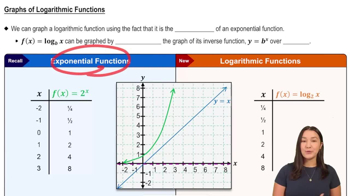
A logarithmic function is the inverse of an exponential function and is written as y = log_b(x), where b is the base. It answers the question: to what power must the base b be raised to produce x? Understanding the domain, range, and behavior of logarithmic functions is essential for graphing them.
Video consigliato:
5:26
Graphs of Logarithmic Functions

Change-of-Base Property

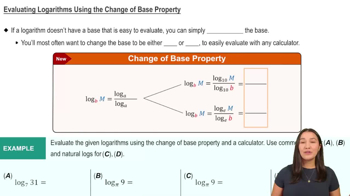
The change-of-base property allows you to rewrite logarithms with any base into a ratio of logarithms with a new base, typically base 10 or e. It is expressed as log_b(x) = log_c(x) / log_c(b). This property is useful when graphing logarithms on calculators or software that only support common or natural logs.
Video consigliato:
5:36
Change of Base Property

Graphing Transformations of Logarithmic Functions

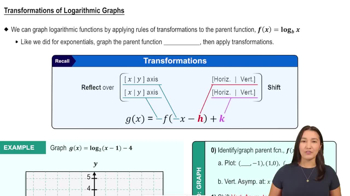
Graphing y = log_2(x + 2) involves shifting the basic log function y = log_2(x) horizontally. The '+2' inside the argument shifts the graph left by 2 units. Recognizing how changes inside the function affect the graph helps in accurately plotting and interpreting logarithmic functions.
Video consigliato:
4:37
Transformations of Logarithmic Graphs