Ch. 4 - Exponential and Logarithmic Functions
Blitzer - College Algebra 8th Edition
Blitzer8th EditionCollege AlgebraISBN: 9780136970514Non è quello che usi tu?Cambia libro di testo
Capitolo 5, Problema 81

Solve each logarithmic equation in Exercises 49–92. Be sure to reject any value of x that is not in the domain of the original logarithmic expressions. Give the exact answer. Then, where necessary, use a calculator to obtain a decimal approximation, correct to two decimal places, for the solution. 2 log x=log 25

Guida verificata passo dopo passo
1
Start with the given equation: \(2 \log x = \log 25\).
Use the logarithmic property that allows you to move the coefficient in front of the log as an exponent inside the log: \(2 \log x = \log x^{2}\), so rewrite the equation as \(\log x^{2} = \log 25\).
Since the logarithms on both sides have the same base (assumed to be 10), set the arguments equal to each other: \(x^{2} = 25\).
Solve the equation \(x^{2} = 25\) by taking the square root of both sides, remembering to consider both positive and negative roots: \(x = \pm 5\).
Check the domain of the original logarithmic expression: since \(\log x\) is defined only for \(x > 0\), reject \(x = -5\) and keep \(x = 5\) as the valid solution.

Risposta video verificata per un problema simile:

Questa soluzione video è stata consigliata dai nostri tutor come utile per risolvere questo problema.
Durata del video:
2m

Concetti chiave

Ecco i concetti essenziali che devi comprendere per rispondere correttamente alla domanda.

Properties of Logarithms

Understanding the properties of logarithms, such as the product, quotient, and power rules, is essential. In this problem, the power rule allows rewriting 2 log x as log(x^2), enabling simplification and comparison of logarithmic expressions.
Video consigliato:
5:36
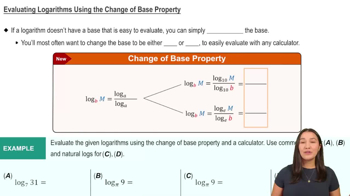
Change of Base Property

Domain of Logarithmic Functions

Logarithmic functions are only defined for positive arguments. When solving equations like 2 log x = log 25, it is crucial to ensure that the solution for x keeps the argument of all logarithms positive, rejecting any values that do not satisfy this domain restriction.
Video consigliato:
5:26
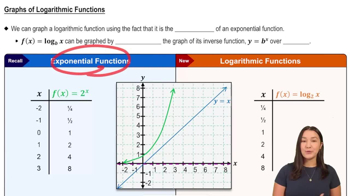
Graphs of Logarithmic Functions

Solving Logarithmic Equations

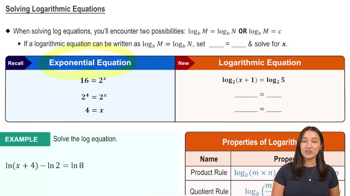
Solving logarithmic equations often involves rewriting the equation using logarithm properties, then converting to exponential form to isolate the variable. After finding exact solutions, decimal approximations can be calculated when necessary.
Video consigliato:
5:02
Solving Logarithmic Equations