Ch. 4 - Exponential and Logarithmic Functions
Blitzer - College Algebra 8th Edition
Blitzer8th EditionCollege AlgebraISBN: 9780136970514Non è quello che usi tu?Cambia libro di testo
Capitolo 5, Problema 91

Evaluate or simplify each expression without using a calculator. In (1/e6)

Guida verificata passo dopo passo
1
Recognize that the expression is \( \frac{1}{e^{6}} \), which is a fraction with the base \( e \) raised to the power of 6 in the denominator.
Recall the property of exponents that \( \frac{1}{a^{n}} = a^{-n} \), where \( a \) is a nonzero number and \( n \) is an integer.
Apply this property to rewrite \( \frac{1}{e^{6}} \) as \( e^{-6} \).
Understand that \( e^{-6} \) is the simplified form of the original expression, representing the exponential function with a negative exponent.
No further simplification is needed unless the problem asks for a decimal approximation, which is not allowed here.

Risposta video verificata per un problema simile:

Questa soluzione video è stata consigliata dai nostri tutor come utile per risolvere questo problema.
Durata del video:
1m

Concetti chiave

Ecco i concetti essenziali che devi comprendere per rispondere correttamente alla domanda.

Properties of Exponents

Understanding how to manipulate expressions with exponents is essential. This includes rules like a^m / a^n = a^(m-n) and (a^m)^n = a^(mn), which help simplify expressions involving powers, especially when dealing with fractions and negative exponents.
Video consigliato:
04:06
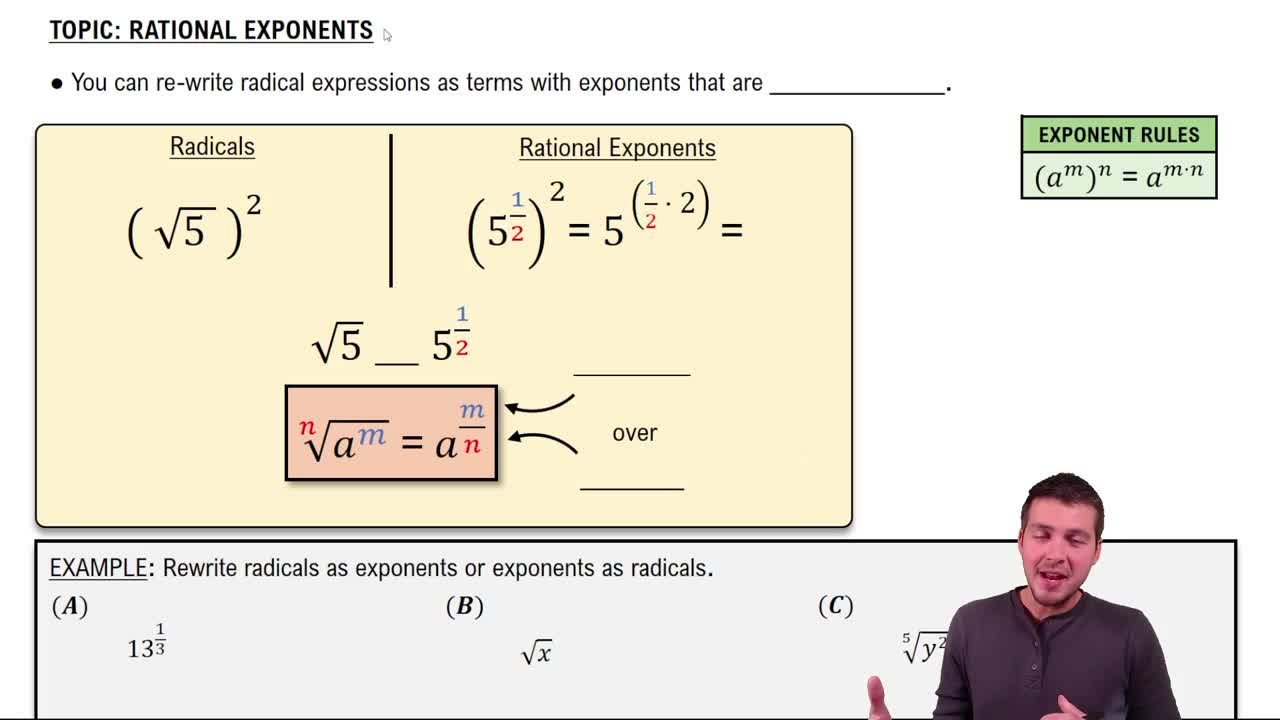
Rational Exponents

Negative Exponents

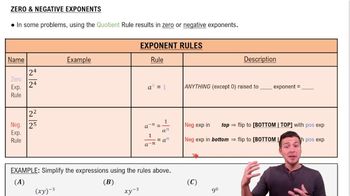
A negative exponent indicates the reciprocal of the base raised to the corresponding positive exponent. For example, a^(-n) = 1 / a^n. Recognizing and applying this rule allows simplification of expressions like 1 / e^6 into e^(-6).
Video consigliato:
6:37
Zero and Negative Rules

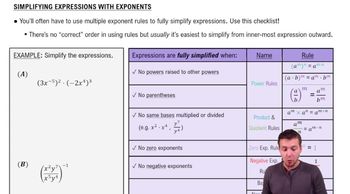
Simplifying Exponential Expressions Without a Calculator

Simplifying expressions without a calculator involves applying exponent rules and algebraic manipulation rather than numerical approximation. This skill is crucial for exact answers and understanding the structure of exponential expressions.
Video consigliato:
6:39
Simplifying Exponential Expressions
Pratica correlata
Domanda del libro di testo

Evaluate or simplify each expression without using a calculator. In e6

794
views
Domanda del libro di testo

n Exercises 92–93, rewrite the equation in terms of base e. Express the answer in terms of a natural logarithm and then round to three decimal places. y = 73(2.6)^x

664
views
Domanda del libro di testo

Solve each logarithmic equation in Exercises 49–92. Be sure to reject any value of x that is not in the domain of the original logarithmic expressions. Give the exact answer. Then, where necessary, use a calculator to obtain a decimal approximation, correct to two decimal places, for the solution. ln(x−4)+ln(x+1)=ln(x−8)

1194
views
Domanda del libro di testo

In Exercises 89–102, determine whether each equation is true or false. Where possible, show work to support your conclusion. If the statement is false, make the necessary change(s) to produce a true statement. log4 (2x3) = 3 log4 (2x)

787
views
Domanda del libro di testo

Determine whether each equation is true or false. Where possible, show work to support your conclusion. If the statement is false, make the necessary change(s) to produce a true statement. ln(8x3) = 3 ln (2x)

718
views
Domanda del libro di testo

Solve each logarithmic equation in Exercises 49–92. Be sure to reject any value of x that is not in the domain of the original logarithmic expressions. Give the exact answer. Then, where necessary, use a calculator to obtain a decimal approximation, correct to two decimal places, for the solution. ln(x−2)−ln(x+3)=ln(x−1)−ln(x+7)

945
views