Ch. 5 - Systems of Equations and Inequalities
Blitzer - College Algebra 8th Edition
Blitzer8th EditionCollege AlgebraISBN: 9780136970514Non è quello che usi tu?Cambia libro di testo
Capitolo 6, Problema 10

Graph each inequality. x≤−3

Guida verificata passo dopo passo
1
Identify the inequality given: \(x \leq -3\). This means we are looking for all values of \(x\) that are less than or equal to \(-3\).
Draw a number line and locate the point \(-3\) on it. This point will be important as it is the boundary of the inequality.
Since the inequality includes \(\leq\) (less than or equal to), use a solid circle or dot at \(-3\) to indicate that \(-3\) is included in the solution set.
Shade the number line to the left of \(-3\) because \(x\) must be less than or equal to \(-3\), which means all values less than \(-3\) are part of the solution.
Label the graph clearly, showing the shaded region and the solid circle at \(-3\), to represent the solution to the inequality \(x \leq -3\).

Risposta video verificata per un problema simile:

Questa soluzione video è stata consigliata dai nostri tutor come utile per risolvere questo problema.
Durata del video:
3m

Concetti chiave

Ecco i concetti essenziali che devi comprendere per rispondere correttamente alla domanda.

Graphing Inequalities on a Number Line

Graphing inequalities involves representing all values that satisfy the inequality on a number line. For example, x ≤ -3 includes all numbers less than or equal to -3, shown by shading to the left of -3 and using a solid dot at -3 to indicate inclusion.
Video consigliato:
02:35
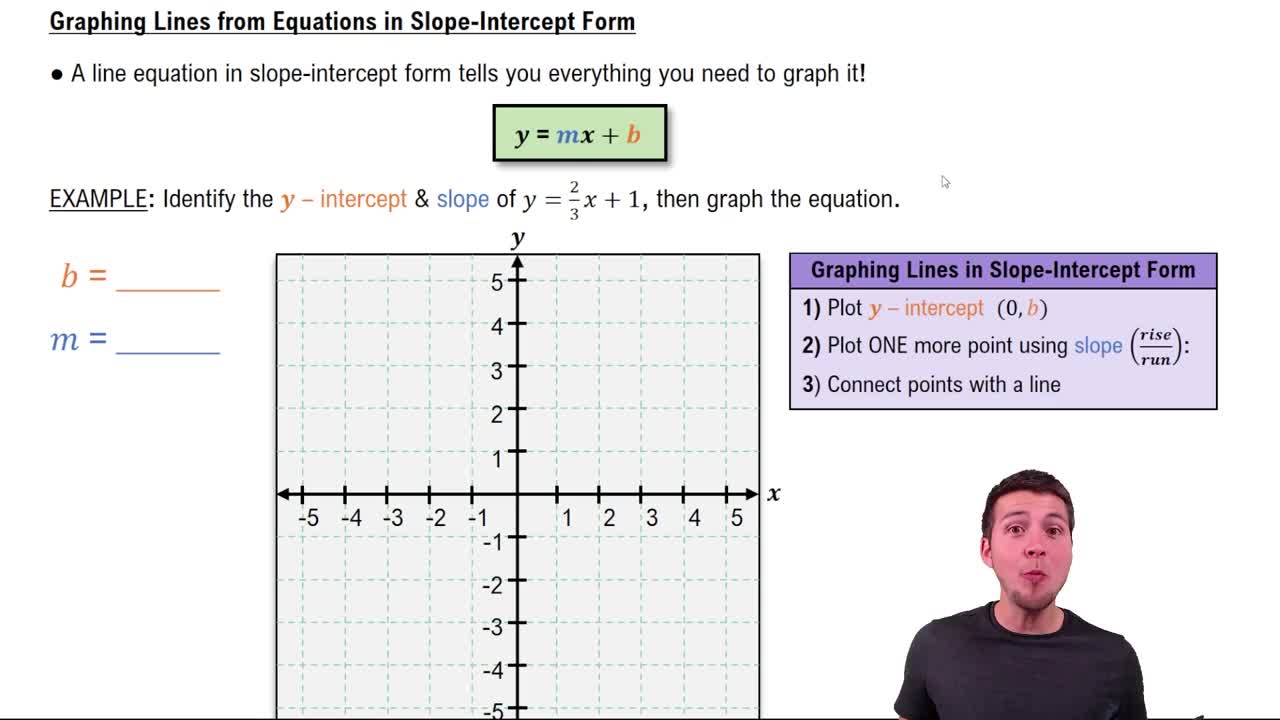
Graphing Lines in Slope-Intercept Form

Understanding Inequality Symbols

Inequality symbols like ≤ mean 'less than or equal to.' This indicates that the solution set includes the boundary value and all values less than it. Recognizing these symbols helps determine which side of the number line to shade.
Video consigliato:
06:07
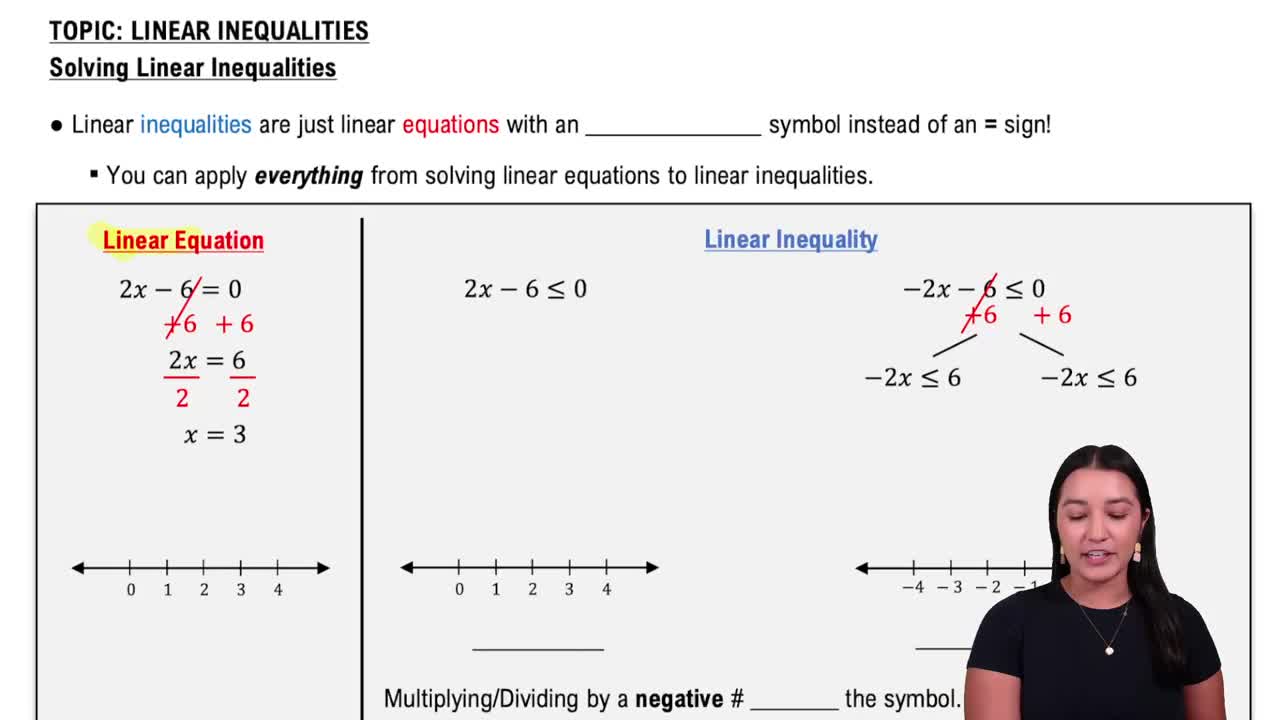
Linear Inequalities

Closed and Open Dots on Graphs

A closed dot on a number line indicates that the endpoint is included in the solution (e.g., ≤ or ≥), while an open dot means the endpoint is excluded (e.g., < or >). This distinction is crucial for accurately representing inequalities.
Video consigliato:
5:10
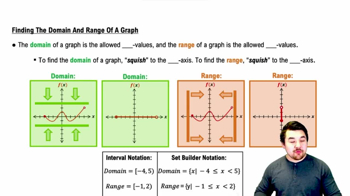
Finding the Domain and Range of a Graph