Ch. 5 - Systems of Equations and Inequalities
Blitzer - College Algebra 8th Edition
Blitzer8th EditionCollege AlgebraISBN: 9780136970514Non è quello che usi tu?Cambia libro di testo
Capitolo 6, Problema 41

Graph the solution set of each system of inequalities or indicate that the system has no solution.
{x+y>4x+y<−1\(\begin{cases}\) x + y > 4 \\ x + y < -1 \(\end{cases}\)

Guida verificata passo dopo passo
1
Step 1: Identify the system of inequalities: \[\begin{cases} -2x + y > 6 \\ -2x + y < -4 \end{cases}\]
Step 2: Rewrite each inequality in slope-intercept form (solve for y): For the first inequality: \[-2x + y > 6 \implies y > 2x + 6\] For the second inequality: \[-2x + y < -4 \implies y < 2x - 4\]
Step 3: Graph the boundary lines for each inequality: - For \[y = 2x + 6\], draw a dashed line because the inequality is strict ( > ). - For \[y = 2x - 4\], also draw a dashed line for the same reason ( < ).
Step 4: Determine the solution region for each inequality: - For \[y > 2x + 6\], shade the region above the line. - For \[y < 2x - 4\], shade the region below the line.
Step 5: Find the intersection of the two shaded regions. Since the first region is above the line \[y = 2x + 6\] and the second is below \[y = 2x - 4\], check if there is any overlap. Because \[2x + 6\] is always greater than \[2x - 4\], there is no region where both inequalities are true simultaneously, so the system has no solution.

Risposta video verificata per un problema simile:

Questa soluzione video è stata consigliata dai nostri tutor come utile per risolvere questo problema.
Durata del video:
1m

Concetti chiave

Ecco i concetti essenziali che devi comprendere per rispondere correttamente alla domanda.

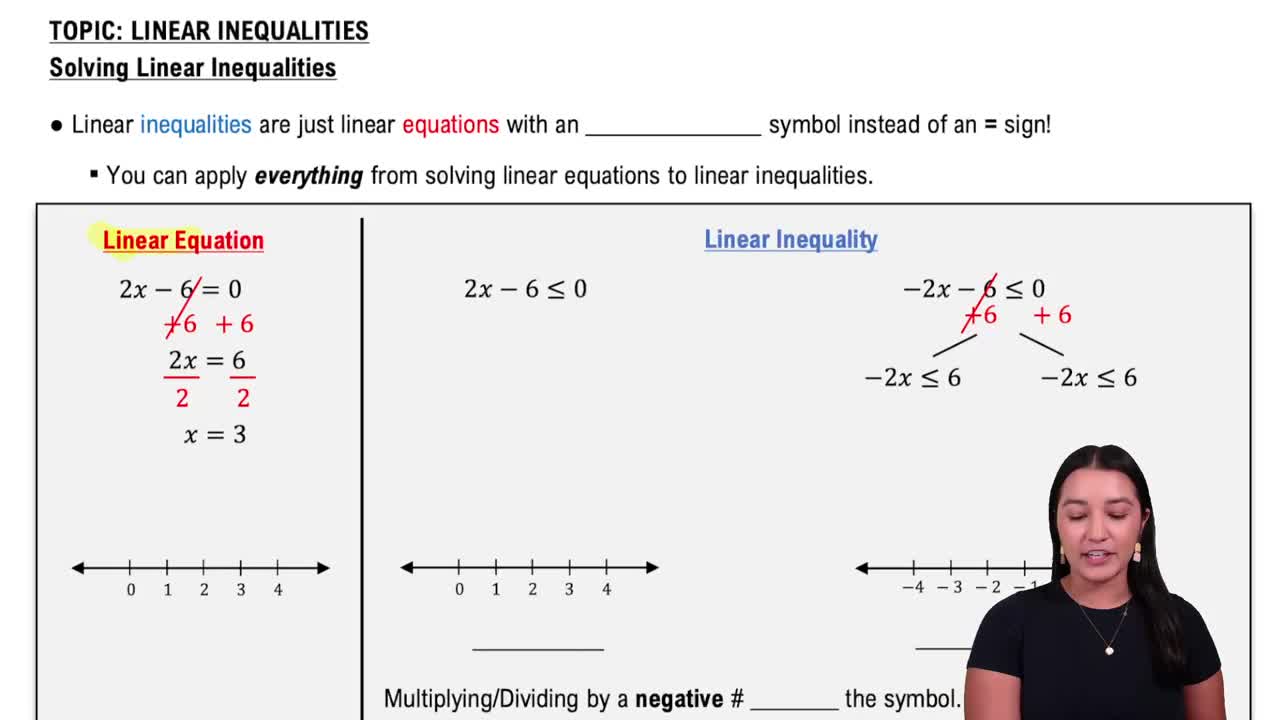
Graphing Linear Inequalities

Graphing linear inequalities involves plotting the boundary line represented by the corresponding linear equation and then shading the region that satisfies the inequality. The boundary line is dashed if the inequality is strict (>, <) and solid if it includes equality (≥, ≤). This visual representation helps identify all points that satisfy the inequality.
Video consigliato:
06:07
Linear Inequalities

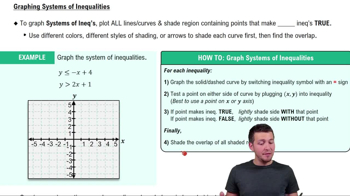
System of Inequalities and Solution Sets

A system of inequalities consists of two or more inequalities considered simultaneously. The solution set is the intersection of the regions satisfying each inequality. If no common region exists, the system has no solution. Understanding how to find and interpret this intersection is key to solving such problems.
Video consigliato:
6:19
Systems of Inequalities

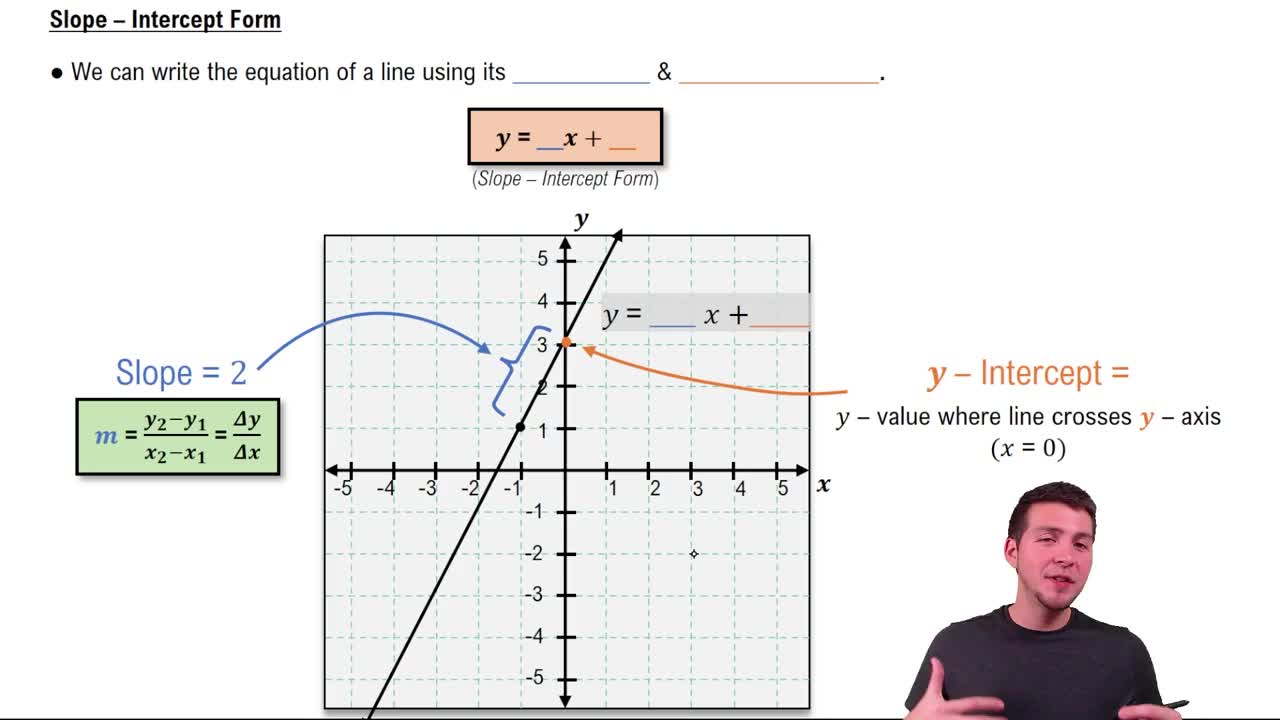
Converting Inequalities to Slope-Intercept Form

To graph inequalities easily, rewrite them in slope-intercept form (y = mx + b). This form clearly shows the slope and y-intercept, making it easier to draw the boundary line. For example, from -2x + y > 6, isolate y to get y > 2x + 6, which guides the graphing process.
Video consigliato:
03:56
Slope-Intercept Form