Ch. 6 - Matrices and Determinants
Blitzer - College Algebra 8th Edition
Blitzer8th EditionCollege AlgebraISBN: 9780136970514Non è quello che usi tu?Cambia libro di testo
Capitolo 7, Problema 43

In Exercises 37 - 44, perform the indicated matrix operations given that A, B and C are defined as follows. If an operation is not defined, state the reason.
A=[40−3501],B=[51−2−2],C=[1−1−11]A=\(\begin{bmatrix}\)4 & 0\\ -3 & 5\\ 0 & 1\(\end{bmatrix}\),B=\(\begin{bmatrix}\)5 & 1\\ -2 & -2\(\end{bmatrix}\),C=\(\begin{bmatrix}\)1 & -1\\ -1 & 1\(\end{bmatrix}\)
A(BC)

Guida verificata passo dopo passo
1
Step 1: Identify the matrices A, B, and C as given: \(A = \begin{bmatrix} 4 & 0 \\ -3 & 5 \\ 0 & 1 \end{bmatrix}, \quad B = \begin{bmatrix} 5 & 1 \\ -2 & -2 \end{bmatrix}, \quad C = \begin{bmatrix} 1 & -1 \\ -1 & 1 \end{bmatrix}\)
Step 2: Determine the dimensions of each matrix to check if the operations are defined: - Matrix A is 3x2 (3 rows, 2 columns) - Matrix B is 2x2 - Matrix C is 2x2
Step 3: Compute the product BC first since the expression is A(BC). Since B is 2x2 and C is 2x2, the product BC is defined and will result in a 2x2 matrix. Use matrix multiplication rules: \( (BC)_{ij} = \sum_{k=1}^{2} B_{ik} \times C_{kj} \)
Step 4: After finding BC (a 2x2 matrix), multiply A (3x2) by BC (2x2). Since the number of columns in A (2) matches the number of rows in BC (2), the product A(BC) is defined and will result in a 3x2 matrix. Use matrix multiplication rules again: \( (A(BC))_{ij} = \sum_{k=1}^{2} A_{ik} \times (BC)_{kj} \)
Step 5: Perform the multiplications and additions step-by-step for each element of the resulting matrix to find A(BC). Remember to multiply corresponding elements and sum them for each position in the product matrix.

Risposta video verificata per un problema simile:

Questa soluzione video è stata consigliata dai nostri tutor come utile per risolvere questo problema.
Durata del video:
6m

Concetti chiave

Ecco i concetti essenziali che devi comprendere per rispondere correttamente alla domanda.

Matrix Multiplication

Matrix multiplication involves multiplying rows of the first matrix by columns of the second matrix and summing the products. The number of columns in the first matrix must equal the number of rows in the second matrix for the operation to be defined.
Video consigliato:
03:42
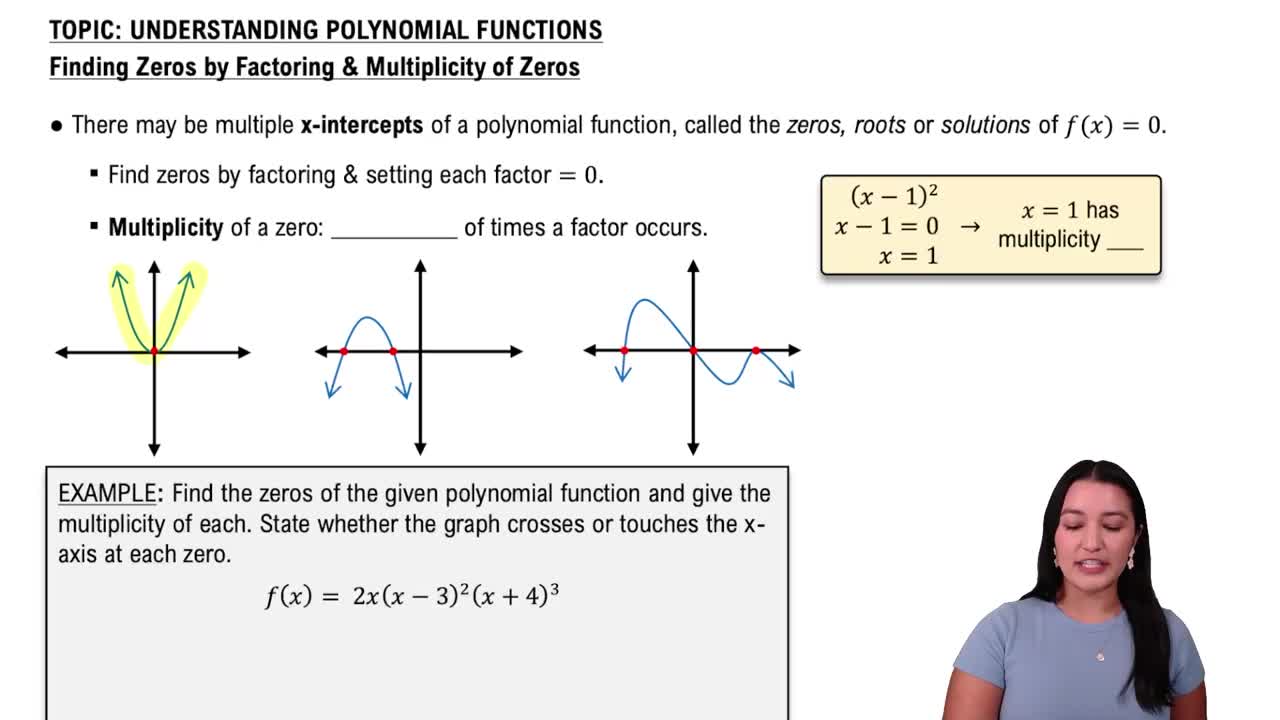
Finding Zeros & Their Multiplicity

Matrix Dimensions and Compatibility

The dimensions of matrices determine whether operations like multiplication are possible. For matrices A (m×n) and B (p×q), multiplication AB is defined only if n = p, resulting in a matrix of dimension m×q.
Video consigliato:
4:35
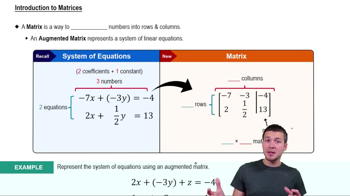
Introduction to Matrices

Associative Property of Matrix Multiplication

Matrix multiplication is associative, meaning (AB)C = A(BC) when the operations are defined. This property allows grouping matrices differently without changing the product, which is useful for simplifying complex matrix expressions.
Video consigliato:
5:36
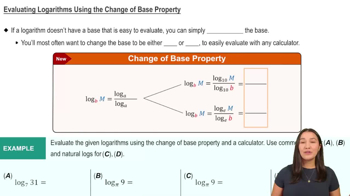
Change of Base Property
Pratica correlata
Domanda del libro di testo

Perform the indicated matrix operations given that A, B and C are defined as follows. If an operation is not defined, state the reason.

A=[40−3501],B=[51−2−2],C=[1−1−11]A=\(\begin{bmatrix}\)4 & 0\\ -3 & 5\\ 0 & 1\(\end{bmatrix}\),B=\(\begin{bmatrix}\)5 & 1\\ -2 & -2\(\end{bmatrix}\),C=\(\begin{bmatrix}\)1 & -1\\ -1 & 1\(\end{bmatrix}\)

A - C

111
views
Domanda del libro di testo

Solve the system: (Hint: Let A = ln w, B = ln x, C = ln y, and D = ln z. Solve the system for A, B, C, and D. Then use the logarithmic equations to find w, x, y, and z.)

{2lnw+lnx+3lny−2lnz=−64lnw+3lnx+lny−lnz=−2lnw+lnx+lny+lnz=−5lnw+lnx−lny−lnz=5\(\begin{cases}\) 2 \(\ln\) w + \(\ln\) x + 3 \(\ln\) y - 2 \(\ln\) z = -6 \\ 4 \(\ln\) w + 3 \(\ln\) x + \(\ln\) y - \(\ln\) z = -2 \\ \(\ln\) w + \(\ln\) x + \(\ln\) y + \(\ln\) z = -5 \\ \(\ln\) w + \(\ln\) x - \(\ln\) y - \(\ln\) z = 5 \(\end{cases}\)

933
views
Domanda del libro di testo

In Exercises 45–48, explain why the system of equations cannot be solved using Cramer's Rule. Then use Gaussian elimination to solve the system.

967
views
Domanda del libro di testo

In Exercises 43–44, (a) Write each linear system as a matrix equation in the form AX = B (b) Solve the system using the inverse that is given for the coefficient matrix.

671
views
Domanda del libro di testo

In Exercises 37–44, use Cramer's Rule to solve each system. {x+2z=42y−z=52x+3y=13\(\begin{cases}\) x + 2z = 4 \\ 2y - z = 5 \\ 2x + 3y = 13 \(\end{cases}\)

875
views
Domanda del libro di testo

In Exercises 37–44, use Cramer's Rule to solve each system. {x+y+z=4x−2y+z=7x+3y+2z=4\(\begin{cases}\) x + y + z = 4 \\ x - 2y + z = 7 \\ x + 3y + 2z = 4 \(\end{cases}\)

864
views