Ch. 6 - Matrices and Determinants
Blitzer - College Algebra 8th Edition
Blitzer8th EditionCollege AlgebraISBN: 9780136970514Non è quello che usi tu?Cambia libro di testo
Capitolo 7, Problema 45

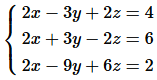
In Exercises 45–48, explain why the system of equations cannot be solved using Cramer's Rule. Then use Gaussian elimination to solve the system.
Image showing a system of three linear equations with variables x, y, and z arranged in matrix form.

Guida verificata passo dopo passo
1
Step 1: Write the system of equations in matrix form as A * X = B, where A is the coefficient matrix, X is the variable vector, and B is the constants vector. Here, A = [[2, -3, 2], [2, 3, -2], [2, -9, 6]], X = [x, y, z]^T, and B = [4, 6, 2]^T.
Step 2: Calculate the determinant of the coefficient matrix A, denoted as det(A). If det(A) = 0, Cramer's Rule cannot be used because it requires a non-zero determinant to find a unique solution.
Step 3: Since det(A) = 0 (as you will find upon calculation), explain that the system either has infinitely many solutions or no solution, so Cramer's Rule is not applicable.
Step 4: Use Gaussian elimination to solve the system. Start by writing the augmented matrix [A | B]: [[2, -3, 2, 4], [2, 3, -2, 6], [2, -9, 6, 2]].
Step 5: Perform row operations to reduce the augmented matrix to row-echelon form, then use back substitution to find the values of x, y, and z or determine if the system is inconsistent or dependent.

Risposta video verificata per un problema simile:

Questa soluzione video è stata consigliata dai nostri tutor come utile per risolvere questo problema.
Durata del video:
8m

Concetti chiave

Ecco i concetti essenziali che devi comprendere per rispondere correttamente alla domanda.

Cramer's Rule and Determinants

Cramer's Rule solves a system of linear equations using determinants, applicable only when the coefficient matrix has a nonzero determinant. If the determinant is zero, the system is either dependent or inconsistent, making Cramer's Rule unusable.
Video consigliato:
6:54
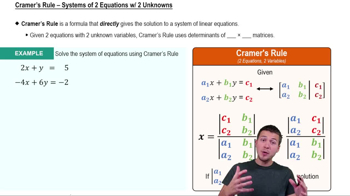
Cramer's Rule - 2 Equations with 2 Unknowns

Gaussian Elimination

Gaussian elimination is a method to solve systems of linear equations by transforming the augmented matrix into row-echelon form using row operations. This process simplifies the system, allowing back-substitution to find the solution or determine if none exists.
Video consigliato:
6:48
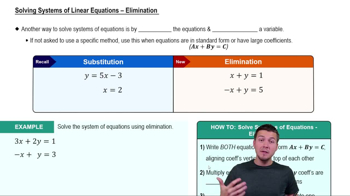
Solving Systems of Equations - Elimination

Consistency and Dependence of Systems

A system is consistent if it has at least one solution and inconsistent if it has none. Dependence occurs when equations are multiples or linear combinations of others, leading to infinite solutions or no unique solution, which affects the applicability of solution methods.
Video consigliato:
6:57
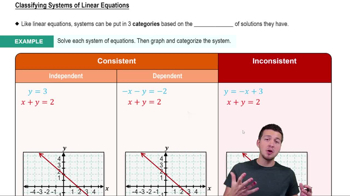
Classifying Systems of Linear Equations