Ch. 8 - Sequences, Induction, and Probability
Blitzer - College Algebra 8th Edition
Blitzer8th EditionCollege AlgebraISBN: 9780136970514Non è quello che usi tu?Cambia libro di testo
Capitolo 9, Problema 78

A club with 15 members is to choose four officers–president, vice president, secretary, and treasurer. In how many ways can these offices be filled?

Guida verificata passo dopo passo
1
Step 1: Recognize that this is a permutation problem because the order in which the officers are chosen matters (e.g., president is different from vice president).
Step 2: Use the formula for permutations, which is P(n, r) = n! / (n - r)!, where n is the total number of items (15 members) and r is the number of items to choose (4 officers).
Step 3: Substitute the values into the formula: P(15, 4) = 15! / (15 - 4)!.
Step 4: Simplify the denominator: (15 - 4)! = 11!, so the formula becomes P(15, 4) = 15! / 11!.
Step 5: Cancel out the common factorial terms (11!) in the numerator and denominator, leaving P(15, 4) = 15 × 14 × 13 × 12. Multiply these terms to find the total number of ways the offices can be filled.

Risposta video verificata per un problema simile:

Questa soluzione video è stata consigliata dai nostri tutor come utile per risolvere questo problema.
Durata del video:
3m

Concetti chiave

Ecco i concetti essenziali che devi comprendere per rispondere correttamente alla domanda.

Permutations

Permutations refer to the different arrangements of a set of items where the order matters. In this scenario, the positions of president, vice president, secretary, and treasurer are distinct, meaning that the arrangement of members in these roles is crucial. The formula for permutations is n! / (n - r)!, where n is the total number of items, and r is the number of items to arrange.
Video consigliato:
7:11
Introduction to Permutations

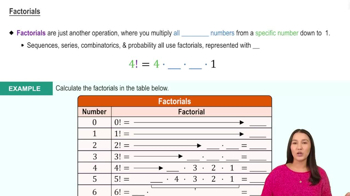
Factorial

A factorial, denoted as n!, is the product of all positive integers up to n. It is a fundamental concept in combinatorics used to calculate permutations and combinations. For example, 5! equals 5 × 4 × 3 × 2 × 1 = 120. Understanding factorials is essential for determining the number of ways to arrange members in the club's officer positions.
Video consigliato:
5:22
Factorials

Combinatorial Counting

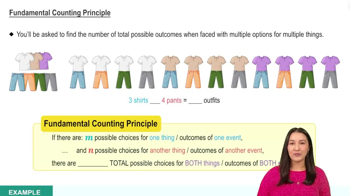
Combinatorial counting involves calculating the number of ways to select or arrange items based on specific criteria. In this question, we are interested in how to fill four distinct officer roles from a group of 15 members. This requires applying the principles of permutations, as the order of selection is important, leading to a systematic approach to counting the arrangements.
Video consigliato:
4:04
Fundamental Counting Principle