Ch. 8 - Sequences, Induction, and Probability
Blitzer - College Algebra 8th Edition
Blitzer8th EditionCollege AlgebraISBN: 9780136970514Non è quello che usi tu?Cambia libro di testo
Capitolo 9, Problema 72

Evaluate the expression. *permutation notation* the number of permutations 8 things taken 3 at a time (sub 8)P(sub 3)

Guida verificata passo dopo passo
1
Understand the permutation formula: The number of permutations of n things taken r at a time is given by the formula: P(n,r)=n!(n-r)!, where n! is the factorial of n.
Identify the values of n and r from the problem: Here, n = 8 and r = 3. This means we are calculating the number of permutations of 8 things taken 3 at a time.
Substitute the values of n and r into the formula: P(8,3)=8!(8-3)!.
Simplify the denominator: Calculate 8-3=5, so the formula becomes: 8!5!.
Simplify the factorials: Expand the numerator and denominator. The numerator is 8×7×6×5!, and the denominator is 5!. Cancel out the common 5! terms, leaving 8×7×6.

Risposta video verificata per un problema simile:

Questa soluzione video è stata consigliata dai nostri tutor come utile per risolvere questo problema.
Durata del video:
2m

Concetti chiave

Ecco i concetti essenziali che devi comprendere per rispondere correttamente alla domanda.

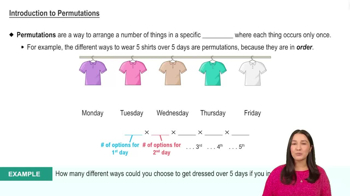
Permutations

Permutations refer to the different ways in which a set of items can be arranged or ordered. In mathematics, the number of permutations of 'n' items taken 'r' at a time is calculated using the formula P(n, r) = n! / (n - r)!, where 'n!' denotes the factorial of 'n'. This concept is crucial for understanding how to count arrangements when the order of selection matters.
Video consigliato:
7:11
Introduction to Permutations

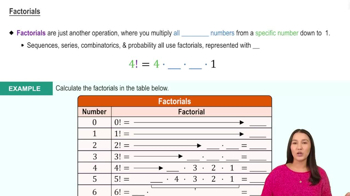
Factorial

The factorial of a non-negative integer 'n', denoted as 'n!', is the product of all positive integers up to 'n'. For example, 5! = 5 × 4 × 3 × 2 × 1 = 120. Factorials are fundamental in permutations and combinations, as they provide the necessary counts of arrangements and selections in various mathematical contexts.
Video consigliato:
5:22
Factorials

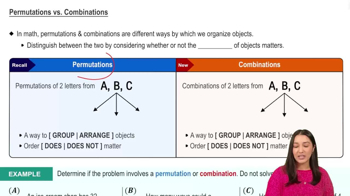
Combination vs. Permutation

While both permutations and combinations deal with selecting items from a set, the key difference lies in the importance of order. Permutations consider the arrangement of items as significant, while combinations do not. Understanding this distinction is essential when determining which formula to apply in problems involving selections of items.
Video consigliato:
3:18
Permutations vs. Combinations