Ch. 8 - Sequences, Induction, and Probability
Blitzer - College Algebra 8th Edition
Blitzer8th EditionCollege AlgebraISBN: 9780136970514Non è quello che usi tu?Cambia libro di testo
Capitolo 9, Problema 4

Use the formula for nPr to evaluate each expression. 10P4

Guida verificata passo dopo passo
1
Recall the formula for permutations: \(\displaystyle {}_nP_r = \frac{n!}{(n-r)!}\), where \(n\) is the total number of items and \(r\) is the number of items to arrange.
Identify the values of \(n\) and \(r\) from the problem: here, \(n = 10\) and \(r = 4\).
Substitute these values into the permutation formula: \(\displaystyle {}_{10}P_4 = \frac{10!}{(10-4)!} = \frac{10!}{6!}\).
Simplify the factorial expression by expanding \$10!$ only as far as needed to cancel with \$6!$: \(\displaystyle \frac{10 \times 9 \times 8 \times 7 \times 6!}{6!}\).
Cancel the \$6!$ terms and multiply the remaining numbers: \(10 \times 9 \times 8 \times 7\) to find the number of permutations.

Concetti chiave

Ecco i concetti essenziali che devi comprendere per rispondere correttamente alla domanda.

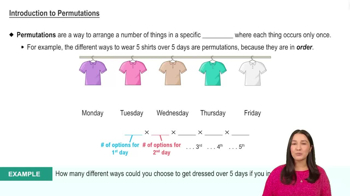
Permutation Formula

The permutation formula, denoted as nPr, calculates the number of ways to arrange r objects from a set of n distinct objects where order matters. It is given by nPr = n! / (n - r)!, where '!' denotes factorial.
Video consigliato:
7:11
Introduction to Permutations

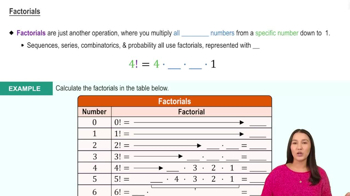
Factorial Function

A factorial, represented by n!, is the product of all positive integers from 1 up to n. For example, 5! = 5 × 4 × 3 × 2 × 1 = 120. Factorials are essential in permutations and combinations to count arrangements.
Video consigliato:
5:22
Factorials

Evaluating Permutations

To evaluate a permutation like 10P4, substitute into the formula: 10P4 = 10! / (10 - 4)! = 10! / 6!. Simplify by canceling common factorial terms and compute the product of the remaining factors.
Video consigliato:
7:11
Introduction to Permutations