Ch. 8 - Sequences, Induction, and Probability
Blitzer - College Algebra 8th Edition
Blitzer8th EditionCollege AlgebraISBN: 9780136970514Non è quello che usi tu?Cambia libro di testo
Capitolo 9, Problema 5

Use the formula for nPr to evaluate each expression. 6P6

Guida verificata passo dopo passo
1
Recall the formula for permutations: \(nP_r = \frac{n!}{(n-r)!}\), where \(n\) is the total number of items and \(r\) is the number of items to arrange.
Identify the values of \(n\) and \(r\) in the expression \$6P6\(. Here, \)n = 6$ and $r = 6$.
Substitute these values into the formula: \(6P6 = \frac{6!}{(6-6)!}\).
Simplify the denominator: \((6-6)! = 0!\). Remember that by definition, \(0! = 1\).
The expression now becomes \(6P6 = \frac{6!}{1} = 6!\). To find the value, you would calculate \(6! = 6 \times 5 \times 4 \times 3 \times 2 \times 1\), but the problem only asks for the setup.

Risposta video verificata per un problema simile:

Questa soluzione video è stata consigliata dai nostri tutor come utile per risolvere questo problema.
Durata del video:
2m

Concetti chiave

Ecco i concetti essenziali che devi comprendere per rispondere correttamente alla domanda.

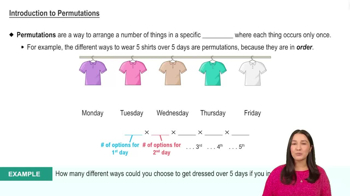
Permutation Formula (nPr)

The permutation formula nPr calculates the number of ways to arrange r objects from a set of n distinct objects, where order matters. It is given by nPr = n! / (n - r)!, where '!' denotes factorial.
Video consigliato:
7:11
Introduction to Permutations

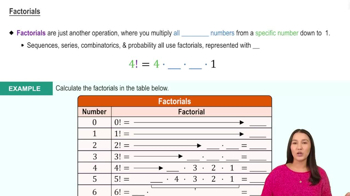
Factorial Notation

Factorial, denoted by n!, is the product of all positive integers from 1 up to n. For example, 6! = 6 × 5 × 4 × 3 × 2 × 1 = 720. Factorials are essential in permutations and combinations calculations.
Video consigliato:
5:22
Factorials

Evaluating nPr When r = n

When the number of objects chosen r equals the total number n, nPr simplifies to n!, because (n - n)! = 0! = 1. Thus, nPn = n!, representing all possible arrangements of the entire set.
Video consigliato:
5:22
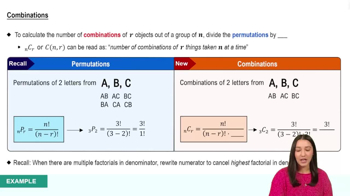
Combinations