Ch. 8 - Sequences, Induction, and Probability
Blitzer - College Algebra 8th Edition
Blitzer8th EditionCollege AlgebraISBN: 9780136970514Non è quello che usi tu?Cambia libro di testo
Capitolo 9, Problema 13

In Exercises 11–16, a die is rolled. Find the probability of getting an odd number.

Guida verificata passo dopo passo
1
Identify the total number of possible outcomes when rolling a die. Since a standard die has 6 faces, the total number of outcomes is 6.
Determine the favorable outcomes for the event. The event is getting an odd number, so list the odd numbers on a die: 1, 3, and 5.
Count the number of favorable outcomes. There are 3 odd numbers on the die.
Use the probability formula: \(P(\text{event}) = \frac{\text{number of favorable outcomes}}{\text{total number of outcomes}}\).
Substitute the values into the formula: \(P(\text{odd number}) = \frac{3}{6}\). This fraction can be simplified if needed.

Risposta video verificata per un problema simile:

Questa soluzione video è stata consigliata dai nostri tutor come utile per risolvere questo problema.
Durata del video:
2m

Concetti chiave

Ecco i concetti essenziali che devi comprendere per rispondere correttamente alla domanda.

Sample Space

The sample space is the set of all possible outcomes of an experiment. For a single die roll, the sample space consists of the numbers 1 through 6, representing each face of the die.
Video consigliato:
5:37
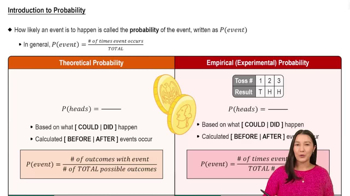
Introduction to Probability

Event

An event is a subset of the sample space that includes outcomes of interest. In this case, the event is rolling an odd number, which includes the outcomes {1, 3, 5}.
Video consigliato:
4:23
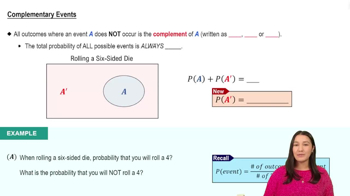
Complementary Events

Probability Calculation

Probability is calculated as the ratio of favorable outcomes to total possible outcomes. For rolling an odd number, it is the number of odd outcomes divided by the total outcomes, i.e., 3/6 or 1/2.
Video consigliato:
5:37
Introduction to Probability