Ch. 8 - Sequences, Induction, and Probability
Blitzer - College Algebra 8th Edition
Blitzer8th EditionCollege AlgebraISBN: 9780136970514Non è quello che usi tu?Cambia libro di testo
Capitolo 9, Problema 14

In Exercises 12–15, write the first six terms of each arithmetic sequence. a1 = 3/2, d = -1/2

Guida verificata passo dopo passo
1
Step 1: Recall the formula for the nth term of an arithmetic sequence: a_n = a_1 + (n - 1) imes d , where a_1 is the first term, d is the common difference, and n is the term number.
Step 2: Identify the given values: a_1 = \(\frac{3}{2}\) (the first term) and d = -\(\frac{1}{2}\) (the common difference).
Step 3: Calculate the second term (a_2) using the formula: a_2 = a_1 + d = \(\frac{3}{2}\) + (-\(\frac{1}{2}\)). Simplify the expression to find a_2.
Step 4: Calculate the third term (a_3) using the formula: a_3 = a_1 + 2d = \(\frac{3}{2}\) + 2(-\(\frac{1}{2}\)). Simplify the expression to find a_3. Repeat this process for a_4, a_5, and a_6.
Step 5: Write the first six terms of the sequence in order: a_1, a_2, a_3, a_4, a_5, a_6, based on the calculations from the previous steps.

Risposta video verificata per un problema simile:

Questa soluzione video è stata consigliata dai nostri tutor come utile per risolvere questo problema.
Durata del video:
2m

Concetti chiave

Ecco i concetti essenziali che devi comprendere per rispondere correttamente alla domanda.

Arithmetic Sequence

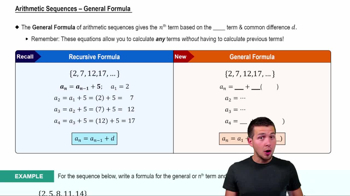
An arithmetic sequence is a sequence of numbers in which the difference between consecutive terms is constant. This difference is known as the common difference (d). In this case, the first term (a1) is given, and the common difference allows us to generate subsequent terms by adding d to the previous term.
Video consigliato:
5:17
Arithmetic Sequences - General Formula

First Term and Common Difference

The first term of an arithmetic sequence is the initial value from which the sequence starts, denoted as a1. The common difference (d) is the fixed amount that is added to each term to obtain the next term. For the given sequence, a1 = 3/2 and d = -1/2, indicating that each term will decrease by 1/2 from the previous term.
Video consigliato:
5:57
Graphs of Common Functions

Generating Terms of the Sequence

To find the terms of an arithmetic sequence, start with the first term and repeatedly add the common difference. For example, to find the first six terms, calculate each term by applying the formula: a_n = a1 + (n-1)d, where n is the term number. This process allows for systematic generation of the sequence's terms.
Video consigliato:
4:45
Geometric Sequences - General Formula