Find the indicated term of the arithmetic sequence with first term, and common difference, d. Find a60 when a1 = 35, d = -3.
Ch. 8 - Sequences, Induction, and Probability

Capitolo 9, Problema 21
Use mathematical induction to prove that each statement is true for every positive integer n. 1 · 2 + 2 · 3 + 3 · 4 + ... + n(n + 1) = n(n + 1)(n + 2)/3
Guida verificata passo dopo passo1
Step 1: Define the statement to prove by induction. Let \( P(n) \) be the statement \( 1 \cdot 2 + 2 \cdot 3 + 3 \cdot 4 + \cdots + n(n + 1) = \frac{n(n + 1)(n + 2)}{3} \). We want to prove \( P(n) \) is true for all positive integers \( n \).
Step 2: Verify the base case \( n = 1 \). Substitute \( n = 1 \) into both sides of the equation and check if the left-hand side equals the right-hand side.
Step 3: Assume the induction hypothesis \( P(k) \) is true for some positive integer \( k \), that is, assume \( 1 \cdot 2 + 2 \cdot 3 + \cdots + k(k + 1) = \frac{k(k + 1)(k + 2)}{3} \).
Step 4: Prove the statement \( P(k + 1) \) is true using the induction hypothesis. Start with the left-hand side of \( P(k + 1) \): \( 1 \cdot 2 + 2 \cdot 3 + \cdots + k(k + 1) + (k + 1)(k + 2) \). Substitute the induction hypothesis for the sum up to \( k(k + 1) \).
Step 5: Simplify the expression obtained in Step 4 and show that it equals the right-hand side of \( P(k + 1) \), which is \( \frac{(k + 1)(k + 2)(k + 3)}{3} \). This completes the induction step and proves the statement for all positive integers \( n \).

Risposta video verificata per un problema simile:
Questa soluzione video è stata consigliata dai nostri tutor come utile per risolvere questo problema.
Durata del video:
7mConcetti chiave
Ecco i concetti essenziali che devi comprendere per rispondere correttamente alla domanda.
Mathematical Induction
Mathematical induction is a proof technique used to establish that a statement holds for all positive integers. It involves two steps: proving the base case (usually n=1) is true, and then proving that if the statement holds for an arbitrary integer k, it also holds for k+1. This creates a chain of truth for all n.
Video consigliato:
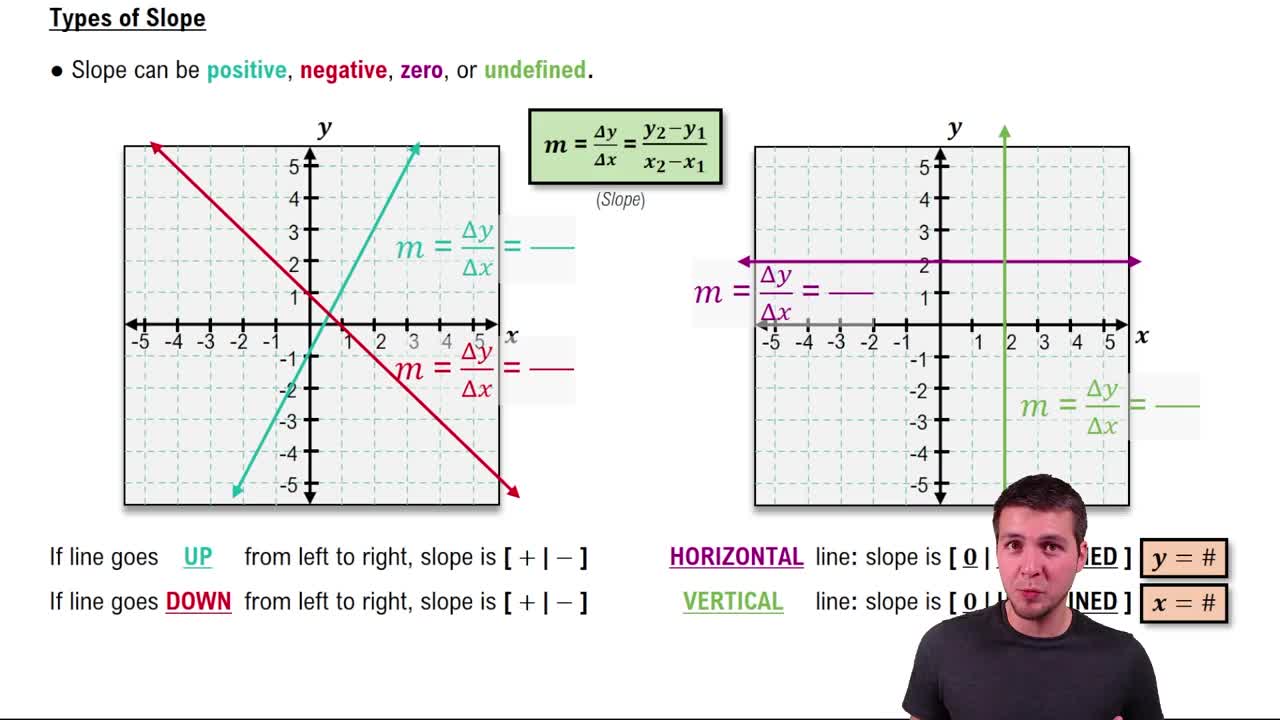
Types of Slope
Summation of Sequences
Summation of sequences involves finding a formula that represents the sum of terms in a sequence. In this problem, the sum is of products of consecutive integers, and the goal is to express this sum in a closed form, which simplifies calculations and helps in proving the formula by induction.
Video consigliato:
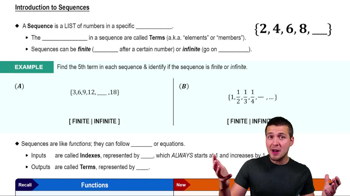
Introduction to Sequences
Algebraic Manipulation
Algebraic manipulation refers to the process of simplifying, expanding, or factoring expressions to transform them into a desired form. In induction proofs, it is essential to manipulate expressions correctly to show that the formula for n+1 follows logically from the formula for n.
Video consigliato:
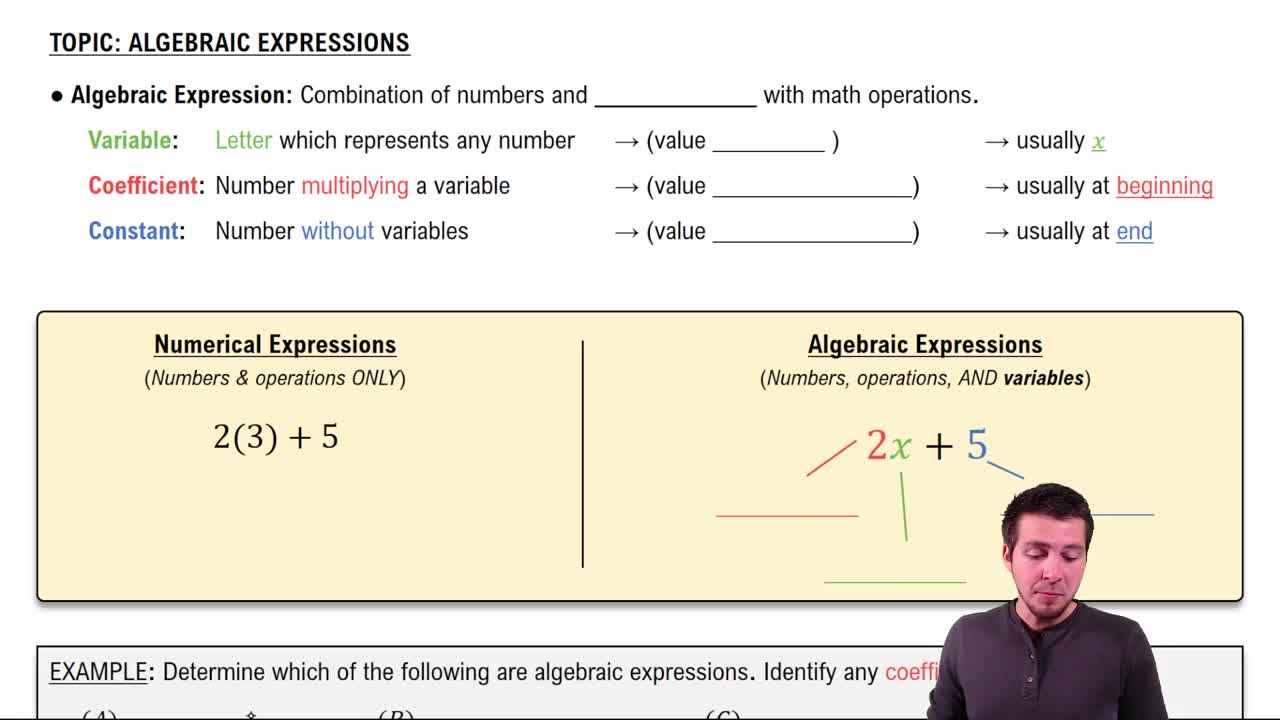
Introduction to Algebraic Expressions
Pratica correlata
Domanda del libro di testo
1213
views
Domanda del libro di testo
Use the Binomial Theorem to expand each binomial and express the result in simplified form. (2x3 − 1)4
634
views
Domanda del libro di testo
In Exercises 19–22, the general term of a sequence is given and involves a factorial. Write the first four terms of each sequence. a_n=(n+1)!/n^2
529
views
Domanda del libro di testo
Write a formula for the general term (the nth term) of each geometric sequence. Then use the formula for an to find a7, the seventh term of the sequence. 1.5, - 3, 6, -12, ...
1098
views
Domanda del libro di testo
In Exercises 21–22, a fair coin is tossed two times in succession. The sample space of equally likely outcomes is {HH,HT,TH,TT}. Find the probability of getting two heads.
781
views
Domanda del libro di testo
In Exercises 19–22, the general term of a sequence is given and involves a factorial. Write the first four terms of each sequence. an=2(n+1)!
801
views