Ch. 8 - Sequences, Induction, and Probability
Blitzer - College Algebra 8th Edition
Blitzer8th EditionCollege AlgebraISBN: 9780136970514Non è quello che usi tu?Cambia libro di testo
Capitolo 9, Problema 21

In Exercises 21–22, a fair coin is tossed two times in succession. The sample space of equally likely outcomes is {HH,HT,TH,TT}. Find the probability of getting two heads.

Guida verificata passo dopo passo
1
Identify the sample space for tossing a fair coin two times. The sample space consists of all possible outcomes: \(\{HH, HT, TH, TT\}\).
Count the total number of outcomes in the sample space. Since there are two tosses and each toss has 2 possible outcomes, the total number of outcomes is 4.
Determine the favorable outcomes for the event 'getting two heads'. This means both tosses result in heads, so the favorable outcome is \(\{HH\}\).
Count the number of favorable outcomes. Here, there is only 1 favorable outcome: \(HH\).
Calculate the probability of getting two heads using the formula: \(P(\text{two heads}) = \frac{\text{number of favorable outcomes}}{\text{total number of outcomes}} = \frac{1}{4}\).

Risposta video verificata per un problema simile:

Questa soluzione video è stata consigliata dai nostri tutor come utile per risolvere questo problema.
Durata del video:
4m

Concetti chiave

Ecco i concetti essenziali che devi comprendere per rispondere correttamente alla domanda.

Sample Space

The sample space is the set of all possible outcomes of an experiment. For tossing a fair coin twice, the sample space includes {HH, HT, TH, TT}, representing all equally likely sequences of heads (H) and tails (T). Understanding the sample space is essential for calculating probabilities.
Video consigliato:
5:37
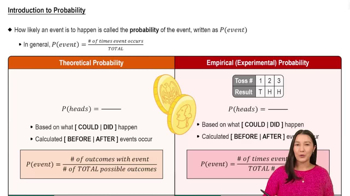
Introduction to Probability

Probability of an Event

Probability measures the likelihood of an event occurring and is calculated as the ratio of favorable outcomes to the total number of outcomes in the sample space. For example, the probability of getting two heads is the number of outcomes with two heads divided by the total outcomes.
Video consigliato:
5:14
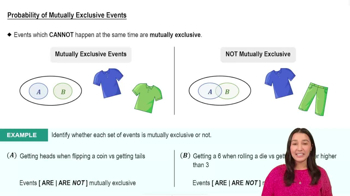
Probability of Mutually Exclusive Events

Equally Likely Outcomes

When all outcomes in the sample space have the same chance of occurring, they are called equally likely. This assumption allows us to use simple ratios to find probabilities, such as dividing the count of favorable outcomes by the total number of outcomes.
Video consigliato:
03:50
Adding & Subtracting Like Radicals