Ch. 8 - Sequences, Induction, and Probability
Blitzer - College Algebra 8th Edition
Blitzer8th EditionCollege AlgebraISBN: 9780136970514Non è quello che usi tu?Cambia libro di testo
Capitolo 9, Problema 24

Evaluate each factorial expression. 18!/16!

Guida verificata passo dopo passo
1
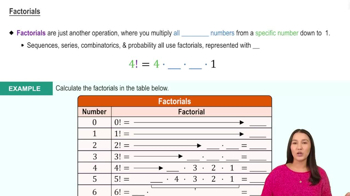
Recall the definition of factorial: for a positive integer \(n\), \(n! = n \times (n-1) \times (n-2) \times \cdots \times 1\).
Write out the factorial expressions explicitly: \(18! = 18 \times 17 \times 16!\).
Substitute \$18!$ in the expression \(\frac{18!}{16!}\) with \(18 \times 17 \times 16!\) to get \(\frac{18 \times 17 \times 16!}{16!}\).
Cancel the common factor \$16!$ in the numerator and denominator, leaving \(18 \times 17\).
Multiply the remaining numbers \(18\) and \(17\) to find the value of the expression.

Risposta video verificata per un problema simile:

Questa soluzione video è stata consigliata dai nostri tutor come utile per risolvere questo problema.
Durata del video:
3m

Concetti chiave

Ecco i concetti essenziali che devi comprendere per rispondere correttamente alla domanda.

Factorial Notation

Factorial notation, denoted by an exclamation mark (!), represents the product of all positive integers up to a given number. For example, n! = n × (n-1) × ... × 2 × 1. It is commonly used in permutations, combinations, and algebraic expressions.
Video consigliato:
5:22
Factorials

Simplifying Factorial Expressions

When dividing factorials like 18!/16!, common terms can be canceled out. Since 18! = 18 × 17 × 16!, the expression 18!/16! simplifies to 18 × 17. This method avoids calculating large factorial values directly.
Video consigliato:
5:22
Factorials

Properties of Factorials in Division

Factorials have a recursive property where n! = n × (n-1)!. This allows breaking down factorial expressions in division to simplify calculations by canceling out the smaller factorial, making complex expressions manageable.
Video consigliato:
5:22
Factorials