Ch. 8 - Sequences, Induction, and Probability
Blitzer - College Algebra 8th Edition
Blitzer8th EditionCollege AlgebraISBN: 9780136970514Non è quello che usi tu?Cambia libro di testo
Capitolo 9, Problema 25

Use the formula for the sum of the first n terms of an arithmetic sequence to find the indicated sum.
∑i=116(3i+2)\(\sum\)_{i=1}^{16} (3i + 2)

Guida verificata passo dopo passo
1
Identify the first term \(a_1\) and the common difference \(d\) of the arithmetic sequence. These are essential to use the sum formula.
Recall the formula for the sum of the first \(n\) terms of an arithmetic sequence: \[ S_n = \frac{n}{2} \times (2a_1 + (n - 1)d) \]
Determine the number of terms \(n\) you need to sum, based on the problem's given range or limits.
Substitute the values of \(a_1\), \(d\), and \(n\) into the sum formula to set up the expression for \(S_n\).
Simplify the expression step-by-step to find the sum of the first \(n\) terms, but do not calculate the final numeric value unless asked.

Risposta video verificata per un problema simile:

Questa soluzione video è stata consigliata dai nostri tutor come utile per risolvere questo problema.
Durata del video:
2m

Concetti chiave

Ecco i concetti essenziali che devi comprendere per rispondere correttamente alla domanda.

Arithmetic Sequence

An arithmetic sequence is a list of numbers where each term after the first is found by adding a constant difference to the previous term. Understanding this pattern is essential for identifying terms and applying formulas related to sums.
Video consigliato:
5:17
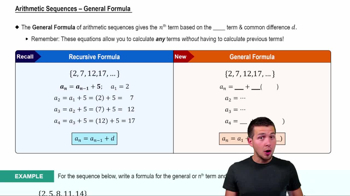
Arithmetic Sequences - General Formula

Sum of the First n Terms of an Arithmetic Sequence

This formula calculates the total of the first n terms in an arithmetic sequence. It is given by S_n = n/2 * (2a_1 + (n-1)d), where a_1 is the first term and d is the common difference, enabling efficient summation without adding each term individually.
Video consigliato:
5:17
Arithmetic Sequences - General Formula

Summation Notation (Sigma Notation)

Summation notation uses the Greek letter sigma (∑) to represent the sum of a sequence of terms. It provides a concise way to express adding multiple terms, which is crucial for interpreting and solving problems involving series.
Video consigliato:
05:18
Interval Notation