Use the Fundamental Counting Principle to solve Exercises 29–40. A popular brand of pen is available in three colors (red, green, or blue) and four writing tips (bold, medium, fine, or micro). How many different choices of pens do you have with this brand?
Ch. 8 - Sequences, Induction, and Probability

Capitolo 9, Problema 31
Use mathematical induction to prove that each statement is true for every positive integer n. n + 2 > n
Guida verificata passo dopo passo1
Identify the statement to prove using mathematical induction: For every positive integer \(n\), the inequality \(n + 2 > n\) holds.
Base Case: Verify the statement for \(n = 1\). Substitute \(n = 1\) into the inequality to check if \(1 + 2 > 1\) is true.
Inductive Hypothesis: Assume the statement is true for some positive integer \(k\), that is, assume \(k + 2 > k\) holds.
Inductive Step: Using the inductive hypothesis, prove the statement for \(k + 1\). Show that \((k + 1) + 2 > k + 1\) is true.
Conclude that since the base case is true and the inductive step holds, by mathematical induction, the inequality \(n + 2 > n\) is true for every positive integer \(n\).

Risposta video verificata per un problema simile:
Questa soluzione video è stata consigliata dai nostri tutor come utile per risolvere questo problema.
Durata del video:
1mConcetti chiave
Ecco i concetti essenziali che devi comprendere per rispondere correttamente alla domanda.
Mathematical Induction
Mathematical induction is a proof technique used to establish that a statement holds for all positive integers. It involves two steps: proving the base case (usually for n=1) and then proving the inductive step, where assuming the statement is true for n=k leads to it being true for n=k+1.
Video consigliato:
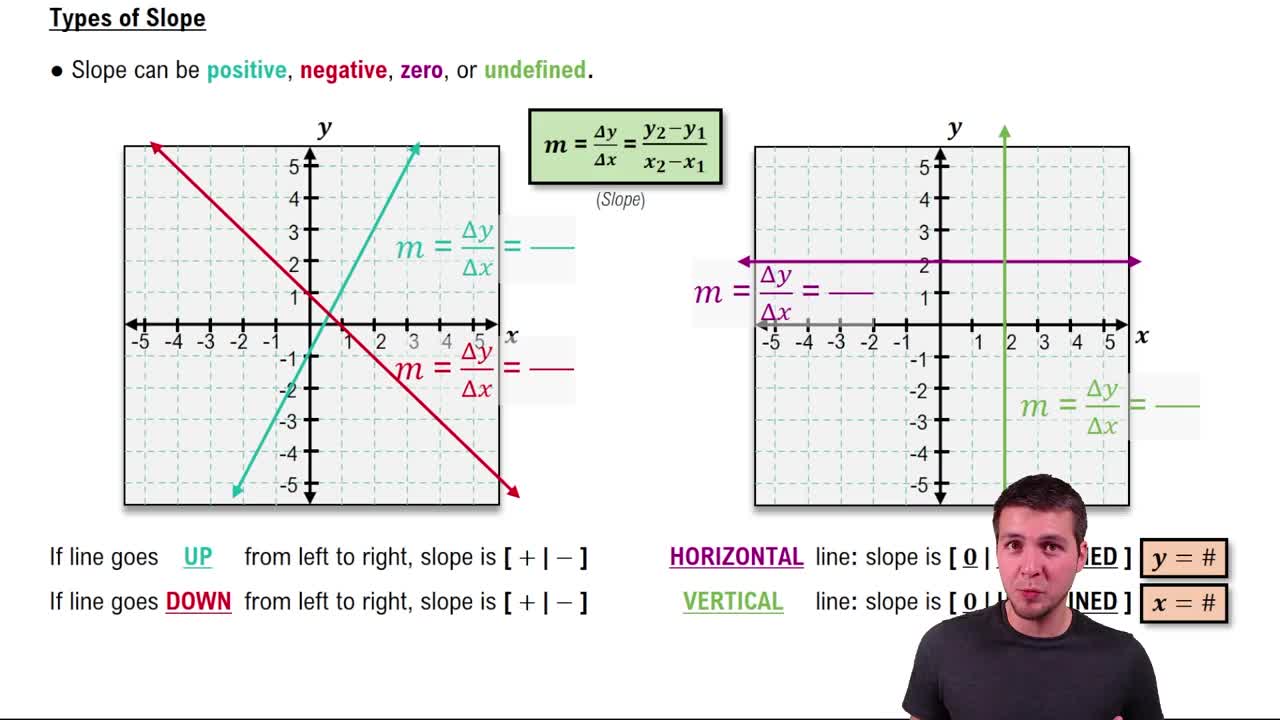
Types of Slope
Base Case Verification
The base case is the initial step in induction where the statement is verified for the smallest positive integer, often n=1. This step confirms the statement holds at the starting point, providing a foundation for the inductive step.
Video consigliato:
Change of Base Property
Inductive Step
The inductive step requires assuming the statement is true for an arbitrary positive integer n=k (inductive hypothesis) and then proving it is true for n=k+1. This step shows the property holds for the next integer, completing the induction process.
Video consigliato:
Solving Linear Equations with Fractions
Pratica correlata
Domanda del libro di testo
643
views
Domanda del libro di testo
Write a formula for the general term (the nth term) of each arithmetic sequence. Do not use a recursion formula. Then use the formula for an to find a20, the 20th term of the sequence. an = an-1 +3, a1 = 4
843
views
Domanda del libro di testo
Write a formula for the general term (the nth term) of each arithmetic sequence. Do not use a recursion formula. Then use the formula for an to find a20, the 20th term of the sequence. a1=-20, d = -4
975
views
Domanda del libro di testo
Find each indicated sum.
823
views
Domanda del libro di testo
Write the first three terms in each binomial expansion, expressing the result in simplified form. (x+2)8
689
views
Domanda del libro di testo
Find the indicated sum. Use the formula for the sum of the first n terms of a geometric sequence.
826
views
