Ch. 8 - Sequences, Induction, and Probability
Blitzer - College Algebra 8th Edition
Blitzer8th EditionCollege AlgebraISBN: 9780136970514Non è quello che usi tu?Cambia libro di testo
Capitolo 9, Problema 45

Express each sum using summation notation. Use 11 as the lower limit of summation and ii for the index of summation. 2+22+23+⋯+2112+2^2+2^3+\(\cdots\)+2^{11}

Guida verificata passo dopo passo
1
Identify the pattern in the sum: the terms are powers of 2 starting from 2^1 up to 2^{11}.
Recognize that the index of summation, i, will represent the exponent on 2 in each term.
Set the lower limit of summation to 1, since the first term is 2^1.
Set the upper limit of summation to 11, since the last term is 2^{11}.
Write the summation notation as \(\sum_{i=1}^{11} 2^{i}\) to represent the entire sum.

Risposta video verificata per un problema simile:

Questa soluzione video è stata consigliata dai nostri tutor come utile per risolvere questo problema.
Durata del video:
2m

Concetti chiave

Ecco i concetti essenziali che devi comprendere per rispondere correttamente alla domanda.

Summation Notation

Summation notation is a concise way to represent the sum of a sequence of terms using the sigma symbol (∑). It includes an index of summation, lower and upper limits, and a general term formula. For example, ∑ from i=1 to n of a_i represents adding terms a_1 through a_n.
Video consigliato:
05:18
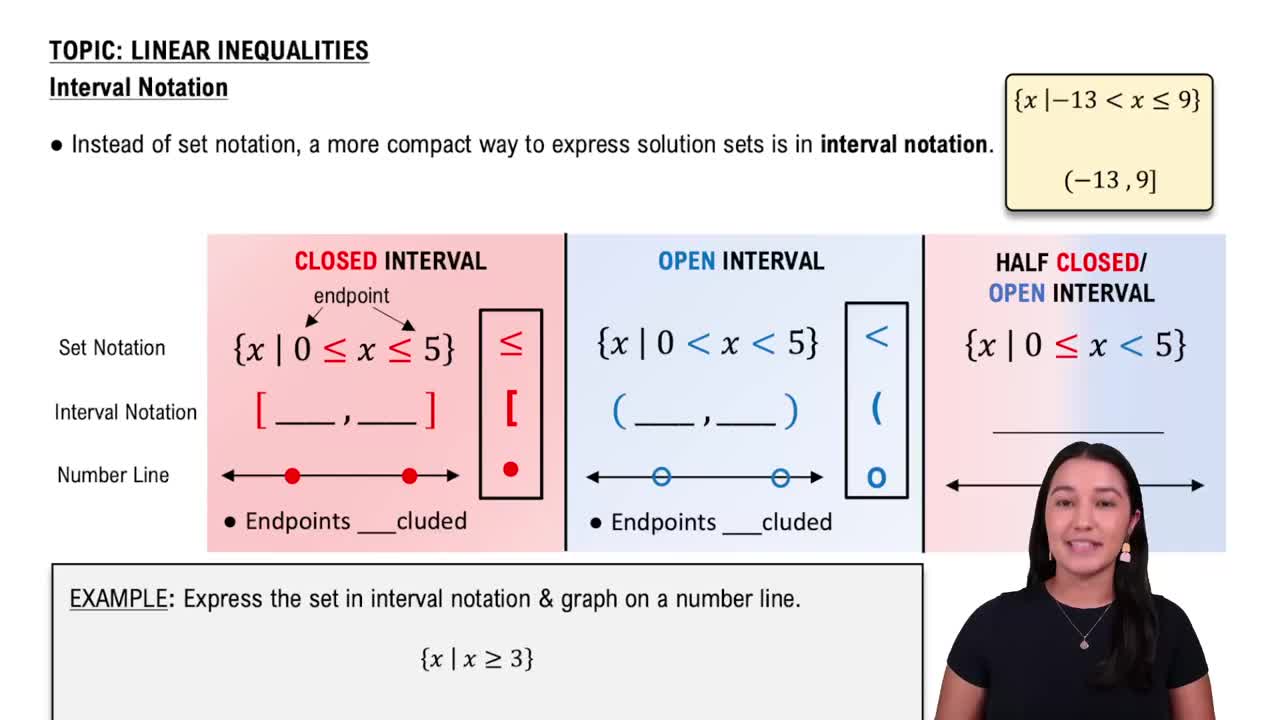
Interval Notation

Exponents and Powers

Exponents indicate repeated multiplication of a base number. For instance, 2^3 means 2 multiplied by itself three times (2×2×2=8). Understanding how to express terms with exponents is essential when writing sums involving powers in summation notation.
Video consigliato:
04:10
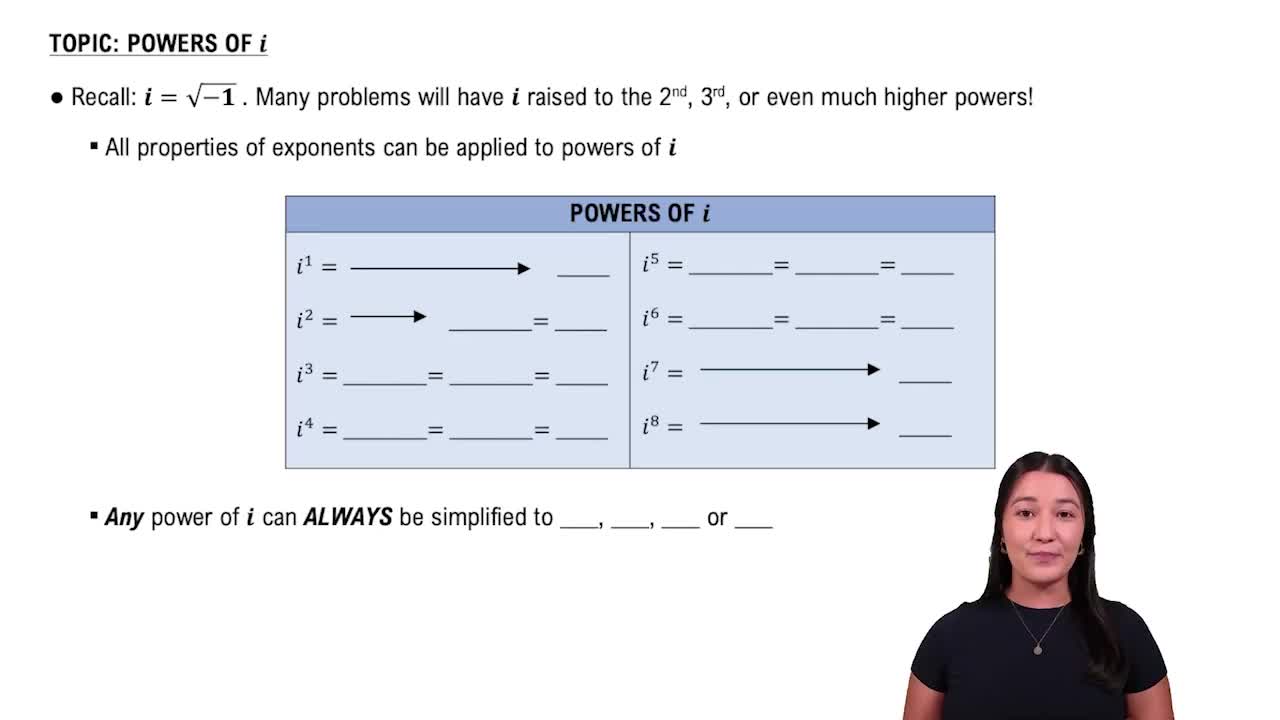
Powers of i

Index of Summation and Limits

The index of summation (commonly i) represents the variable that changes in each term of the sum. The lower limit is the starting value of i, and the upper limit is the ending value. Correctly setting these limits ensures the sum includes all intended terms.
Video consigliato:
03:50
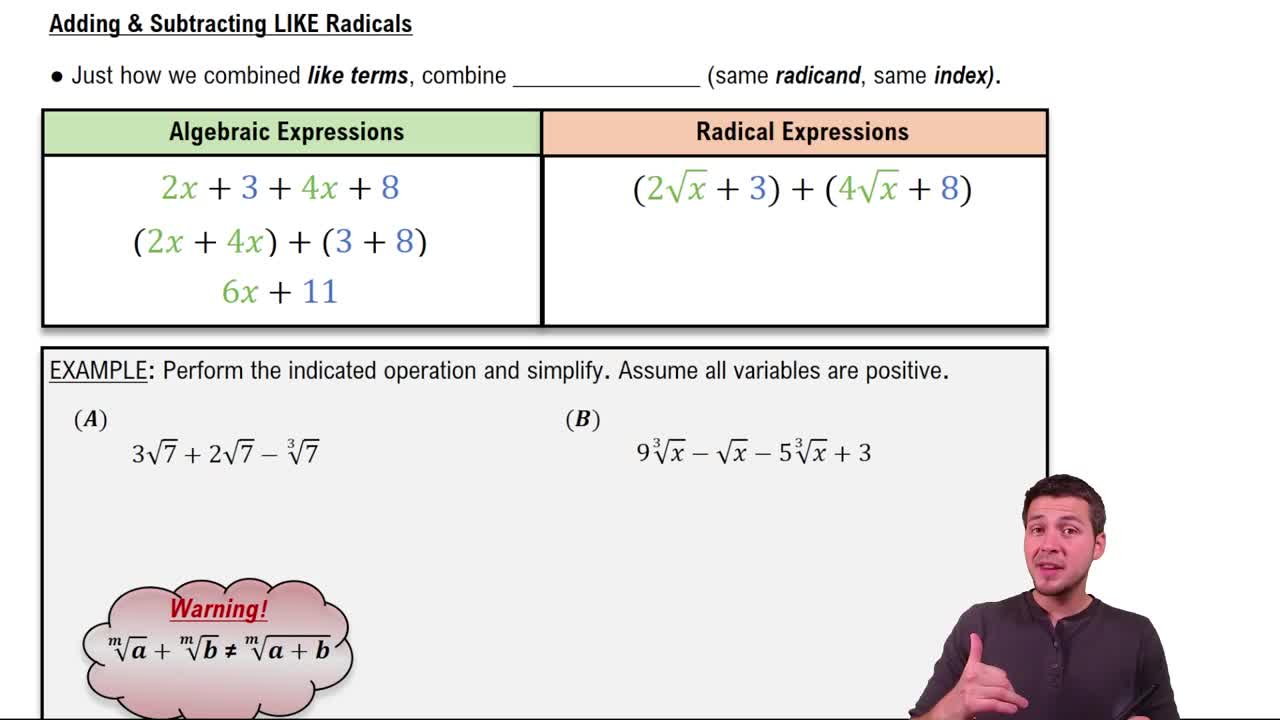
Adding & Subtracting Like Radicals