The general term of a sequence is given. Determine whether the sequence is arithmetic, geometric, or neither. If the sequence is arithmetic, find the common difference; if it is geometric, find the common ratio. an = n + 5
Ch. 8 - Sequences, Induction, and Probability

Capitolo 9, Problema 51
In Exercises 49–52, a single die is rolled twice. Find the probability of rolling an even number the first time and a number greater than 2 the second time.
Guida verificata passo dopo passo1
Identify the sample space for each roll of the die. Since a single die has 6 faces, each roll has 6 possible outcomes: 1, 2, 3, 4, 5, and 6.
Determine the favorable outcomes for the first roll: rolling an even number. The even numbers on a die are 2, 4, and 6, so there are 3 favorable outcomes.
Determine the favorable outcomes for the second roll: rolling a number greater than 2. The numbers greater than 2 are 3, 4, 5, and 6, so there are 4 favorable outcomes.
Calculate the probability of each event separately. The probability of rolling an even number first is \(\frac{3}{6}\), and the probability of rolling a number greater than 2 second is \(\frac{4}{6}\).
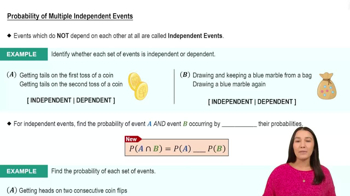
Since the two rolls are independent events, multiply the probabilities of each event to find the combined probability: \(\frac{3}{6} \times \frac{4}{6}\).

Risposta video verificata per un problema simile:
Questa soluzione video è stata consigliata dai nostri tutor come utile per risolvere questo problema.
Durata del video:
2mConcetti chiave
Ecco i concetti essenziali che devi comprendere per rispondere correttamente alla domanda.
Probability of Independent Events
When two events occur independently, the probability of both happening is the product of their individual probabilities. Rolling a die twice are independent events, so multiply the probability of the first event by the probability of the second.
Video consigliato:
Probability of Multiple Independent Events
Sample Space of a Die Roll
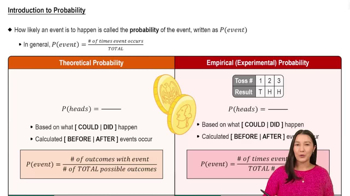
A single roll of a fair six-sided die has six equally likely outcomes: 1 through 6. Understanding this sample space helps determine the probability of specific events, such as rolling an even number or a number greater than 2.
Video consigliato:
Introduction to Probability
Event Definition and Counting Favorable Outcomes
To find the probability of an event, identify all outcomes that satisfy the event's condition. For example, even numbers on a die are 2, 4, and 6; numbers greater than 2 are 3, 4, 5, and 6. Counting these helps calculate the event's probability.
Video consigliato:
Fundamental Counting Principle
Pratica correlata
Domanda del libro di testo
964
views
Domanda del libro di testo
Use the Binomial Theorem to expand each expression and write the result in simplified form. (x1/3 +x-1/3)3
635
views
Domanda del libro di testo
Use the formula for nCr to solve Exercises 49–56. An election ballot asks voters to select three city commissioners from a group of six candidates. In how many ways can this be done?
758
views
Domanda del libro di testo
Express each sum using summation notation. Use 1 as the lower limit of summation and i for the index of summation. 1/2+2/3+3/4+⋯+ 14/(14+1)
922
views
Domanda del libro di testo
Express each repeating decimal as a fraction in lowest terms. 0.6 (repeating 6)
1055
views
Domanda del libro di testo
Use the formula for nCr to solve Exercises 49–56. Of 12 possible books, you plan to take 4 with you on vacation. How many different collections of 4 books can you take?
893
views
