Ch. 8 - Sequences, Induction, and Probability
Blitzer - College Algebra 8th Edition
Blitzer8th EditionCollege AlgebraISBN: 9780136970514Non è quello che usi tu?Cambia libro di testo
Capitolo 9, Problema 49

Use the formula for nCr to solve Exercises 49–56. An election ballot asks voters to select three city commissioners from a group of six candidates. In how many ways can this be done?

Guida verificata passo dopo passo
1
Identify the problem as a combination problem because the order of selection does not matter when choosing city commissioners.
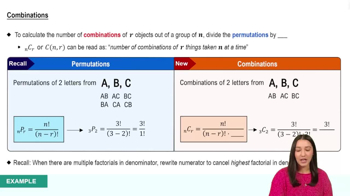
Recall the formula for combinations, which is given by \(nCr = \frac{n!}{r!(n-r)!}\), where \(n\) is the total number of candidates and \(r\) is the number of selections to be made.
Substitute the given values into the formula: \(n = 6\) (candidates) and \(r = 3\) (commissioners to select), so the expression becomes \(\frac{6!}{3!(6-3)!}\).
Simplify the factorial expressions in the numerator and denominator step-by-step to make the calculation easier, for example, expand \$6!$ as \(6 \times 5 \times 4 \times 3!\) and then cancel the \$3!$ terms.
After simplification, calculate the remaining product and quotient to find the total number of ways to select the three city commissioners.

Risposta video verificata per un problema simile:

Questa soluzione video è stata consigliata dai nostri tutor come utile per risolvere questo problema.
Durata del video:
3m

Concetti chiave

Ecco i concetti essenziali che devi comprendere per rispondere correttamente alla domanda.

Combination Formula (nCr)

The combination formula, denoted as nCr, calculates the number of ways to choose r items from a set of n distinct items without regard to order. It is given by nCr = n! / [r!(n - r)!], where '!' denotes factorial. This formula is essential for problems involving selections or groups.
Video consigliato:
5:22
Combinations

Factorial Notation

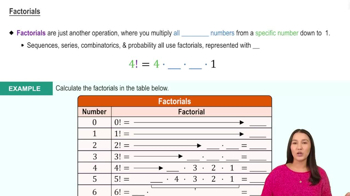
Factorial, represented by '!', is the product of all positive integers up to a given number. For example, 5! = 5 × 4 × 3 × 2 × 1 = 120. Factorials are used in permutations and combinations to calculate the total number of arrangements or selections.
Video consigliato:
5:22
Factorials

Selection Without Replacement

In problems where items are selected without replacement, once an item is chosen, it cannot be selected again. This concept is important in combinations because it ensures that each selection is unique and the order does not matter, which aligns with the use of nCr.
Video consigliato:
2:57
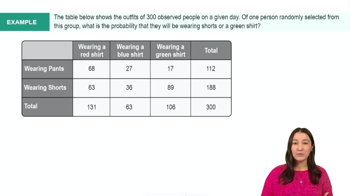
Probability of Non-Mutually Exclusive Events Example