Ch. 8 - Sequences, Induction, and Probability
Blitzer - College Algebra 8th Edition
Blitzer8th EditionCollege AlgebraISBN: 9780136970514Non è quello che usi tu?Cambia libro di testo
Capitolo 9, Problema 59

In Exercises 55–60, express each sum using summation notation. Use a lower limit of summation of your choice and k for the index of summation. a+(a+d)+(a+2d)+⋯+(a+nd)a+(a+d)+(a+2d)+⋯+ (a+nd)

Guida verificata passo dopo passo
1
Identify the pattern in the sum: the terms are a, (a + d), (a + 2d), ..., (a + nd), which shows an arithmetic sequence where each term increases by d.
Choose the index of summation as k, starting from 0 to n, because the first term corresponds to k = 0 and the last term corresponds to k = n.
Express the general term of the sequence using k: the k-th term is a+kd.
Write the summation notation by summing the general term from k = 0 to k = n: ∑k=0n (a + kd).
This summation notation compactly represents the entire sum a + (a + d) + (a + 2d) + … + (a + nd).

Risposta video verificata per un problema simile:

Questa soluzione video è stata consigliata dai nostri tutor come utile per risolvere questo problema.
Durata del video:
3m

Concetti chiave

Ecco i concetti essenziali che devi comprendere per rispondere correttamente alla domanda.

Arithmetic Sequence

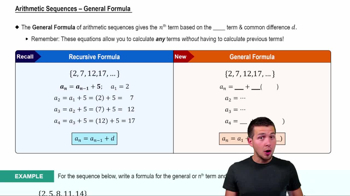
An arithmetic sequence is a list of numbers where each term after the first is found by adding a constant difference, d, to the previous term. In the given sum, the terms follow this pattern: a, a+d, a+2d, ..., a+nd, which is the foundation for expressing the sum in summation notation.
Video consigliato:
5:17
Arithmetic Sequences - General Formula

Summation Notation

Summation notation uses the sigma symbol (∑) to represent the sum of a sequence of terms. It includes an index of summation, a lower limit, and an upper limit, allowing a compact expression of long sums like the arithmetic sequence given in the problem.
Video consigliato:
05:18
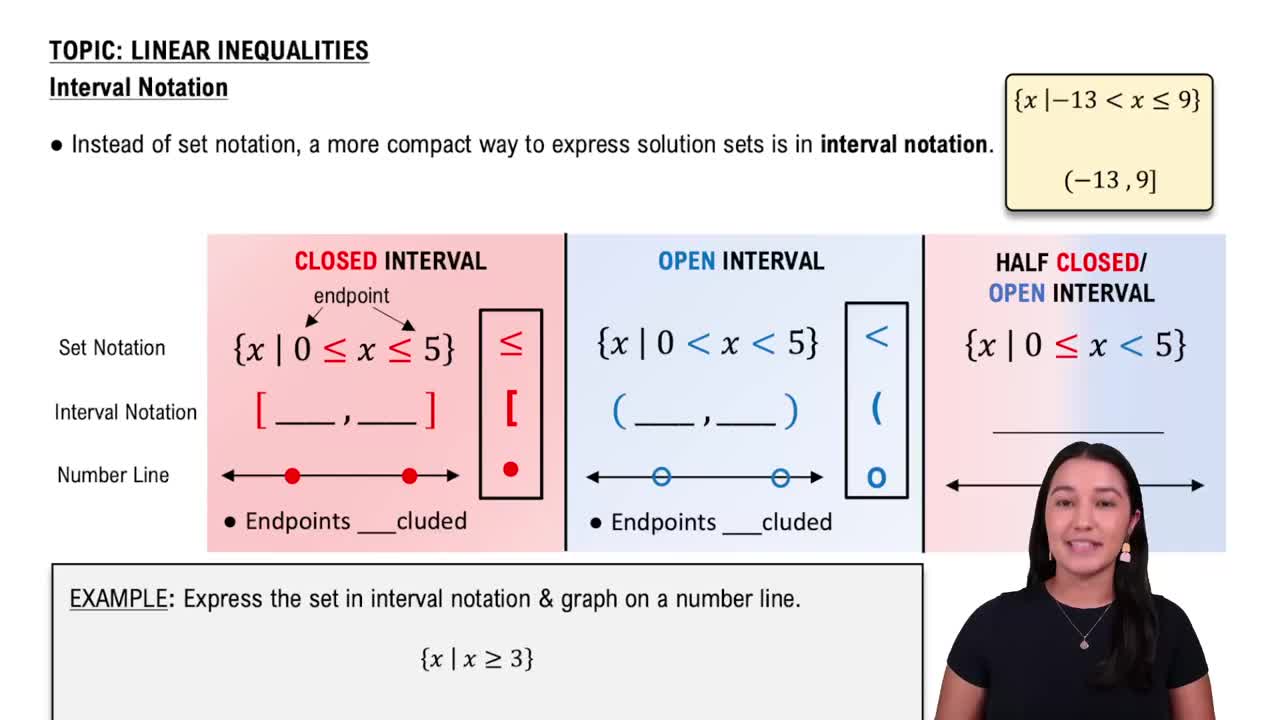
Interval Notation

Index of Summation and Limits

The index of summation, often denoted by k, is a variable that represents each term's position in the sequence. The lower and upper limits define the range of terms to be summed. Choosing appropriate limits and expressing each term in terms of k is essential to correctly write the sum in summation notation.
Video consigliato:
03:50
Adding & Subtracting Like Radicals